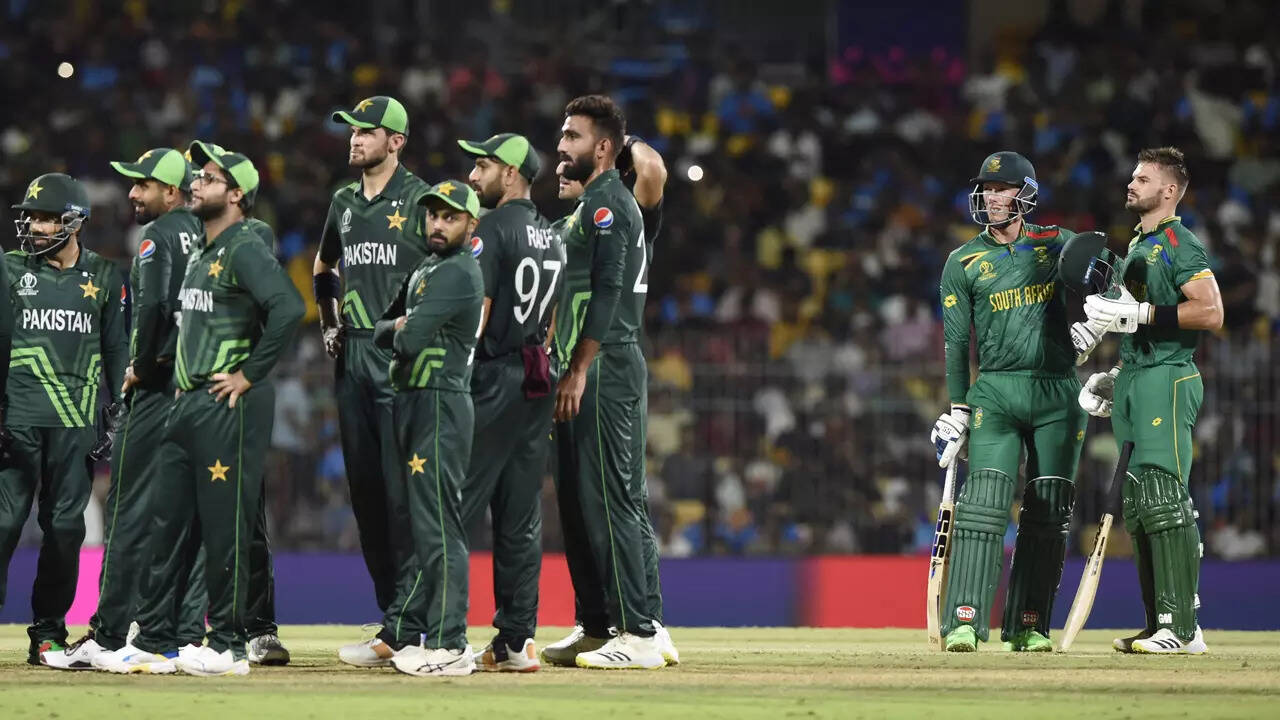
The Decision Review System, also called the DRS or video referral, once again became a topic of debate on Friday when an LBW decision was arguably the difference between a win and a defeat in the ICC World Cup match between Pakistan and South Africa in Chennai.
South Africa seemed to be cruising towards the target of 271 at the MA Chidambaram Stadium, when Pakistan bowlers upped their game to take five quick wickets to reduce the Proteas to 260/9 from a comfortable 206/4.

Eleven runs needed by South Africa in 4.3 overs and just one wicket between Pakistan and a win put the game on a knife's edge. That's when a controversial moment arrived.
Haris Rauf was bowling to tailender Tabraiz Shamsi in the 46th over and the ball thudded into Shamsi's pads. However, the umpire turned down Pakistan's appeal for an LBW.
Skipper Babar Azam asked for a review. The replays showed Shamsi adjacent to the stumps when the ball hit his pads, but the ball tracking was not in the bowler's favour as the ball's trajectory showed it to be just clipping Shamsi's leg-stump.
The on-field umpire's 'not out' decision was upheld, after which Keshav Maharaj hit spinner Mohammad Nawaz for a four to signal South Africa's victory.
While the South Africans celebrated, the DRS call and its rules were hotly debated on social media, when an old video from an India vs England Test match resurfaced on microblogging website 'X' (formerly Twitter), where the ex-England captain Nasser Hussain explained why the 'umpire's call' is required to make up for the margin of error in technology.
WATCH
WHAT IS DRS?
It is a system that uses technology to help match officials in decision-making.
The on-field umpires may ask the third umpire to check on video replay to assist in a decision, and the teams can also opt for the same (maximum of two times each per innings) if they want an on-field umpiring decision to be reviewed.
The 'snickometer', which checks if the ball edged the bat or not, and the 'ball tracker', which checks the trajectory of the ball to decide if it is going to hit the stumps or not are the two main softwares used in DRS.
1/10:World Cup: South Africa break Pakistan hearts with one-wicket win
PTI2/10:South Africa edge past Pakistan
Aiden Markram's 91 guided South Africa to a one-wicket win against Pakistan.AP3/10:Last pair heroics for South Africa
Keshav Maharaj and Tabraiz Shamsi scored the winning runs to seal a dramatic win for South Africa.PTI4/10:Aiden Markram shines for South Africa
Aiden Markram's solid innings of 91 set the foundation for South Africa's successful chase.AFP5/10:Pakistan's semis hopes in jeopardy
Pakistan's fourth consecutive loss put their chances of reaching the World Cup semi-finals in doubt.AP6/10:South Africa top the points table
South Africa's win took them to the top of the World Cup table with 10 points from five wins.IANS7/10:South Africa survive late jitters
South Africa managed to hold off Pakistan's late surge to secure a thrilling victory.Getty Images8/10:Tabraiz Shamsi shines with four-for
Tabraiz Shamsi's impressive bowling figures of 4 for 60 restricted Pakistan to 270 all out.Reuters9/10:Pakistan's Shakeel & Shadab provide resistance
Saud Shakeel and Shadab Khan's partnership of 84 runs lifted Pakistan's total after early setbacks.AFP10/10:Maharaj and Shamsi hold their nerves
Keshav Maharaj and Tabraiz Shamsi kept their composure to guide South Africa to victory in a tense finish.APWHEN WAS DRS IMPLEMENTED
Introduced in November 1992 as third-umpire decisions, video-replay assistance was initially available only to the match officials and started as means to help in ruling close run-out calls. Later, it was renamed as DRS, when it was provided as an option available to the teams as well as the on-field umpires.
DRS introduction:
Tests - 2008
ODIs - January 2011
T20Is - October 2017