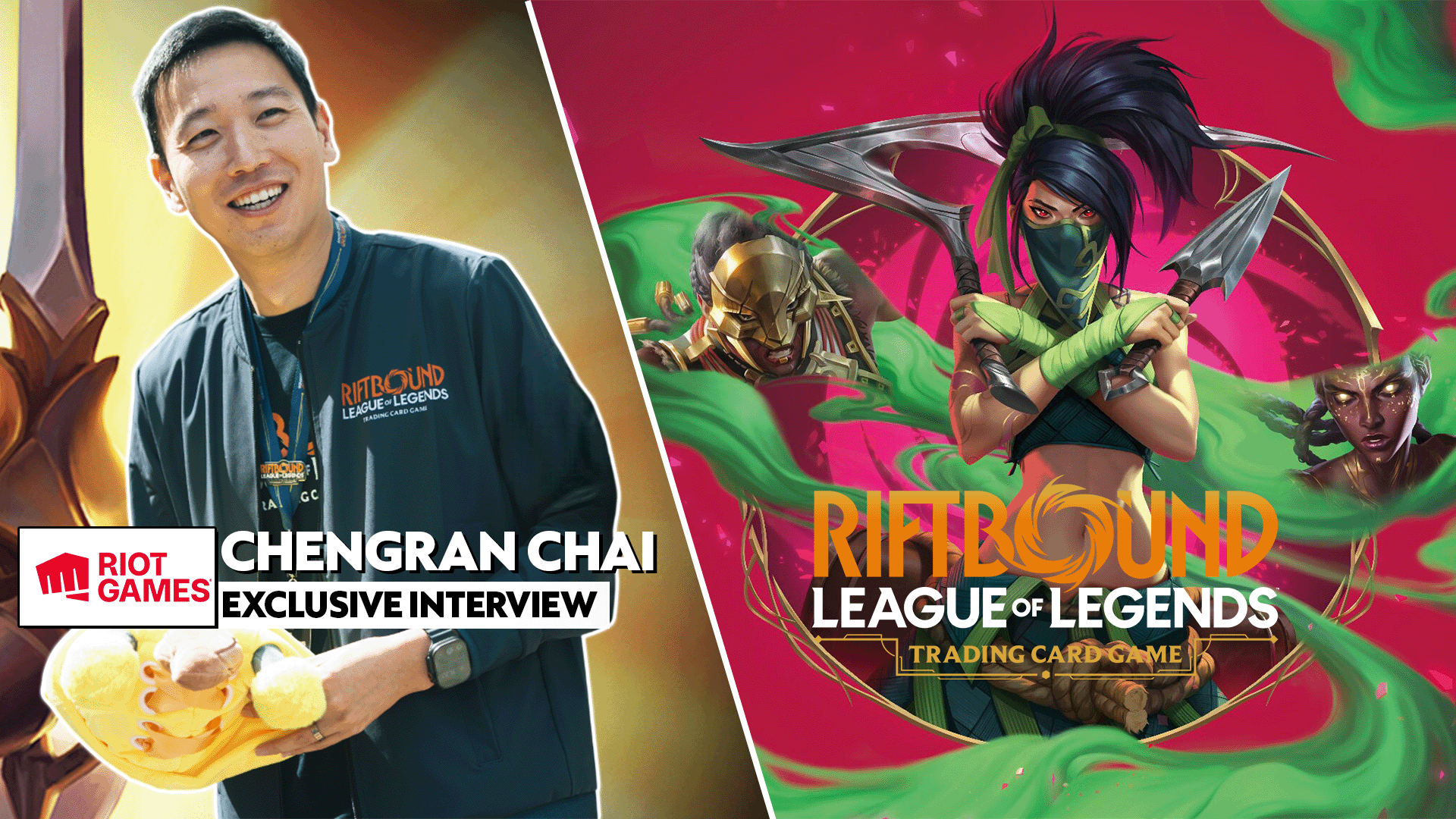
Riot Games is bringing League of Legends to the table, literally. With Riftbound, its first physical trading card game, the developer is making a deliberate shift away from screens and into face-to-face play, aiming to introduce League fans to a new way of competing and connecting.
In an exclusive interview with Dot Esports conducted during Worlds 2025, Riftbound executive producer Chengran Chai says the goal is to bring League’s massive audience into a space that feels more accessible and personal than Riot’s existing titles.
That ambition is shaped by Riot’s previous attempt at the genre. While Legends of Runeterra demonstrated that the studio could build a strategically deep card game, it ultimately reached a narrower audience and struggled to sustain its long-term model. Riftbound is less a fresh experiment than a response to those lessons, applying what worked in Runeterra while directly addressing what didn’t.
Bringing a New Audience Into the TCG Space

Riot isn’t trying to pull players away from other trading card games.
“What Riot uniquely brings to the table is that we’re also bringing in a lot of League players and fans who may have never touched a TCG before,” Chai explains.
That focus shapes Riftbound as a social, in-person experience rather than a purely competitive one. The League IP provides the initial hook, but Chai stresses that the gameplay itself needed to stand on its own.
“Our Riftbound’s value proposition to players, obviously, there’s the League IP, which is hugely resonant, especially to our fan base,” he says. “But on top of that, we’ve brought in the competitive 1v1 play that is deeply strategic.”
That balance also defines where Riot sees Riftbound fitting in the broader TCG landscape. Rather than chasing one end of the spectrum, the developer has been deliberate about carving out a middle ground, aiming to blend approachability with depth in a way that feels familiar yet distinct. That vision becomes clearest when looking at how the studio positions Riftbound between two of the biggest names in the genre, Pokémon and Magic: The Gathering.
Designed to lower the entry barrier without losing strategy

“We wanted to position it somewhere between Pokémon and Magic: The Gathering,” Chai says. In a crowded market, Riftbound is not trying to be everything at once.
The reasoning is deliberate. “Pokémon’s strategic depth is good, but perhaps there are a lot of players who are looking for a little bit more,” Chai explains. “Whereas Magic: The Gathering is obviously (has) very strategic depth,” he said, stating that the developer wants to reach a middle ground to address all types of TCG players and give the best of both worlds.
“We’re looking to perhaps lower the barrier of entry (into TCGs) a little bit,” he says. “And I think we’ve hit a really sweet spot in designing the game there.”
Moving from a digital card game to a physical one forced Riot to confront challenges it had never needed to solve before. While Legends of Runeterra gave the studio experience designing a CCG, Riftbound introduced an entirely different layer of complexity beyond gameplay.

“The first and foremost is actually figuring out the physical, manufacturing, distribution, and retail of our product to get them into players’ hands,” Chai says. “Because we are, historically have been a digital games company, so that part of the expertise are new to us.” Longer production timelines also changed how Riot plans its releases, with Chai noting that the physical nature of cards results in “much, much longer lead times than perhaps what we’re used to.”
That shift has also forced Riot to rethink balance in a way digital games rarely demand. “Everything we put out into the world more or less is permanent,” Chai explains. “Once a card is printed, there is no way for us to hotfix a card.” Unlike Runeterra, where imperfect balance could be corrected with patches, Riftbound requires decisions to be right the first time.
As a result, the producer states that Riftbound relies on “rigorous competitive balance testing internally” and long-term planning rather than reactive fixes. Multiple sets are developed in parallel, allowing future releases to naturally answer powerful cards instead of rewriting them after the fact.
Champion-first design and lessons from Legends of Runeterra

Lessons from Legends of Runeterra sit at the core of how Riot is approaching Riftbound’s first year, particularly when it comes to sustainability and player connection. Chai is clear that Runeterra’s gameplay was never the issue. “It’s a great game,” he says. “There’s no fundamental flaw within the core gameplay itself.”
The bigger lesson came from the business side. “We need a sustainable model such that we can continue to serve players for many years to come,” Chai explains, adding that while Runeterra’s monetization was “a very bold attempt,” it ultimately did not work as intended.
“The TCG model is very well established and proven,” Chai says. “We didn’t feel the need to innovate there. You only innovate if it’s actually meaningful.”

The second and arguably more emotional lesson was about champions. Player testing made it clear where Runeterra fell short. “Sometimes when you go play a Legends of Runeterra deck, it’s actually not about the champions,” Chai admits. “The champion identity is sort of a bit weaker than I would like.”
Riftbound flips that entirely by putting champions at the center of every deck. “We need champion to be front and center of this game,” he says. By making the chosen champion always accessible, Riftbound leans into how players actually engage with League. “People pull out the Sett or Kai’Sa, and they’re like, ‘Oh my God, I’m so excited. I’m the Sett main. I’m going to build the Sett deck,’” Chai says. That emotional attachment is what Riftbound unlocks in a way Runeterra never fully could.

Crossover cards inspired by Arcane and Riot’s other universes are firmly part of Riftbound’s future. “A hundred percent,” he says, pointing to the Arcane collectible bundle that has already been released in both English and Chinese. With League’s growing lineup of alternate universes, Riot sees plenty of creative space to explore. “League has so many amazing alternate universes for us to explore,” he adds. “Without spoiling too much for the players, I think we’ve got a lot of cool stuff in store, and I can’t wait for players to see them.”
Starting at Local stores, aiming for Worlds one day

Perhaps Riftbound’s most distinctive choice in the TCG landscape is its emphasis on multiplayer formats. While most trading card games are built almost entirely around one-versus-one competition, Riot wanted something broader.
“We have designed Riftbound to be played socially with multiple people, not just two,” Chai says. According to the developer, the players can jump into three-player free-for-alls, four-player free-for-alls, or team-based formats like two versus two.
“For a lot of our players playing games, it’s not just about winning,” Chai explains. “It’s about having fun with your friends.” Those moments are intentional. Riftbound is built to create stories, not just results. “You might not win the game, but you pull off this ridiculous board wipe with your partner, and that feels amazing,” Chai explains.
“They may not be able to fully express their skills as they would like to or used to be able to,” Chai says, pointing to how many longtime League players have grown out of the grind of solo queue or no longer have the time or mechanical edge they once did. “But we still have the opportunity within Riftbound for them to express and reach that champion power fantasy.”
Their long-term vision for the game’s competitive scene is built from the ground up, starting at local stores before scaling toward something much bigger.


Chai says the Riftbound team is investing heavily into structured, organized play and views it as essential, explaining that “we’ve built Riftbound to support a very competitive 1v1 experience,” and that this kind of ladder is “extremely important for the health of Riftbound, and for any TCG.”
The foundation begins with weekly store tournaments, then expands into larger city-level events and regional qualifiers, including a North American regional in Houston that took place in December 2025. From there, Riot plans end-of-year regional finals across major territories, with an even bigger ambition on the horizon. “Hopefully, in a couple years, what we will also do is a Worlds,” he says, where the best players from every region compete on a global stage.