The Winter Paralympics are set to officially commence this Friday with an eagerly anticipated opening ceremony in Verona, Italy.
The Milan Cortina Games are poised to make history, featuring a record 665 Para athletes competing for an unprecedented 79 sets of medals.
Athletes will showcase their talents across six dynamic sports: Para alpine skiing, Para biathlon, Para cross-country skiing, Para ice hockey, Para snowboard, and wheelchair curling.
In the various skiing disciplines – Para alpine skiing, Para biathlon, and Para cross-country skiing – competitors are categorised into one of three groups: standing, sitting (utilising a sit-ski or monoski), or vision impaired.
Those with visual impairments race alongside a guide, who communicates via radio and also receives a medal.
Within these categories, skiers are further divided based on their functional ability, with a sophisticated results calculation system determining a factored time for each athlete, ensuring fair competition across different divisions.
Here’s a closer look at the sports...
Para Alpine Skiing
A cornerstone of the Winter Paralympics since its 1976 inception, Para alpine skiing encompasses five events: slalom, giant slalom, super-G, downhill, and super combined.
A total of 30 medal events are contested, split equally between men and women. Athletes in the sitting category employ a specialised monoski – a seat mounted on a single ski with a shock absorber to navigate varied terrain and execute turns.
The competition will unfold on the iconic Olympia delle Tofane course in Cortina d’Ampezzo, the very same venue that hosted the women’s alpine skiing events at the recent Winter Olympics.

Para Biathlon
This demanding sport seamlessly blends the raw power and endurance of cross-country skiing with the meticulous precision of target shooting.
Eighteen medal events are up for grabs, with men and women competing in separate races across three classes: a 7.5-kilometre sprint, a 12.5-kilometre individual race, and a sprint pursuit.
Athletes tackle the ski course multiple times, pausing between laps to shoot at five metal targets positioned 10 metres away. Missed shots incur either a time penalty or a penalty loop, depending on the event.
Unique adaptations include coaches assisting athletes with upper limb disabilities in positioning their rifles and pulling the trigger, while visually impaired athletes are guided by acoustic targets that indicate proximity to the bullseye.
Para biathlon was introduced for athletes with physical disabilities at the 1988 Innsbruck Games and for those with visual impairments in 1992 at Albertville. This year’s events will be held at the Tesero Cross-Country Skiing Stadium.

Para Cross-Country Skiing
Also taking place at Tesero, Para cross-country skiing offers 20 medal events. Men and women compete across the three categories in sprint, 10-kilometre interval start classic, and 20-kilometre interval start free races.
Additionally, there are mixed 4x2.5-kilometre and open 4x2.5-kilometre relays. Courses for sitting athletes feature lower gradients, acknowledging their reliance on upper body strength for propulsion on a sit-ski.
Relay teams can comprise two, three, or four athletes (plus guides), with individuals able to ski multiple legs.

Para Ice Hockey
Born in a Stockholm rehabilitation centre in the early 1960s, Para ice hockey was conceived by physically impaired Swedes eager to continue playing their beloved sport.
It made its Paralympic debut at Lillehammer in 1994 and is contested by athletes with lower limb disabilities. Matches consist of three 15-minute periods.
Players use double-blade sledges, allowing the puck to slide underneath, and wield two sticks – one with a spike for propulsion and the other with a blade for puck handling.
While a mixed-gender sport, only Japan and Slovakia feature a female player in their Milan Cortina squads.
Historically, only three women have ever participated in the Paralympic Games for Para ice hockey: Norway’s Brit Mjaasund Oeyen (1994) and Lena Schroeder (2018), and China’s Yu Jing (2022).
The United States, having dominated five of the last six Winter Paralympics (with Canada breaking their streak in 2006), will be aiming for a three-peat.
Competition will be held at Milan’s new Santagiulia arena, featuring eight teams divided into two groups, with the top two from each advancing to the semi-finals.

Para Snowboard
Para snowboard first appeared at Sochi in 2014 as part of the alpine skiing programme, with the number of events varying since.
At Milan Cortina, there are two events across three men’s categories (two for lower-limb impairments, one for upper-limb) and one women’s category (lower-limb impairments).
Athletes with disabilities affecting their legs can use prosthetics or modified equipment. The two events, banked slalom and snowboard cross, will take place in Cortina.
In banked slalom, athletes complete two individual runs, with their best time determining the final ranking. Snowboard cross sees four athletes race simultaneously in heats and finals, with the first two across the line advancing.

Wheelchair Curling
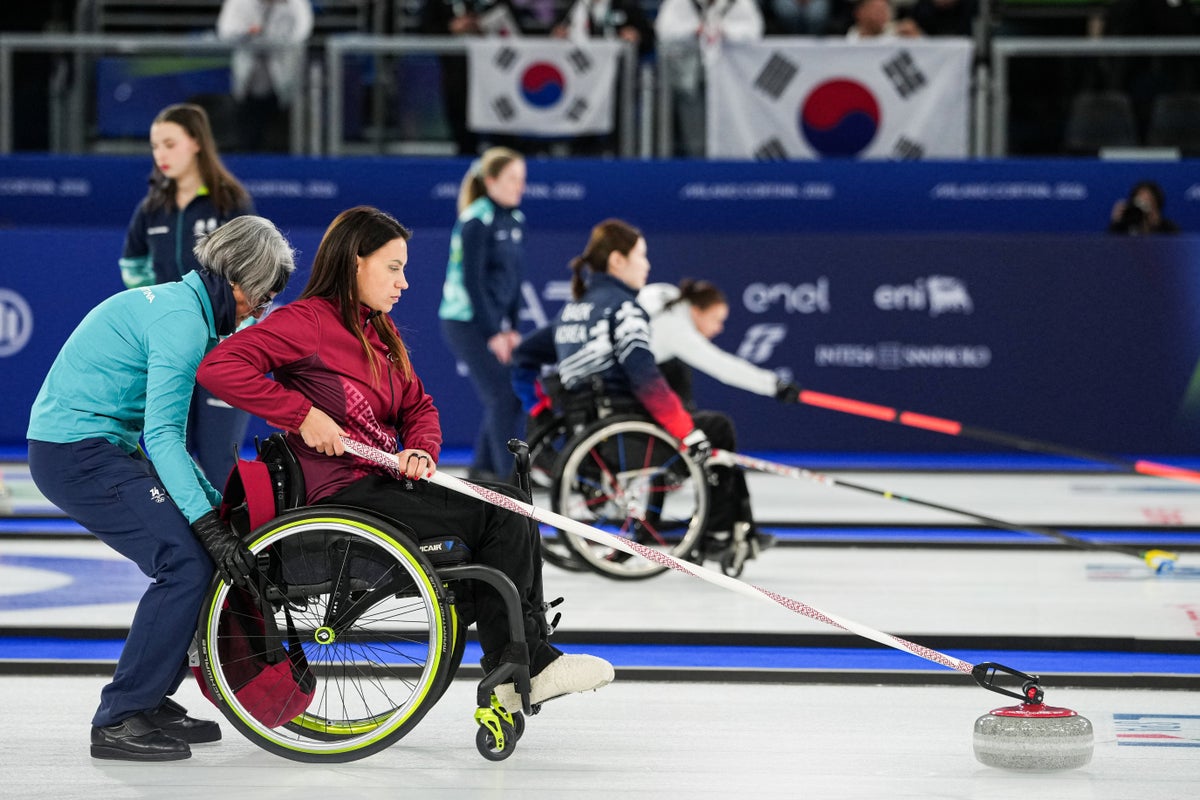
Celebrating its 20th anniversary, this mixed-team event for athletes with physical disabilities affecting their legs was introduced the last time the Paralympics were held in Italy, in 2006.
Players can choose to throw the stone independently or with a teammate stabilising their wheelchair, often using an extender for added speed and direction.

Games consist of eight ends, two fewer than Olympic curling, and sweeping is not permitted.
The Cortina Curling Olympic Stadium will host the competition, which for the first time will include a mixed doubles event alongside the traditional mixed team format.
Russia is back at the Paralympic Games – and this is just the start
England raring to go for ‘toughest test they have ever had against Italy’
Mandatory genetic sex tests for female athletes branded a ‘backwards step’
Paralympics rocked by curling stones theft just hours before start of competition
Germany joins Paralympics opening ceremony boycott amid Russia’s return
Paralympics opening ceremony at risk of being overshadowed by boycott