Get all your news in one place.
100’s of premium titles.
One app.
Start reading
Digital Camera World
David S Young

Everyone thinks Nikon invented the professional system camera – but this forgotten 1953 East German legend got there first

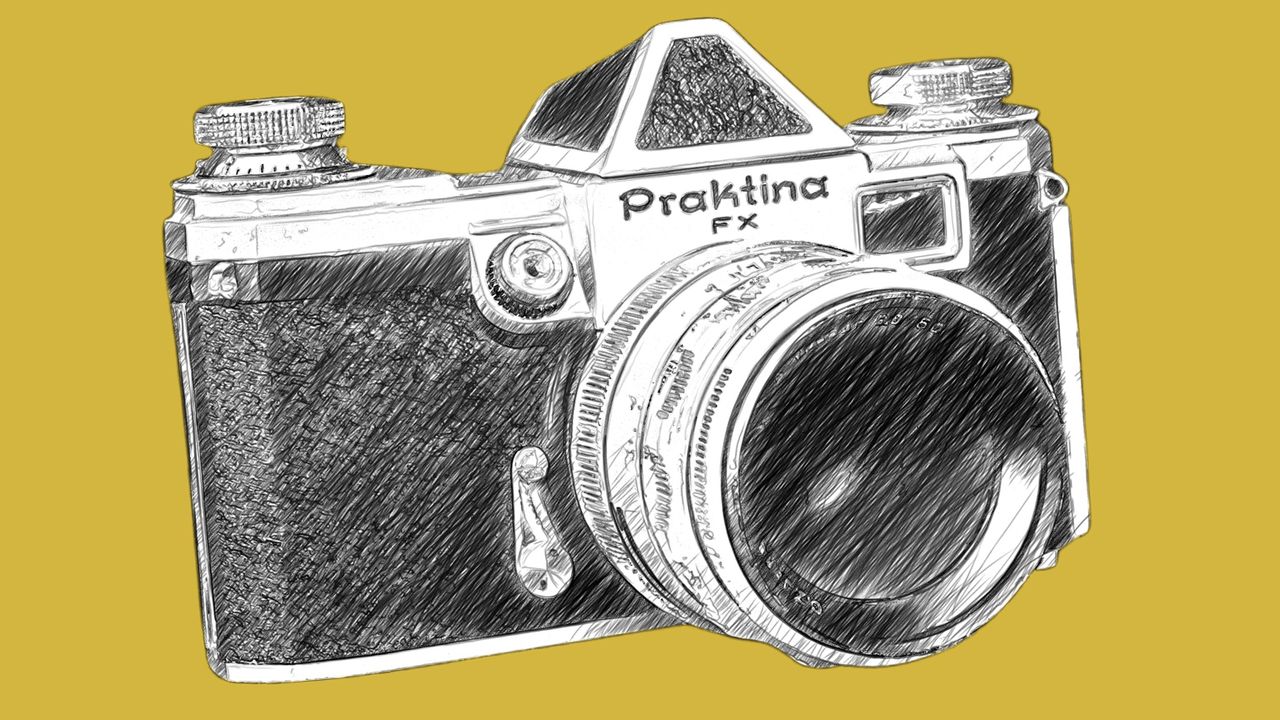
Sketch of Praktina FX camera.

It is often said that the Nikon F was the first “system” camera. But, that’s not quite true.

It all started with a visionary designer, Siegfried Böhm, who dreamed of a camera more advanced than anything being made in 1948. He developed a new shutter with a single, non-rotating dial for both low and high speeds. This convinced his bosses at Kamera-Werkstätten, in Dresden, East Germany, to approve development of what would become the Praktina FX.

With a team of 30, his Praktina was quickly developed and shown at the 1952 Photokina trade show in Cologne, Germany, and went on sale in early 1953.

The Praktina FX had numerous world-firsts, including interchangeable viewfinders, interchangeable focusing screens, the breech-lock, rapid change lens mount (similar to the later Canon FL/FD breech-lock system), interchangeable camera backs, as well as motor drive capability via a coupling on the bottom of the camera.

Both spring-driven motors (20 shots on a wind) and electric motors (with remote control) were offered. There was even a special back that held 17 meters of film, allowing for 450 exposures!

There were multiple viewfinder options, including a pentaprism, both regular and magnifying waist-level finders, a bellows for close-ups, stereo photography adapters and an extensive array of lenses from 35 to 500mm, made by Zeiss, Meyer Optic, Schacht, Schneider, Steinheil and others.

Modern descendents from Praktina's sister brand, Praktica, are still being made today (Image credit: Praktica)

In all of these, the Praktina beat the much better known Nikon F by a full 6 years – and Canon’s first “system camera”, the F1, by 17 years! And most of the Praktina’s innovations would become standard features on later professional cameras.

Kamera-Werkstätten also made the Praktica cameras. The two are often confused, with just one letter different in their names, but make no mistake – they are two very different cameras! The Prakticas were mass-produced, consumer-level offerings, while the Praktinas were solidly made, nicely finished cameras for professionals.

In the March 1957 issue of Modern Photography, Herbert Keppler said that the Praktina was "quite suited to professional work and rugged enough to withstand much abuse".

Praktinas came with either a Carl Zeiss Jena 50mm f/2.8 Tessar for $239.50 or the faster 50mm f/2 Biotar for $297.50 – the rough equivalents of $2,197 / £1,620 and $2,729 / £2,030 today.

The Praktina FX was followed by an improved Praktina IIA in 1958, but production of all models ended in May 1960 – when increasing production costs of the complex camera and more competition from Japanese cameras, notably the Nikon F, spelled the end.

Find out more about photography's past in David Young's book, A Brief History of Photography.

You might also like…

Take a look at the best film cameras you can buy today – or read other articles in David Young's Classic Cameras series.

Sign up to read this article
Read news from 100’s of titles, curated specifically for you.
Already a member? Sign in here
Related Stories
Top stories on inkl right now
One subscription that gives you access to news from hundreds of sites
Already a member? Sign in here
Our Picks
Fourteen days free
Download the app
One app. One membership.
100+ trusted global sources.