
Get all your news in one place.
100’s of premium titles.
One app.
Start reading
Guitar World
Guitar World
Entertainment
Alex Lynham

“Every once in a while a pedal comes along that takes you by surprise. It’s a pedal I didn’t even know I needed”: Electro-Harmonix Effects Interface review

Electro-Harmonix Effects Interface Hardware Plugin is an ingenuous device for bridging the pedalboard-plugin gap.

What is it?

The new EHX Effects interface is a generic version of the idea they first trialled with its Big Muff Pi Hardware Plugin.


Like that pedal, the Effects Interface can operate as a stand-alone 2 in, 2 out audio interface, but that's where the similarities end. Instead of having circuitry of its own, the Effects Interface instead allows you to loop in any number of pedals from your rig to use as an insert in your DAW.

Alternatively, if you use a laptop in your rig, you can use the Effects Interface to insert computer-based plugins into your signal path via the pedal itself.

(Image credit: Future/Lucy Robinson)

Specs

(Image credit: Electro-Harmonix)
  • PRICE: $359 | £365 | €359
  • TYPE: Direct box/Pedalboard Audio Interface
  • MADE: USA
  • CONTROLS: Level, Monitor, Stereo Input, Stereo Output, Footswitch
  • FEATURES: Hardware Plugin Mode (Pedalboard Insert), Pedalboard Mode (DAW Insert), Audio Interface
  • CONNECTIVITY: Stereo Input, Stereo Output, Power, USB-C
  • BYPASS: Buffered
  • POWER: 9V DC Center-negative, 200mA or via USB-C
  • DIMENSIONS: 146 x 57 x 114 mm
  • WEIGHT: 1.45lbs/0.66kg (shipping weight)
  • OPTIONS: None
  • CONTACT: Electro-Harmonix

Build quality

(Image credit: Future/Lucy Robinson)

Build quality rating: ★★★★★

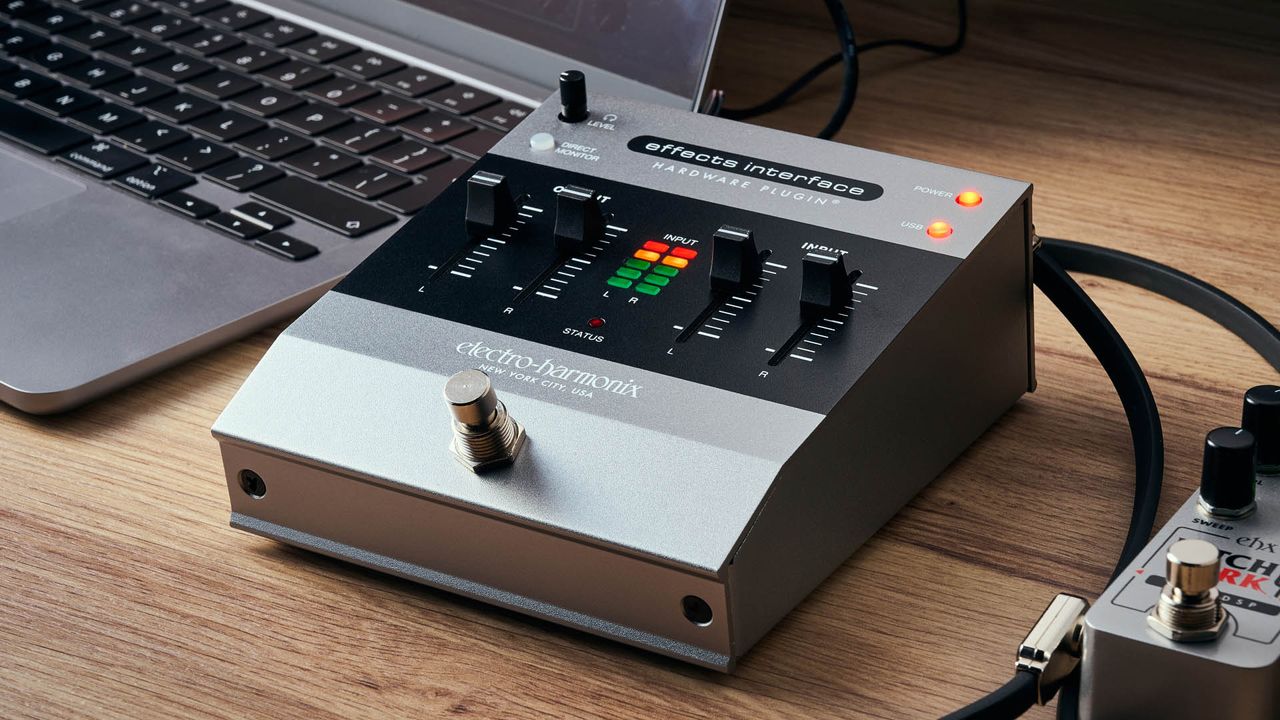
The Effects Interface has a neo-retro vibe, with chunky, tactile sliders and a well laid-out front panel. The case is about the size of an old-school Big Muff, so it's compact enough to fit on a pedalboard or on the studio (or bedroom) floor next to a 'board.

There's a footswitch for when you're using the pedal as a DAW effects insert, and stereo input meters to check your level. Since one of the best uses for this pedal is using analogue distortion pedals to gain-stack inside your DAW, this is a crucial feature.

Even with a delay pedal or similar you can use the output of the Effects Interface to generate a bit of extra 'push.'

Usability

(Image credit: Future/Lucy Robinson)

Usability rating: ★★★★★

The Effects Interface instead allows you to loop in any number of pedals from your rig to use as an insert in your DAW.

The unit itself is simple. Connecting a pedal is straightforward and the indicators on the front panel tell you when it's powered and connected. The metering is solid and makes the pedal usable rather than a frustrating exercise.

On the DAW side, the plug-in required to use the Effects interface is good, telling you clearly when the unit is connected, and what the status is. On first connection, it needs to be calibrated, but this is straightforward.

All of that said, as you'd expect with a pedal this niche and technical, it's not a plug-and-play affair. Although it is possible to set up in under five minutes, you will need to consult the manual and follow the instructions.

Once it's set up, there's not much else required to figure out, but if you want to use it to insert DAW plugins onto your board, you will need to switch around the settings on the plugin, and follow some suggestions for reducing latency.

Sounds

(Image credit: Future/Lucy Robinson)

Sounds rating: ★★★★★

Used as a pedal insert, the Effects Interface is at its best when used to apply analog gain stages to tracks in your DAW projects. Bored of the same digital emulations? Run your drums through a real Big Muff, Tube Screamer, or Smallsound/Bigsound Mini. This is incredibly powerful, as you effectively end up with a new collection of gain plugins.

Taking things a step further, delays and reverbs open up sonic options, especially when you start to include pads and granular reverbs. However, if you're experienced at studio sound manipulation, most of what digital effects on your 'board can do is already easier to create with plugins.

Instead, where the pedal shines is dynamic and expressive effects. Think things like loopers, or any pedal with a rocker footswitch. I found myself processing distorted drums with a wah pedal while chuckling like an idiot, and bit-crushing guitar busses by re-processing them through a pair of DigiTech Whammy pedals that were manipulated in real time.

(Image credit: Future/Lucy Robinson)

There's a bit of gain applied by the pedal that also gently improves the punchiness of most things that you throw at it, and also stacks pretty well with gain stages that are in the loop

Because the input and output sections of the Effects Interface are an active amplifier, there's a bit of gain applied by the pedal that also gently improves the punchiness of most things that you throw at it, and also stacks pretty well with gain stages that are in the loop.

Obviously with any pedal of this type, there's a concern about latency. In the case of using the pedal as an insert for pedals, for example, by sending a bus or single track to it, the latency is unnoticeable with a fast computer.

Moreover, it is simple to bump the recorded output of the track – since you'll probably be printing the output – back into time. In general, for use on guitars, I found that the slight lag resulted in a double-tracked effect that was actually pretty useful as an effect in of itself.

Verdict

(Image credit: Future/Lucy Robinson)

While there are other ways of doing what the Effects Interface does, it really tries to make this process smooth and intuitive

While there are other ways of doing what the Effects Interface does, it really tries to make this process smooth and intuitive for guitarists. That makes sense.

Besides some of their more out-there offerings, EHX are a company that have thrived on a line of pedals that broadly speaking do one thing, and do it well. That much is true of the Effects Interface as an insert.

Guitar World verdict: Every once in a while a pedal comes along that takes you by surprise. The EHX Effects Interface is one – a pedal I didn't even know I needed. The only drawback is the price. It's not cheap, at about the price of an audio interface.

Ratings scorecard

Test

Results

Score

Build quality

Solid EHX build, five stars, no notes.

★★★★★

Usability

A cinch to use, even if running DAW effects on your 'board is a more intricate process.

★★★★★

Sounds

Superlative at adding extra gain flavors, or for use with dynamic effects.

★★★★★

Overall

Okay, it isn't a cheap addition to your pedalboard but once you try it, it's hard to fault.

★★★★★

Also try

Hands-on videos

Electro-Harmonix

Sweetwater

Guitar Center

Sign up to read this article
Read news from 100’s of titles, curated specifically for you.
Already a member? Sign in here
Related Stories
Top stories on inkl right now
One subscription that gives you access to news from hundreds of sites
Already a member? Sign in here
Our Picks
Fourteen days free
Download the app
One app. One membership.
100+ trusted global sources.