An AI-made candidate ad and a real audio clip from the same Texas Senate race show why viewers need to check more than whether a face looks genuine.
A video of a candidate can mislead voters whether the candidate on screen is AI-generated or the recording is entirely real. Two clips from the same Texas Senate race show why.
In an ad released in September, an AI version of Democrat James Talarico delivers remarks about religion. FactCheck.org found that the ad combined things Talarico had said on different occasions, left out context and included phrases that were not part of his remarks. An AI disclosure appeared in small print late in the ad. On September 24, Democrats circulated a six-second audio clip of Republican Ken Paxton discussing the Uvalde school shooting. Paxton had said the excerpted words, but they came from a longer, public 2022 interview that gave listeners more context.
The lesson for anyone scrolling toward November’s midterms: “Is it AI?” is only the first question. “Does this clip support the claim attached to it?” matters just as much.
The stakes go beyond whether viewers can detect a fake. A paper published in March 2026 reports experiments with U.S. and Dutch participants; its U.S. video was tested in 2021. Participants rated the deepfakes as less credible than real footage, yet exposure still lowered their ratings of the politicians depicted. Fact-checks had mixed effects: they improved evaluations in some conditions but did not consistently remove the effect. In the U.S. sample, differences in politician ratings had faded by a follow-up survey days later. The experiments did not measure votes or test 2026 campaign clips.
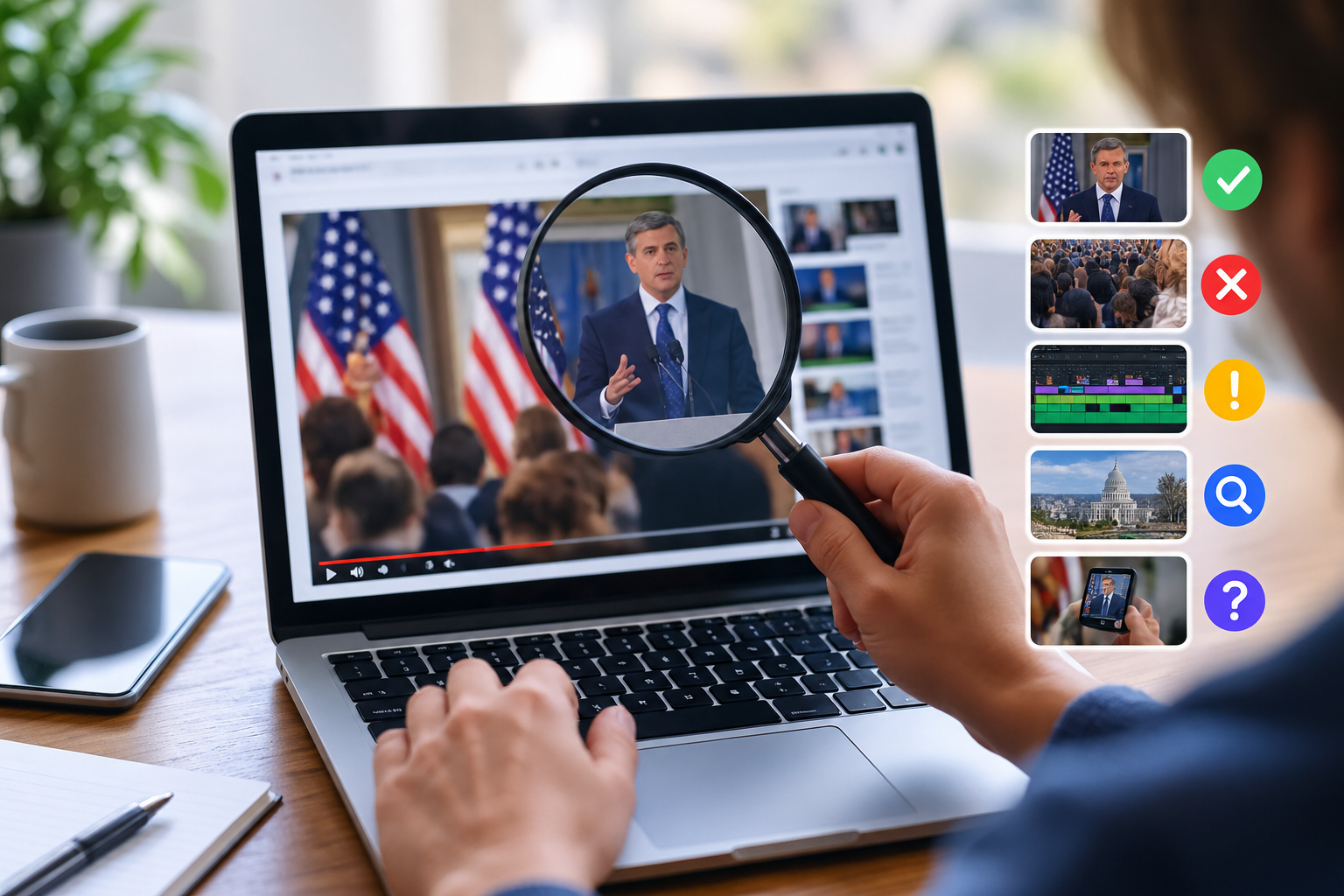
Mindo Liang, founder of AIReel, provides five checks for both AI-made videos and real clips stripped of context.
- Put the claim into a sentence before you react. Ask what the post wants you to believe: Did this candidate say these exact words? Did this event happen? Has my polling place changed? A shocking image can make an accusation feel established before you have identified what needs proving. If you cannot state the claim precisely, pause before sharing it.
- Find the original recording and its date. Search a distinctive phrase together with the speaker’s name. Look for the full speech, interview or official recording, and check when it was made. In the Paxton example, the six-second audio was presented as “leaked,” but the interview had aired publicly in 2022. Finding the source lets you hear what came before and after the excerpt; it does not require you to agree with the speaker.
- Check the words and the video. A real quotation does not prove the person made the video you are watching. Compare the clip with the original record: Were the words said together? Were any added? Was the person actually filmed delivering them? The Talarico adillustrates all three questions. Conversely, an odd-looking frame is a reason to investigate, not grounds to declare a real recording fake.
- 4. Check the underlying allegation somewhere independent. An AI label tells you something about production, not whether the message is true; a campaign’s sponsorship tells you who paid for a message, not whether its claims hold up. For an allegation about a candidate, look for the complete record and independent reporting that examines it. For a claim about voting dates, hours or locations, go directly to your state or local election office. The U.S. Election Assistance Commission warns that AI-generated material can imitate election officials and give voters inaccurate logistical information.
- Decide what to share after the check. If you have confirmed the source, share that source with the relevant context. If the claim is contradicted, share the correction rather than sending the alarming clip around again. If you cannot settle it, say it is unverified and hold off on forwarding it. For a false claim about where or when to vote, save the post’s link and alert the relevant election office so it can respond.
At the end of the day, discerning truth in election coverage requires moving beyond the simple question of whether the media is synthetic or authentic. As digital manipulation and strategic editing become harder to distinguish, critical thinking remains a voter's most effective defense.