
Get all your news in one place.
100’s of premium titles.
One app.
Start reading
LiveScience
LiveScience
Kenna Hughes-Castleberry

Europe's oldest handgun may date to 14th-century siege at German castle

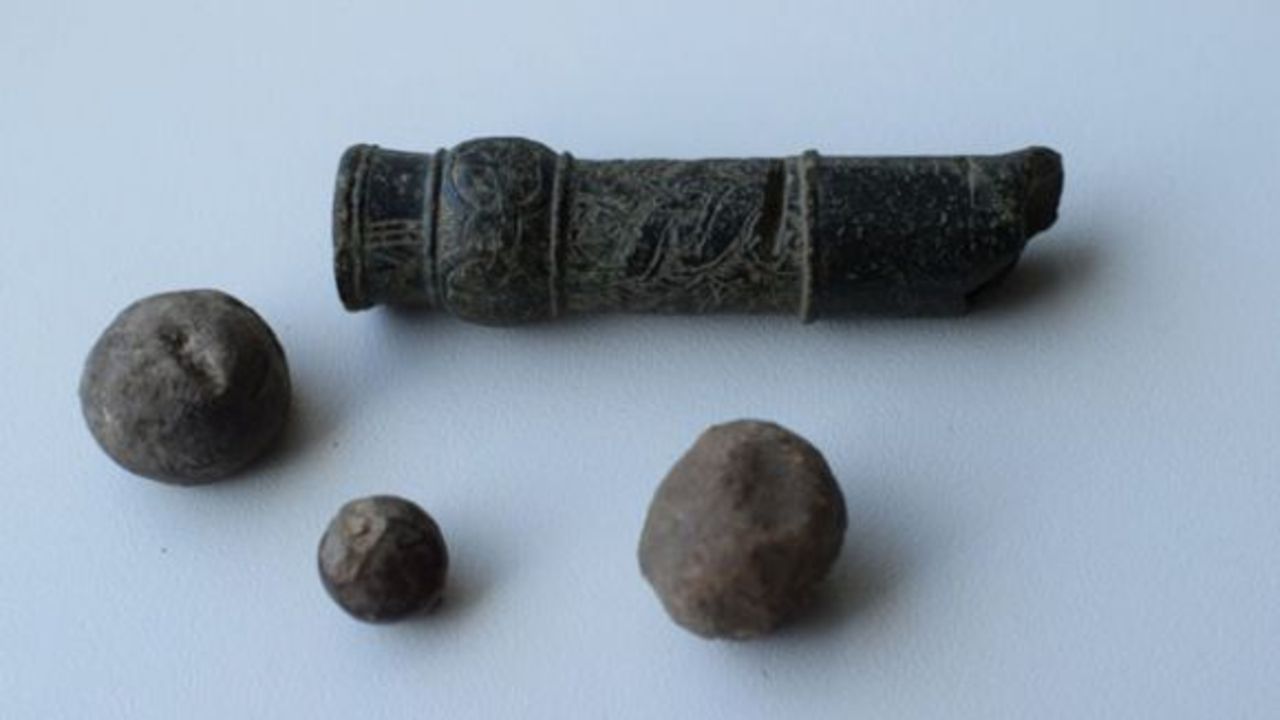
A series of stone balls near a small stone tube with carvings on it, all against a white background.

Fragments of an early handgun found in Brandenburg, Germany, could be from Europe's oldest known portable gunpowder weapon, according to new research.

The artifact, which is about 2 inches (6 centimeters) long, may date to 1390. If so, it would be nine years older than the famous Tannenberg rifle, which dates to 1399 and is widely considered the oldest handheld firearm in Europe.

"We have no written or archaeological evidence of firearm use from that period [in Brandenburg]; until now, we could only assume it in general terms." Christof Krauskopf, the Head of the Brandenburg State Office for Heritage Management and Archaeological State Museum, said in a translated statement.

In 2023, Matthias Dasse, a volunteer heritage conservationist, discovered the handgun fragments during a field survey near Kletzke Castle in the Brandenburg region of Germany. Dasse took the pieces to Gordon Thalmann, head of the Lower Monument Protection Authority of Prignitz, who identified the bronze casting as the barrel of an early firearm.

Researchers have nicknamed the artifact the "Kletzker Handrohr," which translates to "Kletzke hand cannon," because they believe it may be linked to the famed siege of Kletzke Castle in 1390, when the stronghold became the focus of a regional conflict in Brandenburg. According to a surviving account from Franciscan monk Detmar of Lübeck, two dukes led 1,100 men in a march against the castle, which was held by the powerful von Quitzow family. The defenders managed to secure the castle and drive off the attackers. The castle was later renovated in the centuries that followed.

If the link between the siege and the Kletzke hand cannon is confirmed, the object would provide rare physical evidence of early firearms that began to appear in late medieval warfare.

Krauskopf noted, however, that the Kletzke hand cannon was likely not made locally and may have been brought in by outside attackers.

The findings were presented Feb. 27 at the annual conference of the State Archaeology Department. Krauskopf plans to continue studying the fragments while Brandenburg authorities work to develop the Kletzke site for archaeological tourism.

Sign up to read this article
Read news from 100’s of titles, curated specifically for you.
Already a member? Sign in here
Related Stories
Top stories on inkl right now
One subscription that gives you access to news from hundreds of sites
Already a member? Sign in here
Our Picks
Fourteen days free
Download the app
One app. One membership.
100+ trusted global sources.