The most powerful version of Europe's Ariane 6 rocket blasted off on Thursday carrying 32 satellites for the Amazon Leo network, which aims to rival Elon Musk's Starlink.
The launch from Europe's spaceport in Kourou in French Guiana, on the northeastern coast of South America, is a first for Amazon Leo.
US firm Amazon, founded by billionaire Jeff Bezos, is the main commercial partner for the Ariane 6 despite the latter being touted as a symbol of European sovereignty in the sector.
To take on Amazon Leo's 32 satellites, the Ariane 6 has been upgraded with four strap-on boosters, instead of the two used on the first five flights.
Their role is to provide extra thrust, allowing the rocket to carry about 21.6 metric tons into low Earth orbit, which is more than double what it can lift with just two boosters.
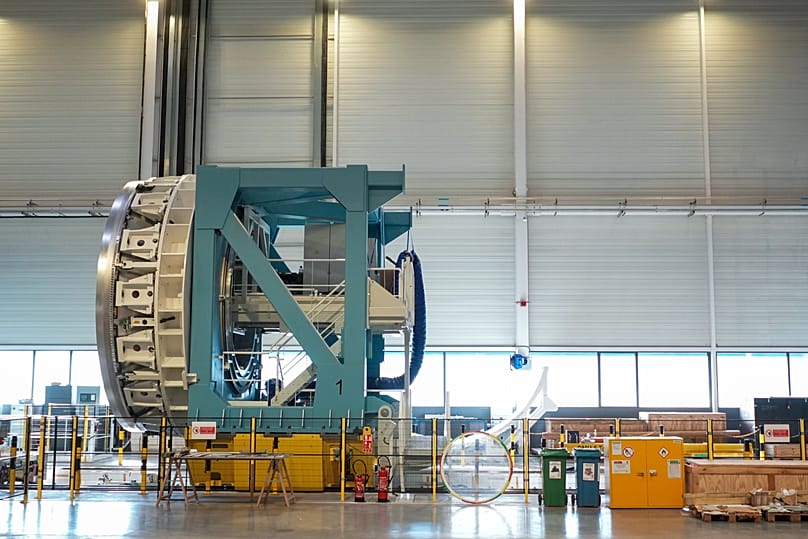
The boosters consume 142,000 kilograms of solid propellant in just over two minutes before burning out.
With 175 satellites already in orbit, Amazon Leo aims to expand its constellation to 3,200.
Rival Starlink, meanwhile, has nearly 9,400 satellites.
Last year, the European rocket focused on institutional missions, placing into orbit a French military reconnaissance satellite, a French weather satellite and European Union-sponsored Earth observation radar and navigation satellites.
The Ariane 6 programme is backed by 13 nations, all members of the European Space Agency.
Building the rocket requires the expertise and coordination of about 600 subcontractors led by ArianeGroup.
The core stage is assembled in Les Mureaux, west of Paris, while the upper stage is built in a factory in Bremen, Germany. There are roughly 300,000 pieces in one rocket.
The core stage, the upper stage and the boosters crossed the Atlantic to French Guiana on a cargo ship equipped with sails to reduce emissions and save fuel.
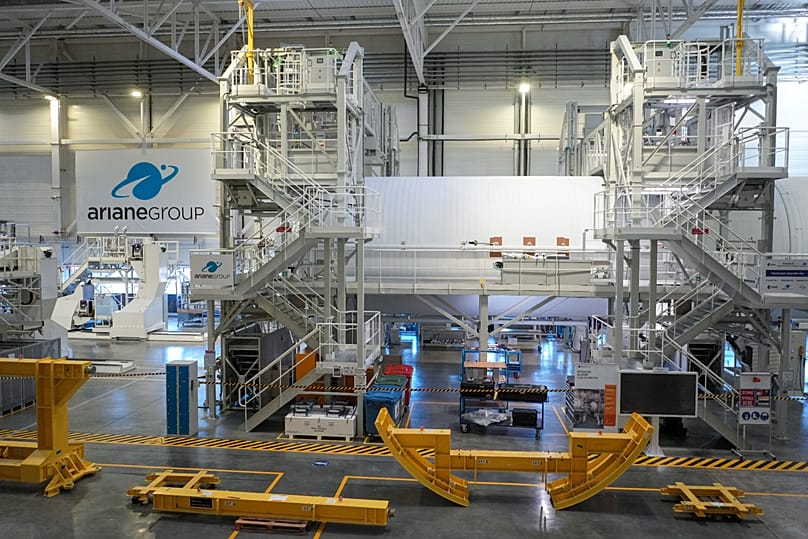
Ariane 64 is 62 metres high with a core stage of 5.4 metres wide.
The mission is expected to last 1 hour, 54 minutes, from liftoff to separation of all satellites.
In addition to its boosters, Ariane 6 is powered by one main engine at the base of its core stage that uses supercooled hydrogen and oxygen as fuel.
A second engine ignited once the upper stage escaped Earth's gravity, placing the satellites into their precise orbits. It can re-ignite up to four times in flight.