
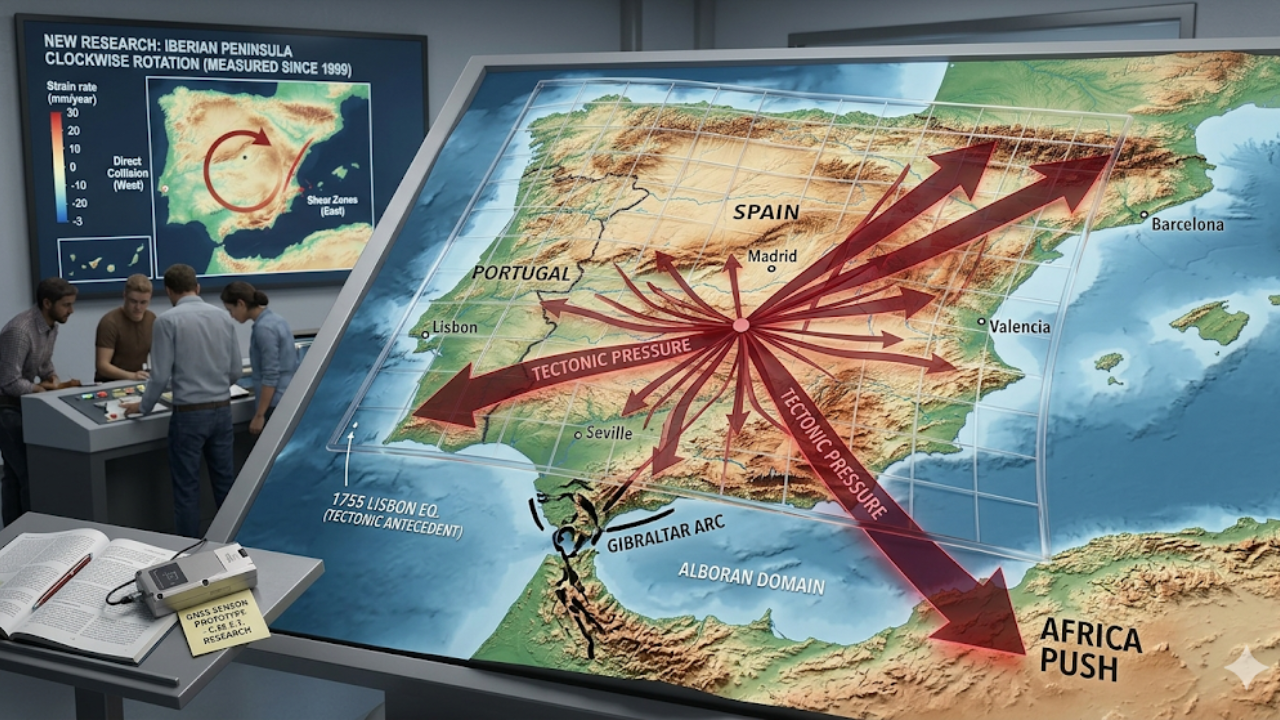
According to new research on the geodynamics of Earth’s crust, the Iberian Peninsula, which includes Spain and Portugal, is turning clockwise due to the pressure applied by the African and Eurasian plates. According to the results of studies of earthquakes, deformation of the Earth’s crust, and GNSS data obtained from satellites, it was found that the Iberian Peninsula is moving and rotating. Scientists from the University of the Basque Country believe that the reason for such changes is associated with the accumulation of stress in the area of the Strait of Gibraltar and the Alboran Sea. This discovery will help to create a better map of earthquake risks in southern Europe and North Africa.

Tectonic movement beneath Spain and Portugal explained
For the most part, everyone sees Spain and Portugal as absolutely stable areas on maps. But underneath it all, the land mass they occupy is actually moving very gradually.
A group of scientists from the Geology Department, Faculty of Science at Tanta University, studied the seismic activity of several decades along with precise GNSS data to determine the way Earth’s crust moves within the Iberian Peninsula. And their results were rather unexpected – the Iberian Peninsula is rotating clockwise as Africa approaches Eurasia.
According to one of the authors of the study, Mohamed K. Salah, “the new data support the idea that the Iberian Peninsula is rotating clockwise”. The findings were published in the scientific journal Gondwana Research.
As the scientists explain, the African and Eurasian tectonic plates are moving closer to each other at 4-6 mm per year. Although this distance seems small, over many years it will transform the landscapes drastically.
How earthquakes and satellite data revealed Iberia’s rotation
The research combined seismic stress patterns from earthquakes with satellite observations capable of detecting ground motion at millimetre-level precision.
As stated in the study, the most complicated processes take place near the Strait of Gibraltar and the Alboran zone in southern Spain. The latter experiences extreme stress because of the collision between Africa and Europe.
It was found that stress and deformation are not distributed uniformly. On the contrary, there are places where stress concentrates and other locations where the movement continues further inland.
The boundary is much less defined. GNSS satellites located all over Spain, Portugal, and Morocco allowed scientists to observe even minor deformations of the Earth’s crust that cannot be detected by people. In particular, the western part of Iberia is rotating in a different direction than its eastern counterpart.
The research has led to the identification of new active faults that can trigger seismic events in the future.
Why the Iberian Peninsula’s movement matters
While it may take many lifetimes before anyone notices any movement in the positions of Spain and Portugal, the findings have far-reaching implications.
The knowledge gained about how tectonic strain is transferred across Iberia might aid in predicting future earthquakes in urban centres such as Lisbon and Seville, and areas around the western Mediterranean basin.
It is also important from the perspective of better understanding continental drift. According to scientists, the continued convergence of Africa and Europe will eventually transform the Mediterranean region entirely.
Geological investigations had previously suggested Iberian rotation. In particular, a 1969 paleomagnetic study entitled "Paleomagnetic evidence for the rotation of the Iberian Peninsula" published in Tectonophysics, suggested that the peninsula has rotated with respect to Europe throughout geological time.
Scientists say Iberia is constantly changing
One of the most obvious lessons learned from this study is that even though something may appear fixed in time, it really is not.
The earth’s crust is continually in movement despite human unawareness of this phenomenon. Minute changes year after year eventually change landscapes and even fault lines.
Scientists expect that measurements made from additional stations in the oceans around Iberia as well as in North Africa will make this deformation and rotation much more visible in the future.
In any case, according to experts, there is enough information available at present to suggest that Spain and Portugal are slowly merging as a result of rotational movements of Iberian land masses.







