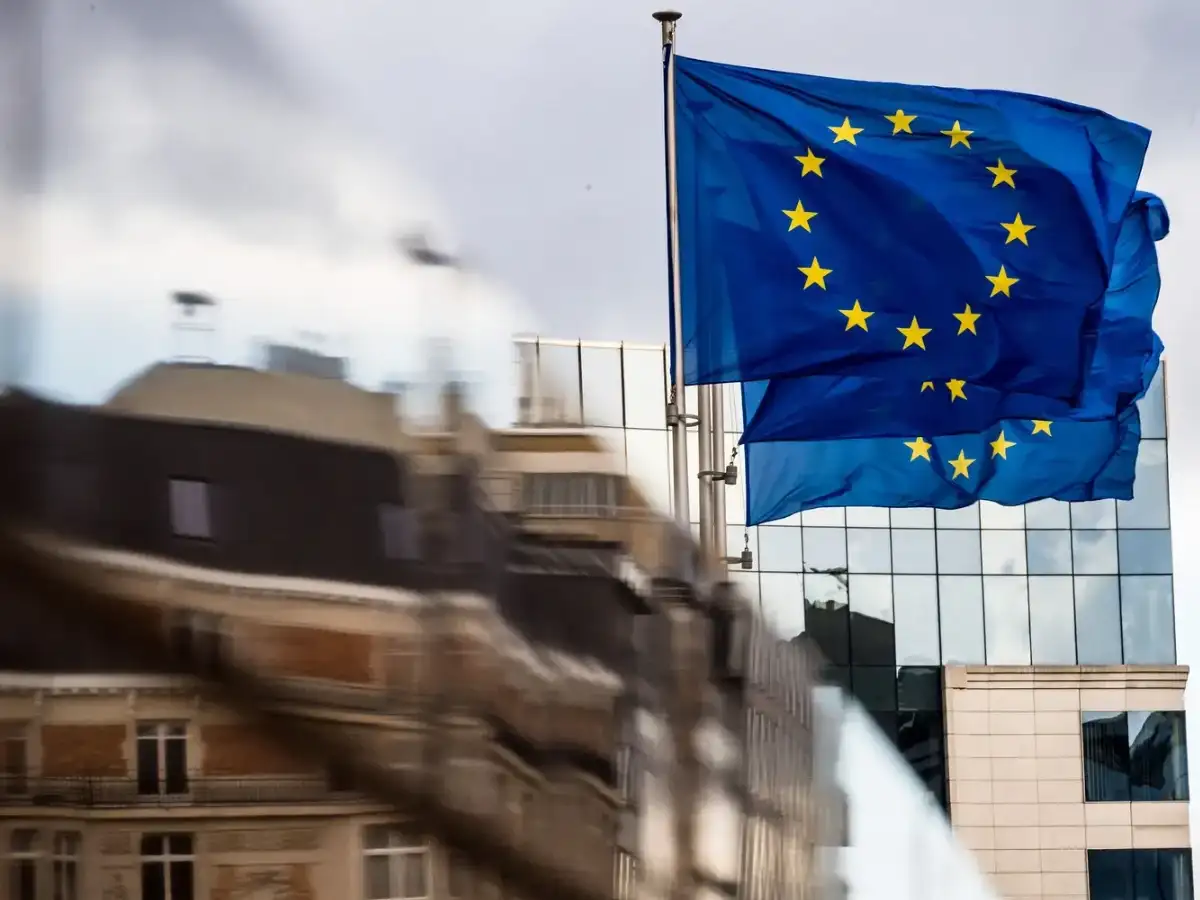
Europe is shaking itself awake.
Ten years after Brexit, the European Union is finally, fitfully advancing fundamental changes meant to preserve its wealth and influence.

As the global order disintegrates and China drives deeper into Europe’s traditional markets, EU leaders say the bloc needs bigger everything to protect itself — bigger banks, bigger tech firms, bigger defense contractors, bigger investments. Startups need access to more money. Companies should merge across borders. Savers must invest across the continent and not at local banks. Countries should buy weapons together.
Also Read: India-based entities among firms targeted in EU's proposed 21st Russia sanctions package
In short, Europe needs more Europe. A Bloomberg Economics’ analysis shows why: Without such steps, the EU could be relegated to a second-tier economy, falling €7 trillion ($8.1 trillion) behind US output by 2040 — twice the bloc’s current shortfall. With them, the EU could roughly double its expected growth rate to 2% and keep pace with the US, potentially even closing the gap over time.
If economic power means global power, that’s the difference between setting the world agenda, and having it dictated to you.
“We will be forced to take the least bad option put forward by the superpowers,” said Mārtiņš Kazāks, governor of the Central Bank of Latvia and member of the European Central Bank’s Governing Council board.
Across the continent, there are signs of action. The EU is revising competition rules to spur consolidation and loaning billions to juice demand. The EU’s six largest economies have banded together to link the bloc’s markets — unilaterally if necessary. Officials are designing trade measures to combat China. Europe has started shedding its Donald Trump appeasement.
Banking, telecom and defense executives are noticing, pursuing mergers that would have once seemed unlikely. European defense firms are going public with record valuations. Countries like France and Spain are touting tens of billions in AI data center investments.
But these changes come at a cost and are far from guaranteed. More Europe risks altering the continent’s core identity as a free-trading, budget-balancing, consensus-oriented, defense-averse peace project — and even making it more like a capitalist US or protectionist China. The continent is also weighed down by an aging population and generous pension systems becoming harder to fund.
“This is not a race to be more Chinese or more American,” said Margrethe Vestager, who policed competition as an EU commissioner from 2014-2024, in an interview with Bloomberg Radio. “This is a race for Europe to be a much better version of herself.”
Also Read: China warns EU on new sanctions over Ukraine war
The Problem
For years, Europe has avoided making the type of major decisions that would keep its economy — and militaries — running alongside the US and China. Fragmented markets, mismatched regulations and decentralized financing have all hampered European markets.
The International Monetary Fund estimated that the EU’s setup effectively creates internal tariffs of 44% for goods and 110% for services — higher than the Trump tariffs the bloc faces. Trading is spread across several dozen stock exchanges — in the US, two dominate.
“We are standing in our own way,” said Helena Melnikov, managing director of the influential German Chamber of Commerce and Industry (DIHK). “A single market must function smoothly internally in order to have a powerful impact externally.”
The result is that EU output has now fallen behind China and is losing even more ground to the US.