Get all your news in one place.
100’s of premium titles.
One app.
Start reading

Europe answers Trump's call on Ukraine

Data: Kiel Institute; Note: Converted from euros to USD using the exchange rate as of Feb. 13, 2026; Kavya Beheraj/Axios

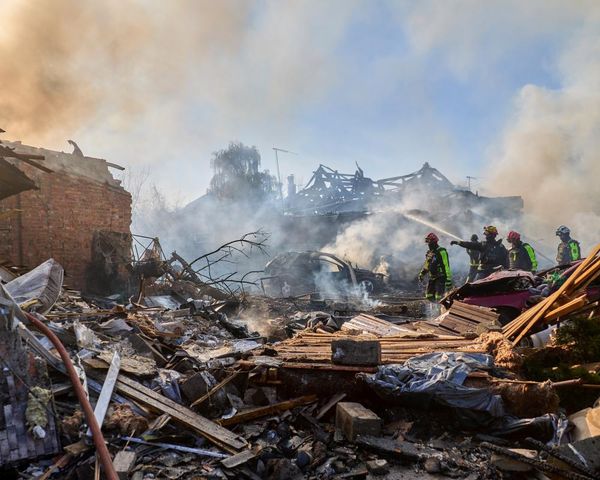
Four years after Russia's invasion, Europe has quietly replaced the United States as the engine of Ukraine's survival.

Why it matters: President Trump and his allies have long insisted that Europe — not Washington — should shoulder the cost of the continent's largest land war since World War II.

  • In 2025, European governments and institutions answered that call — surging military aid by 67% and financial and humanitarian support by 59%, according to the Kiel Institute's Ukraine Support Tracker.
  • Over the same period, U.S. aid effectively ground to a halt — with Trump forcing NATO allies to buy American weapons and bankroll Ukraine's defense themselves.

Zoom in: Top European officials argue that this new dynamic entitles them to a seat at the negotiating table, where U.S. envoys have spent months pressing Ukraine and Russia to end the war.

  • "We are spending real money, whereas the U.S. is actually making money on this war," Polish Foreign Minister Radek Sikorski said at the Munich Security Conference.
  • "That gives us the right to have a voice in the arrangements and the outcomes," he said.

German Chancellor Friedrich Merz struck a similar tone in his address, declaring that the EU — and Germany in particular — have been Ukraine's most important military backers for over a year.

  • In 2025, the year European support overtook American aid, Russian forces suffered roughly 415,000 casualties, according to estimates from the Center for Strategic and International Studies.
  • "We have exacted unprecedented losses and costs on Moscow. If Moscow finally agrees to peace, it will be partly thanks to this," Merz argued.

Reality check: American intelligence, sanctions enforcement and weapons sales still play an indispensable role in Ukraine's defense.

  • And the White House has shown little interest in elevating Europe as a formal negotiating partner, seeing its hawkish leaders as both a nuisance and an impediment to swift peace.
  • Just last year, Trump officials accused Europe of prolonging the war by allegedly urging Kyiv to hold out for a "better" deal — all while continuing to purchase Russian energy.

The big picture: The first shock to European security this decade was Russia's invasion of Ukraine. The second was Trump's return to the White House.

  • Trump's intimidation of allies and threats to seize Greenland spurred a crisis at Davos last month, where NATO leaders described a "rupture" in the post-war order.
  • Secretary of State Marco Rubio struck a softer tone in Munich, seeking to quell transatlantic nerves as he insisted the U.S. and Europe "belong together."

Still, as the Ukraine pivot makes clear, Europe is undergoing a profound shift in power and responsibility.

  • In Munich, British Prime Minister Keir Starmer called Europe a "sleeping giant" whose economic and military weight far exceeds Russia's — if only it can act in concert.
  • Merz quipped that Europe "has just returned from a long vacation from world history" — and is now shedding its "immaturity" as it steps into strategic adulthood.
Sign up to read this article
Read news from 100’s of titles, curated specifically for you.
Already a member? Sign in here
Related Stories
Top stories on inkl right now
One subscription that gives you access to news from hundreds of sites
Already a member? Sign in here
Our Picks
Fourteen days free
Download the app
One app. One membership.
100+ trusted global sources.