
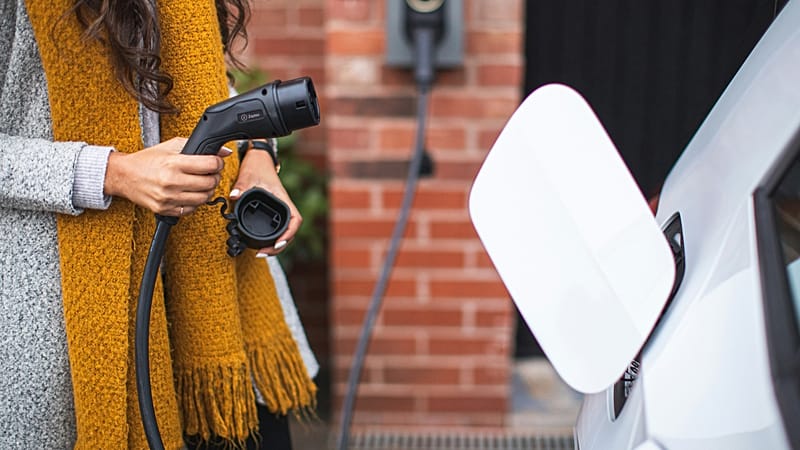
Switching to green heating and transport can cut EU household energy bills by thousands of euros every year, even before accounting for fossil fuel shocks, according to a new report.
The analysis by Danish green think tank CONCITO found that investing in heat pumps and electric vehicles (EVs) alone can provide equal savings to almost two years of free heating for an average EU household. Experts say these savings could be even greater if national governments adjust energy taxes and when power is used during off-peak hours.
Researchers analysed five EU states and found that energy bill savings varied significantly based on local energy prices and household energy demand. However, the savings were “substantial everywhere”, with the EU average hitting €2,200 per year.
How much could a heat pump and EV save you?
The report found that German households could save at least €1,950 annually by switching to a heat pump and an EV, which is roughly equivalent to a year of free home heating.
In Spain, this increased to annual savings of €2,000, the equivalent of 22 months of free electricity.
Out of the five countries sampled, France came out as the biggest winner, with households standing to save a staggering €3,070 annually by making the switch.
For Poland and Italy, annual savings were €1,870 and €1,780, respectively.
CONCITO states these estimates are based on Eurostat data from before the war on Iran, which has seen oil and gas rockets skyrocket.
“Consequently, the estimates can be considered as relatively conservative,” the report reads. “The recent fossil fuel spikes only strengthen the business case for electrification and the political imperative to protect consumers from price shocks.”
Iran war sparks renewables boom
The US-Israel conflict in the Middle East has ignited a renewables boom across Europe, bolstering home-grown, clean energy.
Sales of heat pumps in the UK rose more than 50 per cent in the first three weeks of March compared to the same period the month before, according to energy firm Octopus Energy. This coincides with the effective closure of the Strait of Hormuz, one of the world’s most vital fossil fuel shipping routes that usually carries around one-fifth of global oil supplies.
Residential heat pump sales spiked by 25 per cent in the first quarter of 2026 in France, Germany and Poland on average, compared to the same period in 2025. In Germany, heat pumps have outsold traditional gas boilers, despite the country recently backpeddling on its green heating law.
Multiple car sales retailers, including second-hand markets, have also witnessed interest in EVs surge in recent months. This includes Amsterdam-based Olx, which says customer enquiries for EVs have jumped across its marketplaces in France, Romania, Portugal and Poland, with growth “accelerating consistently week-over-week across all markets”.
“The fossil fuel price spikes we are seeing today are not an accident, they are the predictable consequence of Europe’s continued dependence on oil and gas – around 90 per cent of which is imported,” says Jens Mattias Clausen of CONCITO.
“This analysis shows that the tools to protect European families already exist. What is needed now is the political will to remove the barriers that are standing in the way.”
What are the barriers to electrification?
Upfront costs remain one of the biggest barriers for many households wanting to electrify their heating and transport.
The report identifies that targeted subsidies of €4,500 would bring the payback period for a heat pump down to five years for the average EU household. Many countries, such as the UK, provide additional grants for households on low incomes to help families pay for installation costs.
The price of EVs is also dropping, reaching price parity with petrol vehicles in many countries. Last month, the UK’s biggest automotive marketplace Autotrader, reported that new EVs are now, on average, cheaper to buy than petrol models for the first time.
According to Octopus Electric Vehicles, many EVs now cost the same or even less to lease than their petrol equivalent.
Many EU countries also offer incentives for buying electric cars and installing charging infrastructure.