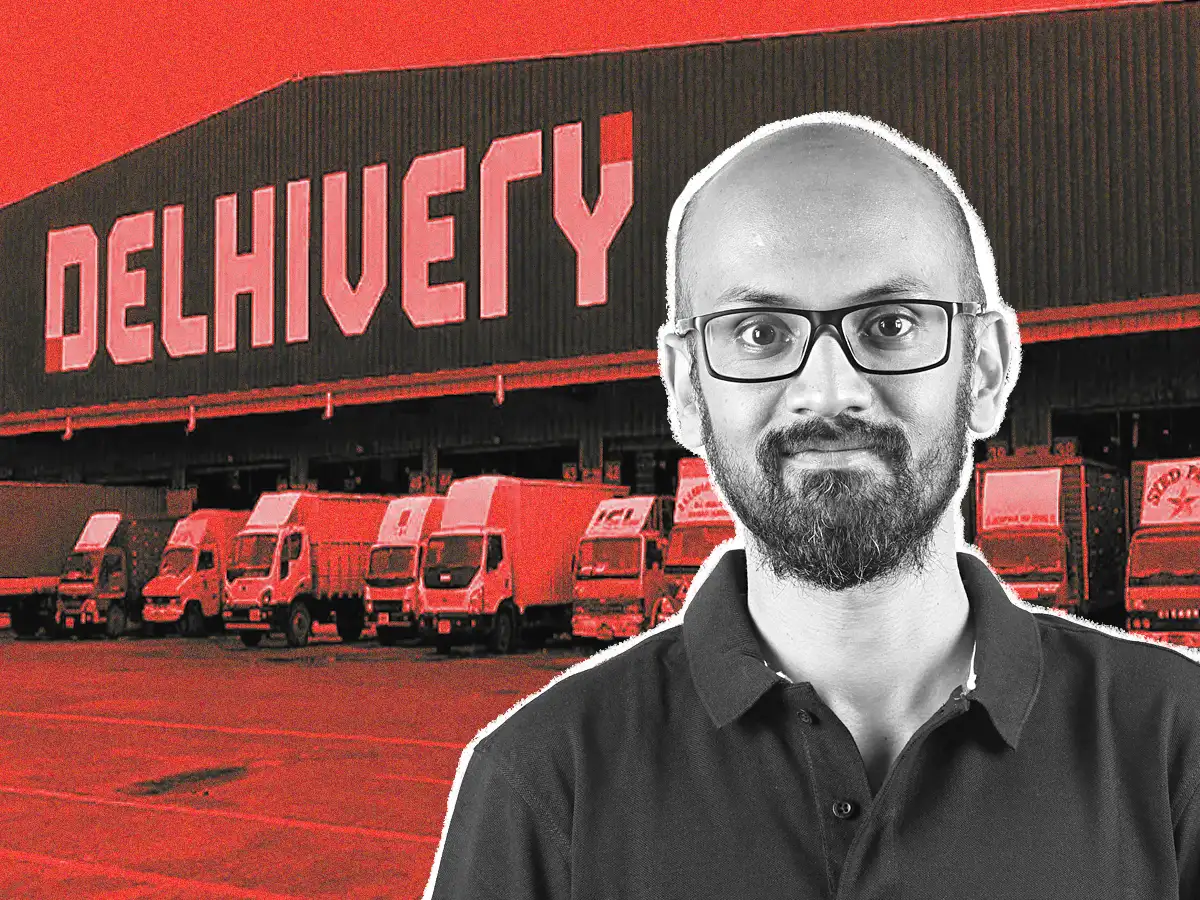
Four years after listing and a year after acquiring Ecom Express , Delhivery cofounder and CEO Sahil Barua expects further consolidation in the logistics sector, as he says there isn't enough volume for more than three players. He also said that the quick commerce industry carries a high economic cost and it’s difficult to see players other than Blinkit turning profitable in the near-term.
“You already have Blue Dart, Delhivery, and Shadowfax, all of which have strong, competitive positions in their respective segments. It’s very difficult for another independent, third-party ecommerce logistics company to survive, whether that’s Xpressbees or anyone else,” Barua said in an exclusive interview with ET.

“The problem is that there simply isn't enough incremental volume left to capture because the rest of us have already established strong positions. At the same time, costs are rising (fuel and labour)”. Xpressbees spun off from the now listed baby and mother care etailer FirstCry a decade ago, and has struggled amid mounting losses. For the financial year ending March 31, 2025, its losses grew 85% to Rs 370 crore.
Delhivery acquired the Warburg Pincus-backed logistics firm Ecom Express in a fire sale for Rs 1,407 crore last April amid declining market share and mounting costs. Barua said there was still room for one or two players to exit the market "gracefully".
Currently the country's largest third-party logistics provider, Delhivery’s stock came under pressure as ecommerce growth tapered. On Friday, Delhivery's shares closed at Rs 465.20 on the BSE as the stock has gained 21% over the past year. “There are short-term reasons for it (the stock price) to go up or down that are beyond our control. One example is that we had a very strong end to the last financial year. It was the first time in the 15 years I've been here that Q4 was better than Q3. Normally, in our industry, Q3 is the strongest quarter,” Barua said.
Also Read: Delhivery investors cash out as stock nears IPO price
Quick comm and profitability
While Delhivery has stayed away from the buzzy quick commerce sector, it took a bet on two to four-hour deliveries for direct-to-consumer brands through a network of multi-brand dark stores. Barua said the company may consider entering the broader quick commerce space only if pooled last-mile deliveries became viable or platforms began operating out of shared dark stores.
“If the model evolves and delivery becomes more efficient through aggregation, clubbing, and pooling of orders, in that scenario, we could participate. But as things stand today, we don't see much of a role for us in standalone last-mile delivery. Our focus will remain on the upstream parts of the supply chain,” he pointed out.
Barua, who served on Swiggy's board until April 2025 , also mentioned that while demand for 15-minute deliveries has been established, it remains unclear whether it will sustain once discounts and incentives are withdrawn.
“The industry is still subsidising consumers. Once you add up the capital expenditure, the overall economic cost of the business is very high… Blinkit has done a great job of demonstrating that there's money to be made in quick commerce. The bigger question is whether all the players can make money at the same time. It's hard to see how,” he said.
Blinkit reported an operating profit of Rs 37 crore for the January-March quarter after breaking even in the three months ended December 2025. Barua's comments come as Blinkit and Instamart sharpen their focus on profitability, while standalone quick commerce player Zepto faces scrutiny over its cash burn as it prepares to go public later this year.
He also observed that Amazon and Flipkart's push into quick commerce was largely aimed at protecting their high-value customer base from migrating to 10-minute delivery platforms.
“For the horizontal marketplaces, the push into quick commerce is primarily about protecting their customer base. They don't want consumers shifting their purchases to platforms like Blinkit or Instamart,” Barua explained, adding that growth in the broader ecommerce market remained within the expected range.
“We’ve consistently said that ecommerce is a 15-20% growth market. Meesho has grown faster, while Flipkart has grown a bit slower. On average, though, the market is still growing within that range,” he added.
Ecommerce and costs
Ecommerce accounts for the bulk of the Gurgaon-based company’s FY26 revenues , which posted a 72% year-on-year (YoY) increase in ecommerce parcel volumes. Its operating revenues rose 30% YoY to Rs 2,849 crore, while net profit remained flat at Rs 72 crore.
Barua said one of Delhivery's key growth drivers will be ecommerce companies increasingly outsourcing their logistics as rising fuel and labour costs make in-house operations less efficient.
Besides Amazon and Flipkart, which have built their own logistics arms, listed ecommerce company Meesho has also launched its in-house logistics platform, Valmo , which now handles more than half its volumes. Delhivery was among those affected by Valmo’s launch in 2024, as a chunk of its volumes came from Meesho. Since then, Delhivery has broadened its offerings to diversify beyond ecommerce.
“Ecommerce operates on razor-thin margins. Every rupee they save on logistics is a rupee they can invest in customer acquisition or improving the customer experience,” Barua said. “Meesho has its own logistics network, and we understand that. Others are experimenting with in-house operations as well. We believe there are limitations to that model, though they may continue to run a certain share of their volumes through it”.
He said these companies had invested heavily in first-party logistics and were subject to the sunk-cost fallacy. “Over time, many of these operations have turned out to be heavily loss-making and a drain on resources. At the same time, all of them are expanding into low-value ecommerce. Amazon has Bazaar and Flipkart has Shopsy. Once you start serving those segments, every rupee spent on logistics matters a lot,” Barua said.