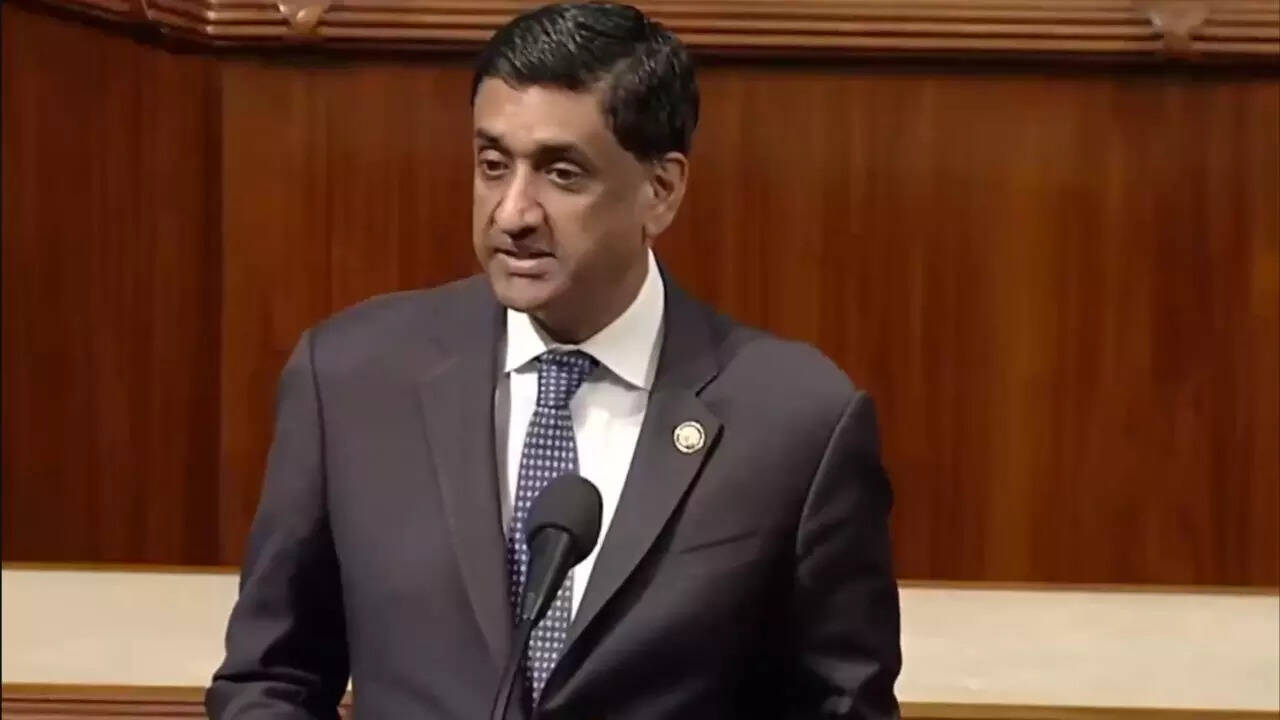
A fresh political storm erupted on Capitol Hill after Indian-origin US Democrat Rep. Ro Khanna (D-Calif.) named six “wealthy and powerful” men he claims were redacted from the Jeffrey Epstein files, accusing the US Justice Department of hiding their identities without explanation.
The six individuals identified were Les Wexner, Sultan Ahmed bin Sulayem, Salvatore Nuara, Zurab Mikeladze, Leonic Leonov, and Nicola Caputo.Khanna read out the names during a House speech, a move protected under the US Constitution’s speech and debate clause, shielding lawmakers from defamation lawsuits for remarks made in Congress. A video clip of the moment circulated widely on social media.

.@RepThomasMassie and I forced last night the DOJ to disclose the identities of 6 men:Salvatore Nuara, Zurab Mikeladze, Leonic Leonov, Nicola Caputo, Sultan Ahmed Bin Sulayem, and billionaire businessman Leslie Wexner.
I share details of what more we learned to hold the… pic.twitter.com/5JwKwRUNIF
— Rep. Ro Khanna (@RepRoKhanna) February 10, 2026
Khanna and Rep. Thomas Massie (R-Ky.) said they spent two hours at the Justice Department in Washington on Monday reviewing unredacted versions of the Epstein documents. The duo co-sponsored the Jeffrey Epstein Transparency Act, which compelled the Trump administration to release a vast trove of records related to Epstein’s network and activities.
“There were six wealthy, powerful men that the DOJ hid for no apparent reason,” Khanna said, claiming he and Massie had “forced” the department to unredact the names. “If we found six men they were hiding in two hours, imagine how many men they are covering up for in those files.”
Massie said he was prepared to name the individuals publicly in Congress if the department did not act. “What I saw that bothered me were the names of at least six men that have been redacted that are likely incriminated by their inclusion in these files,” he said.
Who are the six men named?
Les Wexner is the billionaire founder of Victoria’s Secret and former head of L Brands. His long and controversial association with Epstein was detailed in a 2019 New York Times investigation, which examined their financial ties and Epstein’s influence over Wexner’s affairs.
Sultan Ahmed bin Sulayem is a Dubai-based billionaire businessman and real estate developer. He is the brother of Mohammed Ben Sulayem, president of the FIA, the global governing body for motorsport, including Formula One. Email exchanges between Bin Sulayem and Epstein have previously been reported.
DOJ denies cover-up
Deputy Attorney General Todd Blanche denied any cover-up, maintaining that certain redactions were necessary to protect victims. He argued that Wexner’s name appears thousands of times elsewhere in the files and said the department had been “hiding nothing.”
Political storm widens
Epstein, a convicted sex offender, pleaded guilty in 2008 to procuring a minor for prostitution and later died by suicide in a Manhattan jail in 2019 while awaiting trial on federal sex trafficking charges. His death and the breadth of his elite connections have continued to cast a long shadow over US politics.
Democrats argue that roughly three million pages remain unreleased, despite the Justice Department declaring its review complete after publishing a large tranche of documents in January.
Several lawmakers who reviewed the files this week complained of “mysterious” and “unnecessary” redactions beyond those permitted to protect victims’ identities.
House Judiciary ranking member Jamie Raskin said he observed “tons of completely unnecessary redactions,” while also raising concerns that some victims’ names had not been properly shielded.
The controversy has also expanded beyond the six names cited by Khanna. US commerce secretary Howard Lutnick is facing bipartisan calls to resign after newly surfaced correspondence showed he had arranged travel to Epstein’s private Caribbean island in 2012.
Lutnick admitted before a Senate panel on Tuesday that he had lunch with Epstein there, after previously stating he had spent “zero time” with him.
Senate minority leader Chuck Schumer, appearing alongside a small group of Epstein survivors, announced legislation aimed at eliminating the statute of limitations for certain sexual offences.
The proposed law is named in honour of Virginia Giuffre, one of Epstein’s most prominent accusers, who died by suicide in April 2025. “Justice should not expire,” Schumer said. “For years, survivors were told it was too late.”
Meanwhile, Ghislaine Maxwell, Epstein’s convicted associate serving a 20-year sentence for sex trafficking, declined to testify before a House oversight committee, invoking her right against self-incrimination.
With lawmakers continuing to review documents through the week, pressure is mounting on the Justice Department amid renewed demands for full disclosure in one of the most explosive scandals involving powerful global figures.