
Get all your news in one place.
100’s of premium titles.
One app.
Start reading
Tom’s Hardware
Tom’s Hardware
Technology
Hassam Nasir

Enthusiast strips GPU cooler to run sub-zero water through its heatpipes, drops temps to 13C — Modded, liquid-cooled RTX 2060 maintains 13C in gaming & unlocks higher boost clocks

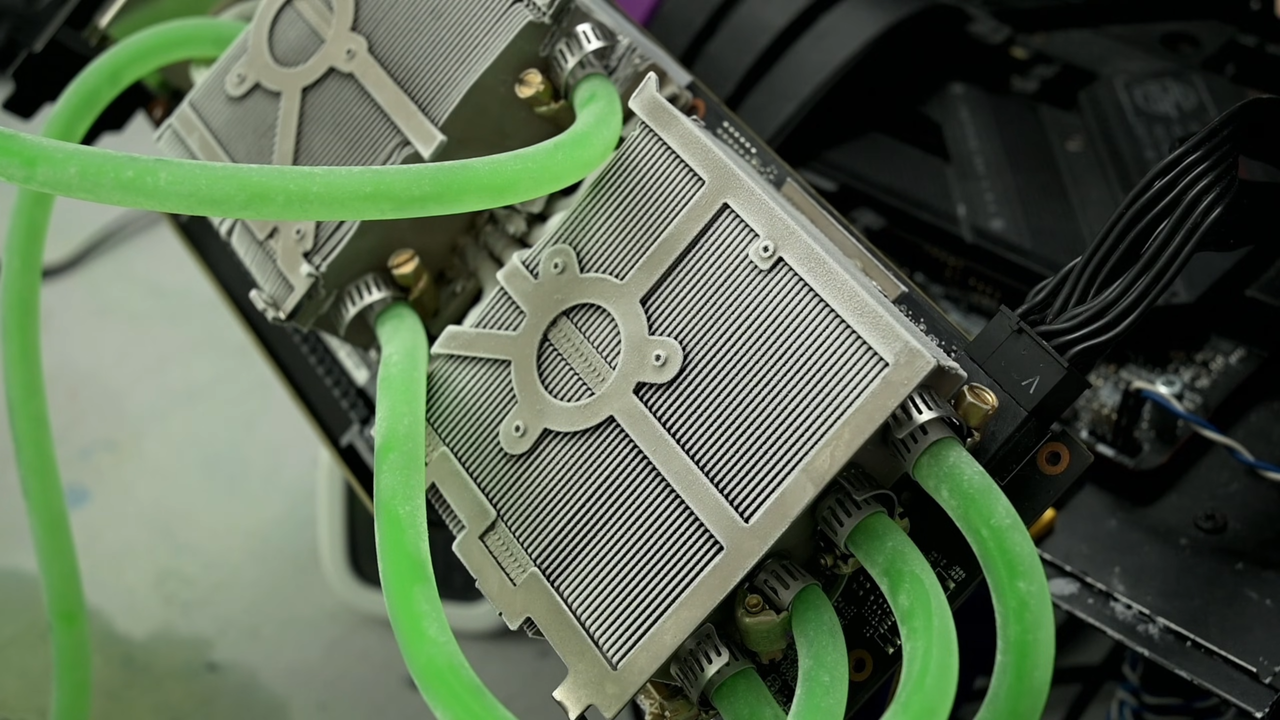
Running sub-zero water through the modded heatpipes of an RTX 2060 .

We've covered a bunch of escapades from the evil genius mind of TrashBench. He's back with yet another creation that makes you wonder if just because something is possible, should it really be done? This one is a follow-up to a previous project where he Frankenstein'd a CPU cooler onto a GPU — now he's eliminated the middleman and decided to mod the GPU cooler itself directly. Even if the final outcome looks unwieldy, the results are bloody impressive.

The video starts with an Asus Dual RTX 2060 being dismantled to expose its cooler, then TrashBench picks at the heatsink long enough to gain a clean entry to the heatpipes. This wasn't an easy process but eventually he could see the end of the pipes protruding, at which point he cut them off. These pipes have a tiny bit of liquid that enables a phase change system when heated, keeping the GPU cool conventionally.

(Image credit: TrashBench on YouTube)

But convention has been completely thrown out the window at this point. TrashBench takes some silicone tubes and attaches them to these cut heatpipe ends, tests for a leak, and gets to benchmarking as soon as possible. While stock, the GPU stayed at 70 degrees Celsius while maintaining an average boost clock speed of 1935MHz.

With nothing running through the newly-installed tubes, the card reached 88 degrees while boosting only up to 1350 MHz. It was time to add a conduit into the mix: regular ol' water. With H₂O flowing through those pipes, the GPU dropped to 47 degrees, shaving off 23 degrees compared to stock and 39 degrees compared to no water before.

(Image credit: TrashBench on YouTube )

Adding two 120mm fans on top of the card didn't affect the temperature; the same goes for a whole radiator with the tubes connected to it. The big change came about thanks to sub-zero water, enabled by an ice chiller. The 2060 was taken apart once again to cover the PCB in Vaseline to protect it from condensation.

Once that ice-cold water was running through the GPU's veins, the temperature under full load dropped to a mere 13 degrees — that's 57 degrees less than stock and a whopping 23 degrees less than even the previous ambient-temp water result. The clock speeds reached a record-high 2025 MHz.

Adding fans, once again, didn't do anything. TrashBench didn't try a radiator but did also include a few swooping shots of the entire GPU being completely frozen over, proving the experiment a success.

(Image credit: TrashBench on YouTube )

Throughout the process, our resident enthusiast used a CH-060 (60W) submersible water pump, but switched to a more powerful Seaflo 12V diaphragm pump for the sub-zero part. The water used here was mixed with antifreeze, which is what gives it the acid green color.

All in all, apart from the painful heatsink disassembly at the start, this was a relatively smooth exercise and another entry into the weird ways computers can be cooled. Most of this list is dominated by TrashBench, including that one time he dunked a GTX 1080 into transmission fluid.

Follow Tom's Hardware on Google News, or add us as a preferred source, to get our latest news, analysis, & reviews in your feeds.

Sign up to read this article
Read news from 100’s of titles, curated specifically for you.
Already a member? Sign in here
Related Stories
Top stories on inkl right now
One subscription that gives you access to news from hundreds of sites
Already a member? Sign in here
Our Picks
Fourteen days free
Download the app
One app. One membership.
100+ trusted global sources.