
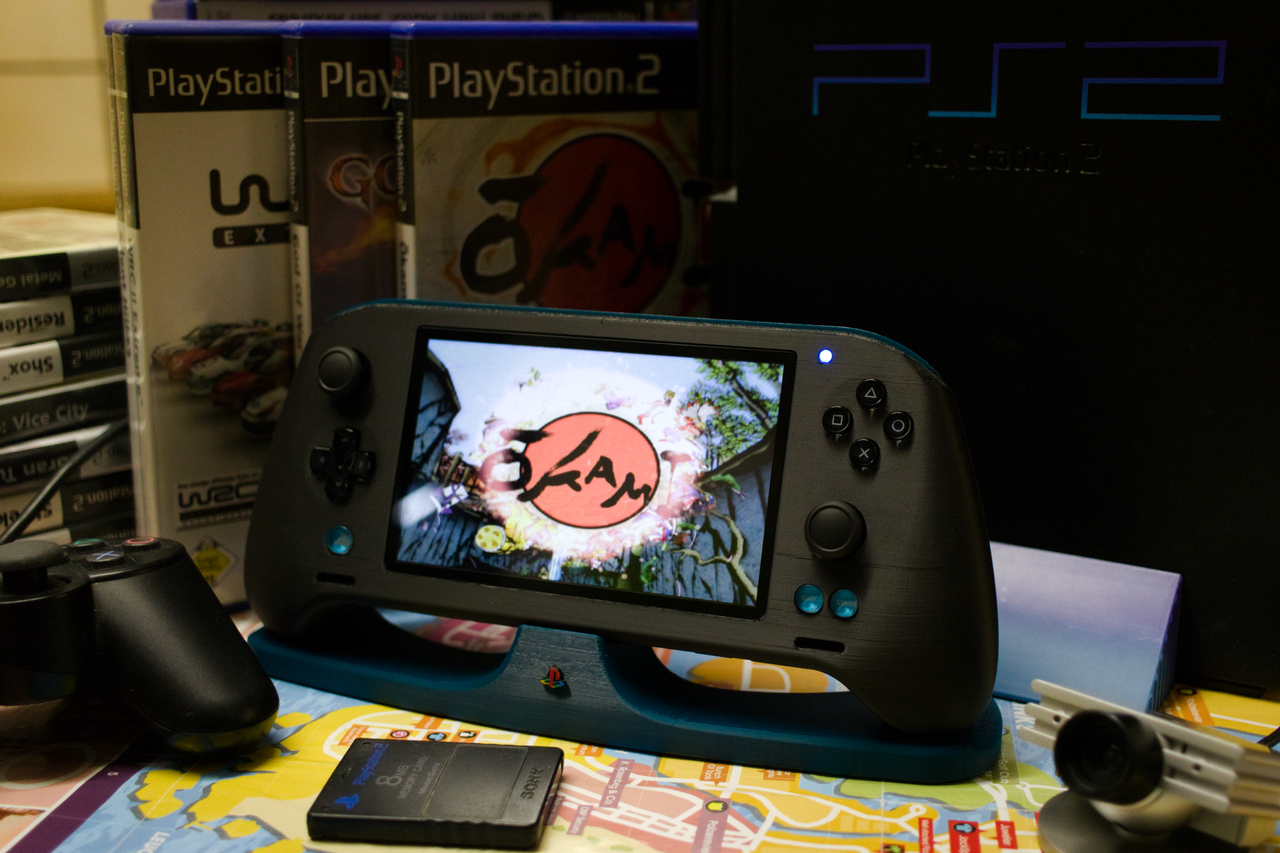
A modder by the name of tschicki has built a custom "PlayStation 2 Portable" from scratch, powered by a reverse-engineered motherboard that features original PS2 silicon. The hardware sits inside a 3D-printed shell with proper controls, USB-PD charging, and a bespoke cooling solution. The project is entirely open-source and available on GitHub for anyone to follow along with, if you have the right skills and patience required.
Work on the PS2 Portable actually began way back in 2022, but it was only made public last year. The four-year development period really shows when you take a look at how polished the finished product is. The design is inspired by modern handhelds such as the ROG Ally; it has an ergonomic shape with large grips that house two 5000mAh batteries to enable up to 4.5 hours of playtime on a single charge.
On the front, there's an asymmetric control scheme that actually features hall-effect joysticks and face buttons from the PS Vita 2000 model. There's a blue accent piece running along the top, enveloping the triggers and the USB-C port, providing some variety in an otherwise minimalist aesthetic. You'll also find vents up there for exhaust. The rear is largely plain with a few threaded screws and a cutout with a grill for intake.

The entire assembly is broken down into just two parts: a top half and a bottom half that screw into each other. The cooling is handled by a custom heatsink solution that uses the fan from the Switch Lite to keep the ICs under control.
This transitions us nicely into the actual crux of the project. The modder took six original ICs from the SCPH-7900x or SCPH-9000x PS2 models and put them on a custom motherboard.
Built upon the existing work of community veterans who have mapped out PS2 mainboards over the years, Tschicki reverse-engineered the entire circuitry of the console. They were then able to manually draw up a new motherboard layout that integrates the aforementioned original chips with completely new traces, video routing, and power management.
The donor ICs handle the bulk of the processing, such as the Emotion Engine (EE) and the Graphics Synthesizer (GS), while RP2040 microcontrollers are responsible for secondary tasks like thermals, controls, sound, and more. The modder used a custom FPGA-based video processor to get direct video out from the GS instead of going through an analog-to-digital converter that'd otherwise degrade the quality.

As such, the PS2 portable supports many resolutions, but it's wired up to a 5" 480x800p IPS LCD running at 60 Hz. To ensure the controls work on this screen, the RP2040 is utilized to convert data from the buttons and joysticks into native DualShock 2 signals, with full rumble support. Another RP2040 monitors the battery and controls power, allowing for fast charging or "charge and play" at 5V, 9V, or 12V.
Finally, to actually use the console, tschicki customized the original boot ROM to directly launch into homebrew, from where you can use the two microSD card slots present on the device to access your games. One slot hooks directly to the PS2 Memory Card's data lines and tricks the system into thinking one of those bulky 8MB Memory Cards is plugged in. You can use this for boot files and game saves, for instance.
The other slot bypasses the PS2's memory controller entirely and uses the open-source MX4SIO routing standard that doesn't try to emulate a memory card. Instead, it relies on custom homebrew apps running on the console to talk directly to the SD card's native storage interface. Once the custom MX4SIO driver is initialized, you can load up any game you want, which means this slot is better for library storage.
This is possible because the BIOS chip from the actual PS2 is one of the six ICs lifted from the original console, along with the CPU+GPU, the RAM (two separate chips), the I/O processor, and the SP2 audio processor. Anyhow, after the games are loaded, the handheld can play PS2 titles natively via custom software like OPL (Open PS2 Loader) or NHDDL, and supports PS1 games via DKWDRV. There is no emulation happening here.

Because of the sheer stature of custom modding work done, the PS2 Portable is one of the most impressive community projects in recent times. The fact that everything from the 3D printer files (STLs), the PCB schematics, the FPGA code, and the software firmware is open source is just the cherry on top. You can build your own identical handheld, but it's not going to be easy, and Tschicki even warns against it.
All of the relevant resources are available on GitHub, including the BOM (bill of materials) for the mechanical assembly and each PCBA. There's a 10-part documentation with steps you can follow, but they're incredibly detailed and only meant for experts with high-level soldering and programming knowledge. Do not attempt this as a fun DIY project, but then again, curiosity killed the cat.
Now, technically speaking, a portable PS2 already exists — it's called the PlayStation Portable (PSP), and it was one of the most successful consoles of all time. But it doesn't have the PS2's massive catalog of classics, so there's an argument to be made there. That being said, emulation has come a long way, and your phone can even play AAA PC games now, so stick to emulation if you're only after the nostalgia and not the microsoldering anguish.


