
Get all your news in one place.
100's of premium titles.
One app.
Start reading
The Conversation
The Conversation
Miguel Clavero Pineda, Científico titular CSIC, Estación Biológica de Doñana (EBD-CSIC)

Eels have fascinated us for ages - now we need to stop eating them

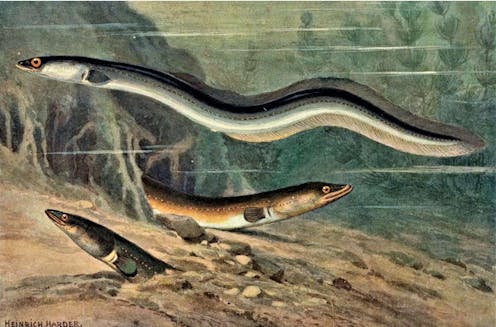
European eel drawn by German artist Heinrich Harder for Emil Walter’s 1913 'Unsere süßwasserfische'. Biodiversity Heritage Library/Flickr

Few animals have sparked humanity’s curiosity as much as the eel (Anguilla anguilla). Until a recent past, this slimy, slippery, snake-shaped, incredibly agile fish inhabited virtually every body of water in Europe and Northern Africa, often in mind-blowing abundances. And nobody knew where they came from.

Philosophers and naturalists from Aristotle to Linnaeus were fascinated by the eel’s apparent lack of reproduction. Sexual organs or eggs had never been observed, so scholars generated diverse and imaginative explanations for the existence of eels.

Sign up to read this article
Read news from 100's of titles, curated specifically for you.
Already a member? Sign in here
Related Stories
Top stories on inkl right now
One subscription that gives you access to news from hundreds of sites
Already a member? Sign in here
Our Picks
Fourteen days free
Download the app
One app. One membership.
100+ trusted global sources.







