Get all your news in one place.
100's of premium titles.
One app.
Start reading
The Economic Times
The Economic Times
Gandharv Walia

Earlier in 2026, a University of Sydney PhD student traced a 1.34497-hour radio pulse to a dead star. Today, its 1.368-hour orbit explains why the bursts repeat

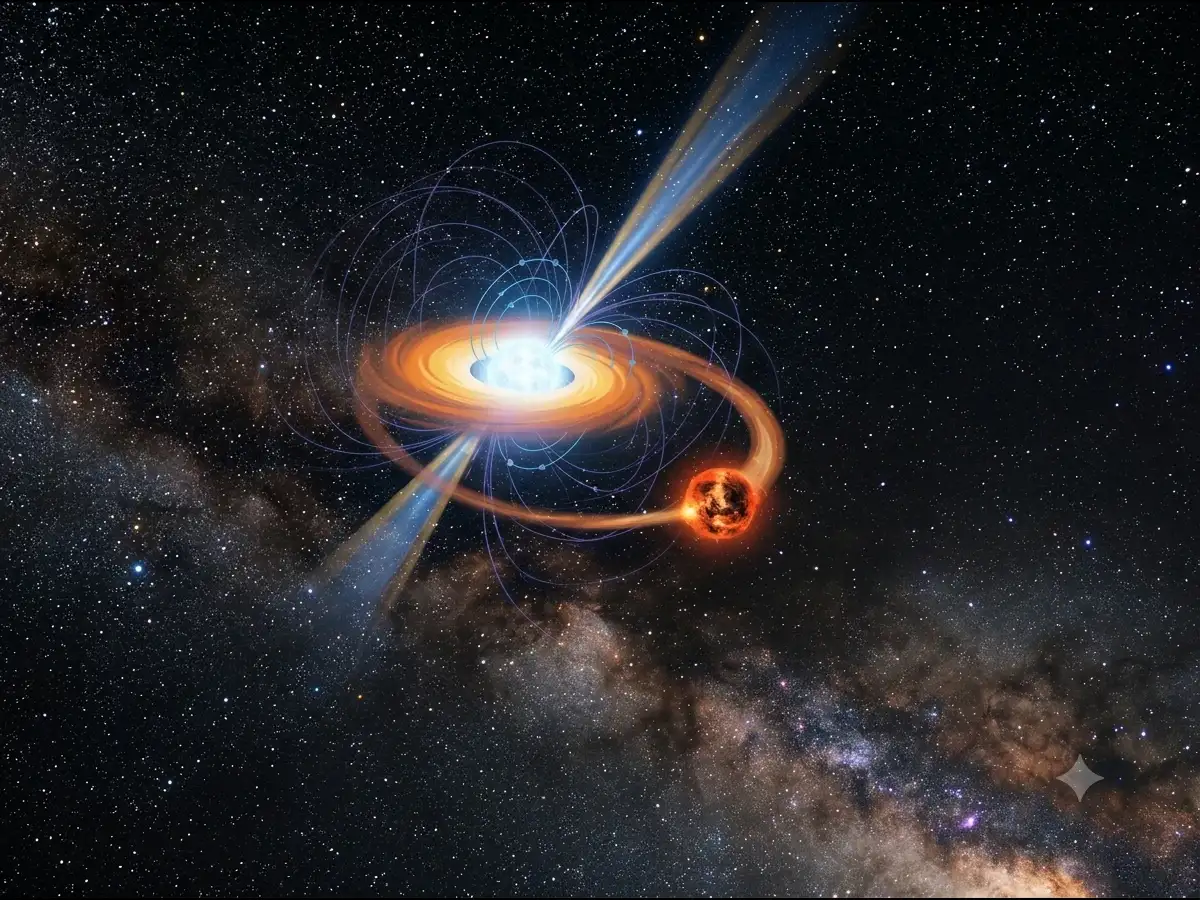
Earlier in 2026, a University of Sydney PhD student traced a 1.34497-hour radio pulse to a dead star . Today, its 1.368-hour orbit explains why the bursts repeat. The source is ASKAP J1745−5051, a binary system in the Milky Way containing a white dwarf and a low-mass companion. Radio observations found bursts that returned about every 1.4 hours. Optical observations then measured the movement of gas in the system and found an orbital period of 1.368 ± 0.053 hours. X-ray observations showed another cycle of about 1.32 hours. Together, these measurements connect the radio bursts with the binary orbit.

How ASKAP J1745−5051 was found?

Sign up to read this article
Read news from 100's of titles, curated specifically for you.
Already a member? Sign in here
Related Stories
Top stories on inkl right now
One subscription that gives you access to news from hundreds of sites
Already a member? Sign in here
Our Picks
Fourteen days free
Download the app
One app. One membership.
100+ trusted global sources.