
Get all your news in one place.
100’s of premium titles.
One app.
Start reading
TechRadar
TechRadar
Ruth Hamilton

Dyson just brought out a new hard-floor cleaner, and I'm sorry, but I prefer the old one – here's why

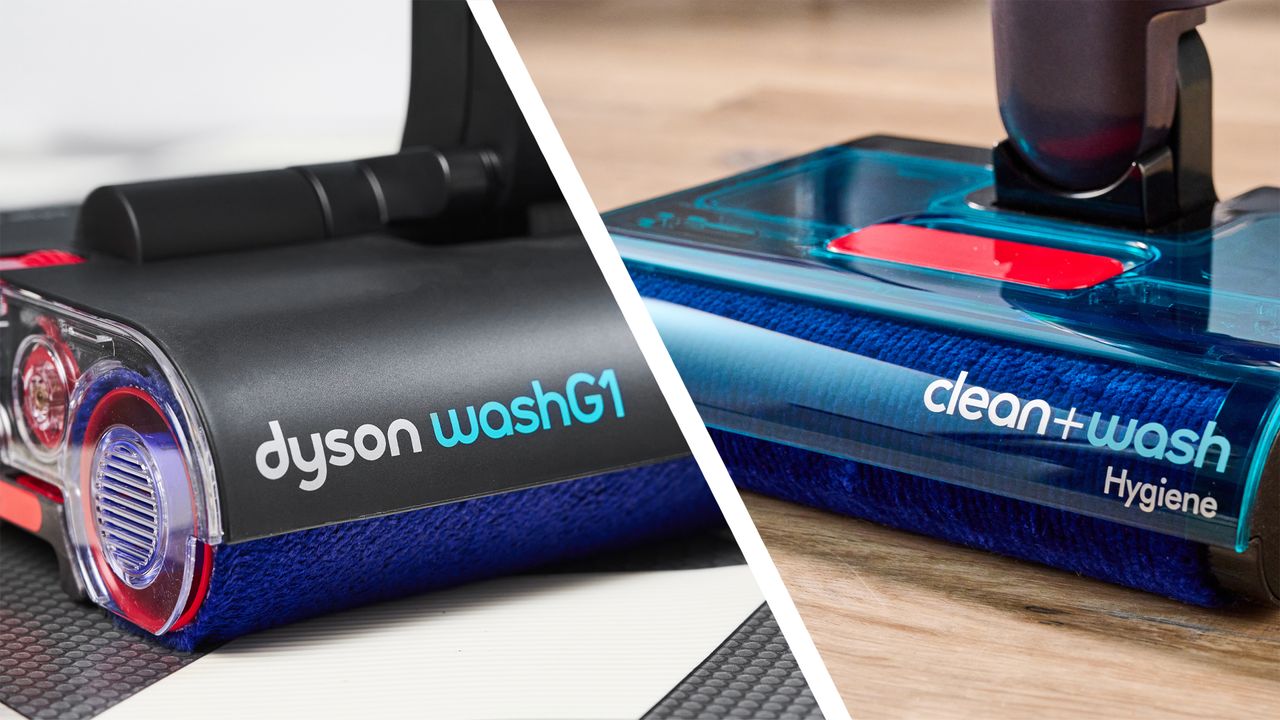
Dyson WashG1 (left) and Clean+Wash Hygiene (right).

Dyson is known for its vacuum cleaners, but recently it has been getting more into wet hard-floor cleaners. Its first attempt launched in August 2024, and you can read all about it in my Dyson WashG1 review. Now there's a new model on the block: the Dyson Clean+Wash Hygiene.

Unlike the best wet-and-dry vacuums on the market, neither use suction, but instead harness a combination of hydration, agitation and separation to clean your hard floors. To put it another way, they add water, dislodge dirt using cleverly designed rollers, and then separate solid and liquid waste for easy disposal.

Beyond that, though, there are a couple of key differences between the Dyson WashG1 and Clean+Wash Hygiene. The first is that the dock will dry the roller with hot air once it's finished its self-washing cycle. This is a solid improvement; no notes.

The second is that the Clean+Wash stores all the waste water in its floorhead, rather than on a tank mounted to the handle. The idea behind this is that because the liquid's not traveling anywhere, there are no tubes to get gunked up. This design shift makes sense in theory, but has several knock-on effects I'm not such a fan of. In fact, I'd go as far as to say that in making this one change, Dyson has sacrificed most of the WashG1's best features.

Here's why I actually prefer the older Dyson WashG1 over the new and shiny Clean+Wash Hygiene...

The original Dyson WashG1, launched 2024... (Image credit: Future)
... and the new Clean+Wash Hygiene (Image credit: Future)

1. It's fiddly and messy to empty

The WashG1 has its dirty-water tank mounted to its handle, and this is easy to remove and empty. The solid waste tray slots into the floorhead, and is slightly more complex to fit, but still fairly straightforward.

In contrast, the Clean+Wash Hygiene has its dirty-water tank mounted into the top of the floorhead, with a two-part solid waste tray integrated in. Separating the three components is fiddly, and putting it back together again even more so – and I say this as someone who's pretty good at jigsaws.

The knock-on effect of having a more complicated floorhead, with lots of connecting components, is that it's a lot leakier than the nice, simple WashG1. Now, all the wet floor cleaners I've used are a little bit drippy – it feels like an unavoidable problem – but the Clean+Wash Hygiene seems especially bad. It felt like every time I went to empty the dirty-water tank something would dribble out onto me or the floor.

The WashG1 collects solid dirt in this tray, and waste liquid in a tank mounted to the handle (Image credit: Future)
The Clean+Wash Hygiene has a complex, multi-part floorhead instead (Image credit: Future)

2. There's only one roller

The WashG1's floorhead has two large microfiber rollers and a bristled roller for solid messes, and delivers efficient cleaning. In contrast, the Clean+Wash Hygiene only has space for one roller on its more complicated floorhead.

I will say I do prefer the microfiber roller design on the Clean+Wash. The scrubbing action is slightly improved, thanks to the addition of wiry, longer fibers that extend a bit from the roller. My ideal scenario? The upgraded microfiber roller design, mounted in the old floorhead.

The WashG1 has multiple rollers... (Image credit: Future)
... whereas the Clean+Wash Hygiene just has one microfiber roller (Image credit: Future)

3. The water tanks are too small

The WashG1 has a 1L clean-water tank, and a 0.8L dirty tank, whereas the Clean+Wash Hygiene equivalents are 0.75L and 0.52L respectively, and the difference was noticeable on test; not so much during the actual mopping – Dyson has tweaked the water delivery so there's only a fine sheen of liquid applied to floors, eking out the clean water as much as possible – but during the self-clean cycle.

Each self-clean cycle uses more than half a tank of clean water, which means for the first few times I ran one of these I had to stop twice per cycle: once to refill the clean water tank and again to empty the dirty tank. Eventually I learned to do this before each self-clean cycle to avoid annoying interruptions.

The benefit of smaller tanks is a more streamlined and lighter machine, so I can see why Dyson was keen to keep things compact here – you'll need to decide your priorities when making your choice.

The Clean+Wash Hygiene's water tanks are just a bit too small (Image credit: Future)

4. Cleaning the dirty-water tank is tricky

One of the things I liked about the design of the dirty-water tank on the WashG1 – and something Dyson highlighted as a big benefit when I was first shown that machine – was that the waste water tank was designed to be easy to clean.

It's wide enough that you can get your hand in and wipe everything out, and there are no awkward corners where grime can collect. I've tested a number of wet-dry vacuums now, and I've never seen anything like it – dirty water tanks are always too small to get your hand in, and always have sharp edges that get grubby almost instantly.

The setup on the Clean+Wash is especially bad, though. It opens with a screw cap, and there's no access to the inside at all. It's not the worst thing for a dirty water tank to be dirty, but this feels like an oversight in terms of long-term maintenance.

Dyson made sure the dirty water tank was easy to clean on its WashG1 (Image credit: Future)
On the Clean+Wash Hygiene, the inside of the dirty water tank is inaccessible (Image credit: Future)

Dyson WashG1 vs Clean+Wash Hygiene: specs compared

Dyson WashG1

Dyson Clean+Wash Hygiene

Cleaner size (H x L x W):

44.9 x 8.9 x 11.8 in / 114 x 22.5 x 30cm

43.1 x 9.6 x 11 in / 109.6 x 24.4 x 28cm

Dock size (H x L x W):

9.4 x 9.4 x 11.8 in / 24 x 24 x 30cm

9.4 x 11 x 10.1 in / 24 x 28 x 25.7cm

Weight (empty):

10.8 lbs / 4.9kg

8.4 lbs / 3.8kg

Clean water tank volume:

1L

0.75L

Dirty water tank volume:

0.8L

0.52L

Max runtime:

35 mins

45 mins

Dock cable length:

3.9ft / 1.2m

5.9ft / 1.8m


Follow TechRadar on Google News and add us as a preferred source to get our expert news, reviews, and opinion in your feeds. Make sure to click the Follow button!

And of course, you can also follow TechRadar on YouTube and TikTok for news, reviews, unboxings in video form, and get regular updates from us on WhatsApp too.

Sign up to read this article
Read news from 100’s of titles, curated specifically for you.
Already a member? Sign in here
Related Stories
Top stories on inkl right now
One subscription that gives you access to news from hundreds of sites
Already a member? Sign in here
Our Picks
Fourteen days free
Download the app
One app. One membership.
100+ trusted global sources.