
Get all your news in one place.
100's of premium titles.
One app.
Start reading
Times Life
Times Life
Aishwarya Kapoor

Dust Mite Allergies Are Behind Half of All Asthma Cases in Indian Homes, and Here Is Why

The creature living in your mattress right now

A standard double mattress in an Indian home can harbour between one and ten million dust mites at any given time. The figure comes from a 2018 review published in the Indian Journal of Allergy, Asthma and Immunology, which found that house dust mite sensitisation was present in 60 to 80 percent of allergic asthma patients studied across multiple Indian cities. The mites themselves, Dermatophagoides pteronyssinus and Dermatophagoides farinae are the two species most commonly found in Indian homes, do not bite and are not parasites. What they produce is the problem. Each mite sheds roughly 20 faecal particles per day, and it is these particles, along with fragments of their shed exoskeletons, that act as allergens. They are light enough to become airborne when bedding is shaken or a mattress is sat upon, and small enough to reach deep into the lungs.

Why Indian homes are especially hospitable

Dust mites need two things above all else: warmth and humidity. They thrive between 25 and 30 degrees Celsius and at relative humidity above 70 percent. Most of coastal and peninsular India, Mumbai, Chennai, Kolkata, Kochi, sits in that range for eight to ten months of the year. Even drier inland cities see humidity spike sharply during monsoon, which is also when asthma emergency visits in Indian hospitals reliably increase. The construction habits common in Indian homes compound this. Thick cotton mattresses, cotton-stuffed pillows, and heavy woollen blankets stored through summer and pulled out in winter provide the mite colony with both shelter and food, mites feed on shed human skin cells, of which the average adult loses about 1.5 grams per day. Carpets and heavy curtains extend the habitat beyond the bedroom. A 2020 study in the Lung India journal found that homes with wall-to-wall carpeting had mite allergen concentrations roughly three times higher than those with bare floors.

How allergen exposure becomes asthma

The immune system of a sensitised person identifies Der p 1, the primary protein in dust mite faecal particles, as a threat. On repeated exposure, it mounts an IgE-mediated response: the airways inflame, the surrounding muscles tighten, and mucus production increases. The result is the wheezing, chest tightness, and breathlessness that define an asthma attack. In children, this sensitisation can happen early. Research from the Indian Study on Epidemiology of Asthma, Respiratory Symptoms and Chronic Bronchitis found that mite allergens were the most common sensitising agent in children with asthma under the age of twelve, ahead of cockroach allergens and mould. The clinical picture matters here: a child who wheezes only at night, or whose symptoms worsen after sleeping, is showing a pattern consistent with mite allergen exposure from bedding, not with outdoor air pollution or pollen, which tend to produce daytime or seasonal patterns.

What actually reduces mite load, and what does not

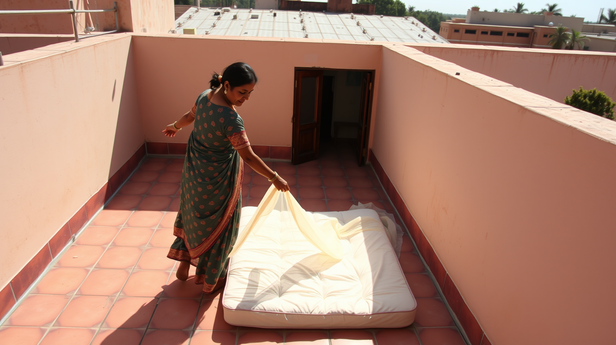
Regular dusting with a dry cloth does not help. It disperses allergen particles into the air and lets them resettle. Wet wiping of hard surfaces reduces allergen on contact but does nothing to the colony inside soft furnishings.The interventions with documented effect are specific:- Mite-proof mattress encasements and pillow covers made from tightly woven microfibre reduce allergen exposure by encasing the colony rather than eliminating it. A 2019 Cochrane review found that encasements alone, without other changes, produced modest but measurable reductions in allergen levels.- Washing bedding in water at or above 60 degrees Celsius kills mites. A standard Indian washing machine's hot cycle, if it reaches this temperature, is sufficient. Cold or warm washes leave the mites alive.- Reducing indoor humidity below 50 percent is the most effective long-term control. In humid climates, this means running an air conditioner or dehumidifier in the bedroom, not just during peak heat but through the monsoon months.- Sunlight exposure kills mites directly. In cities where outdoor air quality allows, spreading mattresses and bedding in direct afternoon sun for two to three hours is a practical and cost-free intervention, one that traditional Indian households practised routinely before the shift to enclosed urban apartments.- Replacing cotton-stuffed mattresses and pillows with foam or latex alternatives removes the preferred mite habitat. Foam does not hold moisture the way cotton fill does.Vacuuming helps only with HEPA-filter vacuums. Standard vacuum cleaners exhaust fine particles, including allergens, back into the room air.

The gap between diagnosis and environment

Most asthma management in India focuses on inhaler technique, medication adherence, and avoiding outdoor triggers like vehicular pollution and crop-burning smoke. These are real concerns. But a patient who uses a corticosteroid inhaler correctly every night and then sleeps on an unencased mattress in a humid room is fighting the trigger and the treatment simultaneously. Allergy testing for dust mite sensitisation, a simple skin-prick test available at most pulmonology and allergy clinics, takes fifteen minutes and tells you definitively whether mites are the primary driver. For a condition as prevalent as asthma in India, where an estimated 30 million people are affected, that fifteen-minute test is used far less often than the evidence warrants.The mite allergen does not clear from a mattress when the season changes. It accumulates. Each year of exposure in a sensitised person is another year of airway remodelling, a gradual structural change in the bronchial walls that makes the asthma progressively harder to control. The bedroom, the room where a person spends a third of their life, is where the allergen load is highest and where the most controllable interventions live.

Sign up to read this article
Read news from 100's of titles, curated specifically for you.
Already a member? Sign in here
Related Stories
Top stories on inkl right now
One subscription that gives you access to news from hundreds of sites
Already a member? Sign in here
Our Picks
Fourteen days free
Download the app
One app. One membership.
100+ trusted global sources.