Get all your news in one place.
100’s of premium titles.
One app.
Start reading
The Times of India
The Times of India
World
TOI World Desk

Drug lord El Mencho killed; cartel rampage brings cities to a halt: What happened in last 24 hours in Mexico

Mexico witnessed one of its most intense waves of violence in the last 24-hour after the killing of its most-wanted drug lord, Nemesio Oseguera Cervantes, widely known as "El Mencho" on Sunday.

His death during a military operation in Jalisco triggered coordinated retaliation by cartel members, leading to arson attacks, highway blockades, prison breaks and deadly clashes across multiple states.
By Monday, the federal government had deployed 10,000 troops in an effort to regain control as dozens were reported dead.

How was he killed

According to Mexican defense secretary general Ricardo Trevilla Trejo, authorities tracked Oseguera by monitoring one of his romantic partners.

Mexican intelligence supported by US military intelligence, learned of a rendezvous between the woman and the cartel boss and used that information to locate him at a ranch in Tapalpa, Jalisco state, Trevilla told reporters, AFP reported.

Troops supported by helicopters launched a pre-dawn raid. Security forces encountered heavy gunfire as they closed in.

Oseguera and members of his inner circle fled into nearby wooded terrain, prompting a pursuit by special forces.

Officials said Oseguera and two of his bodyguards were wounded during the confrontation. All three later died while being flown to Mexico City for medical treatment.

Their bodies were transported to the capital for formal identification.

Violent backlash, retaliation by cartel members

Within hours of confirmation of his death, cartel members launched coordinated acts of violence.

The federal authorities reported that the country woke up without major highway blockades after 85 roadblocks were recorded across 20 states.

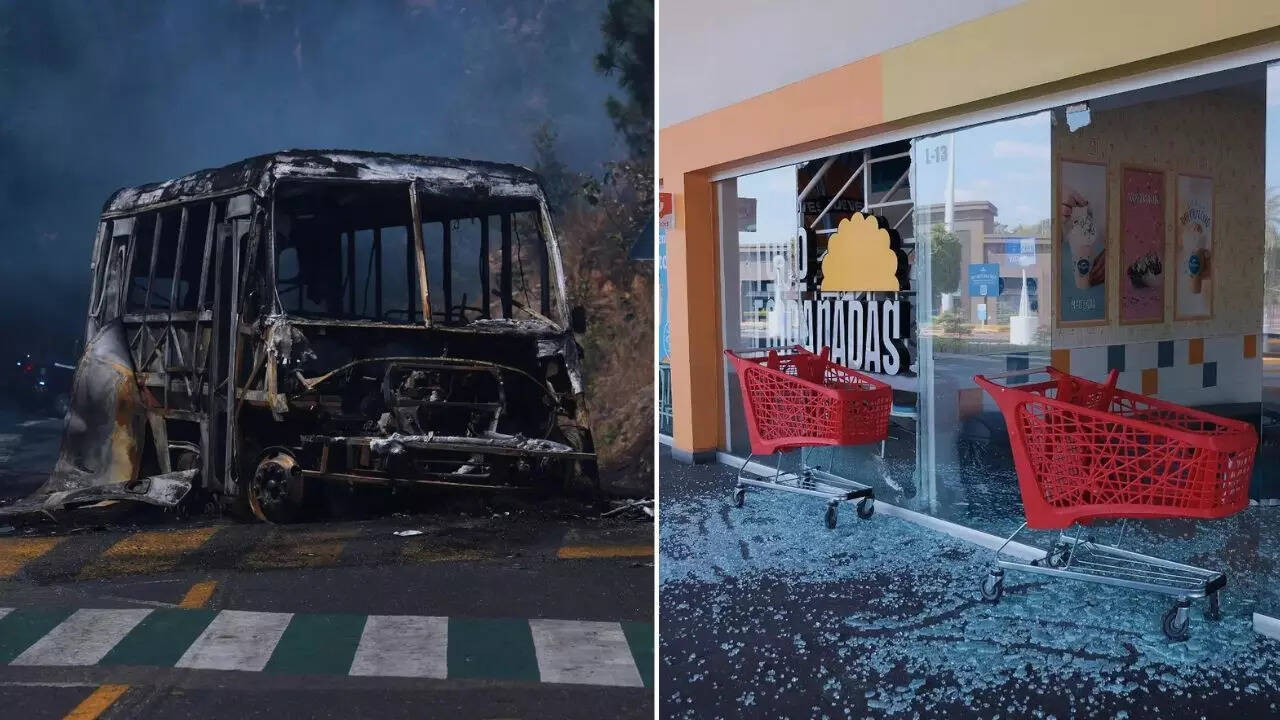
Vehicles, banks, supermarkets and other businesses were set ablaze. Authorities described the unrest as one of the most widespread and organized backlashes seen in the country in recent memory.

During the military operation and subsequent clashes, officials reported that at least 27 security personnel, 46 suspected criminals and one civilian were killed.

In many areas, residents remained indoors as armed groups erected barricades and torched vehicles. Fear gripped Jalisco, the cartel’s traditional stronghold, and quickly spread beyond.

10,000 troops deployed

To contain the violence, the Mexican government deployed an additional 2,500 troops to Jalisco, bringing the total number of security personnel sent to affected areas to 10,000 since Sunday, officials said on Monday.

President of Mexico, Claudia Sheinbaum insisted that no US forces took part in the capture operation.

While White House Press Secretary Karoline Leavitt confirmed that Washington "provided intelligence support," Sheinbaum stated that no US troops participated in the raid.

The government suspended public transportation in some areas of Jalisco and instructed hotels to tell guests to remain indoors. Authorities said calm had largely returned by Monday, but tension remained high.

Prison break in Jalisco

At least 23 inmates escaped after gunmen attacked a jail in a hail of gunfire, according to the state security secretary. Officials blamed "criminal groups" for the assault.

The prison attack added to fears that the cartel was mobilizing across multiple fronts to demonstrate its strength even after the death of its leader.

International travel advisories issued

The US government advised its citizens to "shelter in place until further notice" in parts of Jalisco, Tamaulipas, Michoacán, Guerrero and Nuevo León.

Britain, Canada and the United States issued travel advisories, while Australia urged travelers to "exercise a degree of caution."

Several US and Canadian flights were canceled as airlines reassessed routes to affected regions.

Daily life disrupted in key cities

Guadalajara, the capital of Jalisco and one of this year's FIFA World Cup host cities, was heavily affected. Schools closed, public transportation was halted, and government offices temporarily shut down.

Residents queued outside small grocery stores and tortilla shops to stock up on supplies. Pharmacies were shuttered.

The violence also reached Puerto Vallarta, a major tourist destination. Visitors and locals sought shelter as unrest spread through the area.

Soldiers continue clashes with cartel gunmen

By Monday morning, grocery stores in Puerto Vallarta reopened, and long lines formed outside. However, in-person classes remained suspended in several states including Jalisco, Nayarit, Colima and Michoacán as a precaution.

State oil company Pemex said operations continued normally, with fuel supplies secure. Airports resumed operations, though some airlines reported delays and cancellations.

Yet the calm was fragile.

Gunshots echoed intermittently through the area, and just outside town limits, the body of a man lay beside a Jeep riddled with bullets, AP reported.

Heavily armed Mexican security forces continued operations against cartel gunmen following the killing of Nemesio Oseguera Cervantes, known as "El Mencho." His death triggered a wave of retaliatory attacks and left large parts of the country on edge.

Cartel fighters maintained roadblocks in several areas, while plumes of smoke rose from burning vehicles and barricades on the outskirts of Tapalpa.

President Claudia Sheinbaum said that "virtually all activity has been restored," CNN reported.

Who was ‘El Mencho’?

Oseguera, born in 1966 to farming parents, rose from modest beginnings to become one of Mexico’s most feared criminal figures.

After moving to California as a teenager, he faced drug trafficking charges twice in the United States. Upon returning to Mexico, he briefly worked as a police officer before deepening his involvement in organized crime.

In 1996, he married Rosalinda González Valencia, linking him to an influential criminal network. He later broke away from the Sinaloa Cartel and founded the Jalisco New Generation Cartel (CJNG) around 2009.

Under his leadership, CJNG expanded aggressively, forging alliances with smaller gangs and extending operations beyond its base in western Mexico.

The US government had placed a $15 million reward on him. Christopher Landau described him as "one of the bloodiest and most ruthless drug kingpins."

What is the Jalisco New Generation Cartel?

The CJNG emerged as a powerful rival to the Sinaloa Cartel and became one of Mexico’s dominant trafficking organizations.

US estimates suggest it has between 15,000 and 20,000 members and generates billions of dollars annually. The group’s operations include drug trafficking, extortion, fuel theft, kidnapping, illegal logging and mining, and migrant smuggling.

Known for its brutality, CJNG has carried out public executions, attacked officials and spread fear through violent displays often circulated on social media.

The US State Department designated the cartel as a foreign terrorist organization last year, accusing it of sending cocaine, heroin, methamphetamine and fentanyl into the United States.

The operation came amid heightened pressure from US President Donald Trump for Mexico to intensify efforts against drug trafficking networks or face economic consequences.

Washington has repeatedly cited CJNG’s role in fentanyl trafficking as a major concern.

Oseguera’s death is being viewed as a major achievement for Mexico’s security forces. However, experts caution that eliminating a cartel leader does not automatically dismantle the organisation.

For now, while visible unrest has subsided in several areas, security remains tight and anxiety lingers among residents.

Sign up to read this article
Read news from 100’s of titles, curated specifically for you.
Already a member? Sign in here
Related Stories
Top stories on inkl right now
One subscription that gives you access to news from hundreds of sites
Already a member? Sign in here
Our Picks
Fourteen days free
Download the app
One app. One membership.
100+ trusted global sources.