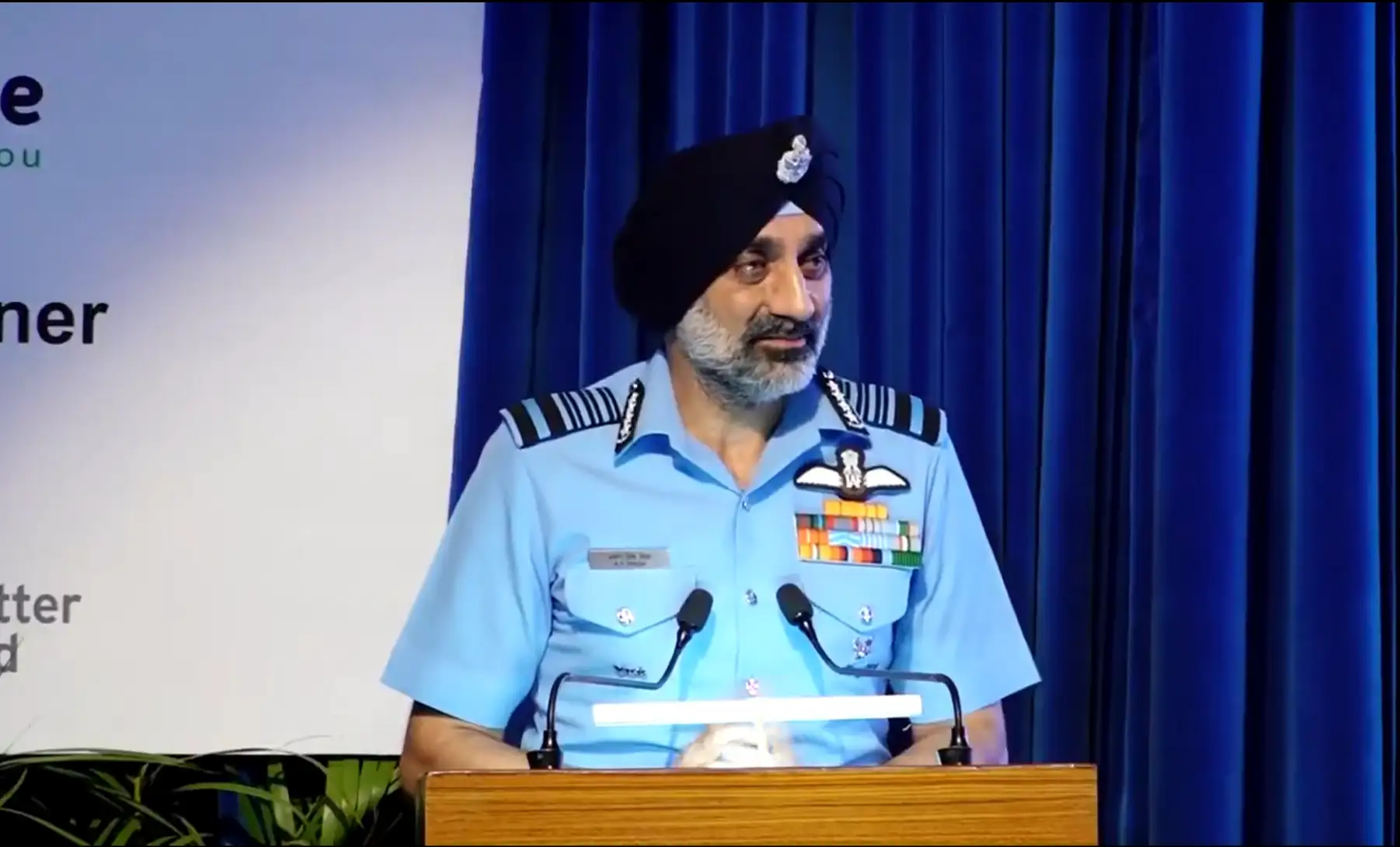
New Delhi: IAF Chief Air Chief Marshal A P Singh on Friday said drones and other unmanned aerial systems are no more just eyes in the sky, rather they are now akin to "claws in the sky", being an extension of air power.
In his address at a defence seminar themed on unmanned aerial systems (UAS) and counter-UAS, he asserted that in any modern aerial threat, complete domain awareness is the key, and there should be "total coordination" among the three services which will be operating in the same air space.

"We have seen what happens... if you don't have domain awareness, you don't know where your people are and where others are. We've seen what happened to F-15s in Kuwait. The fratricide part. So we cannot afford to have things like that," the IAF chief said, referring to the incident on March 1 in which three US F-15E Strike Eagles went down over Kuwait due to an apparent friendly fire, according to the US CENTCOM.
The seminar is being co-hosted by think-tank Centre for Aerospace Power and Strategic Studies (CAPSS) and Indian Military Review (IMR) publication, at the IAF's Subroto Park here.
The drones, UAS and counter-UAS are very relevant today; it is a reality and not something for the future, the IAF chief said.
"So, there is no denying that the battlefield has shifted. We are shifting totally from those very concentrated air power to a sort of decentralised and autonomous way," he added.
The air chief marshal underlined that the UAS is an "extension of air power".
"So all the rules of air power will apply when you use the UAS, just remember that. And, they are no more eyes in the sky. They are like claws in the sky now. This, we've seen it in the recent conflicts that have taken place. And we also realised that during Operation Sindoor, and this part cannot be forgotten," he asserted.
"And, when it comes to counter-UAS, it is like a cat and mouse game. You develop technology in one field; the counter technology has to develop along with it. Because that is how the game can be played, otherwise, one side will have total advantage," the IAF chief said.
"You can't always have force versus force. It has to be force versus defence and others."
Singh recalled the key role of the Indian Air Force during Operation Sindoor, the decisive military action by India during May last year.
"I think we've done reasonably well in Op Sindoor. And why that happened, because there was coordination. Without coordination, without central, agency coordinating it. Without having that IACCS (Integrated Air Command and Control System) becoming a nerve centre, whether it is counter-UAS or counter-weapon or counter-aircraft, it wouldn't have been possible," he said.
"So, we were successful, we were successful... none of their weapons systems landed upon target. None of their UAS landed upon target, is because we were operating in a manner that is the way to go," he added.
A swarm of drones were sent in multiple waves by the adversary during the nearly four-day conflict, which were countered effectively by the Indian forces.
On the importance of an integrated air defence system system, he said structures have been put in place so that "every time, we are able to counter them in that manner".
Singh also spoke of the much talked about cost asymmetry that military drones have brought in to battlefield, but asserted that one must also consider that the "cost is not of the weapon system that is coming to hit, it is the cost of the system that it is going to hit".
"There was a mention about low-cost attack and high-cost defence. That means you know using... we've been hearing it, you know, using a million dollar missile, for a few hundred or a few thousand dollar drones.
"If we have to scale up our counter-UAS, we need to make it low-cost because if the attacking systems can be scaled up because of their low cost and numbers can be in thousands, obviously I need to have something that I can afford," the IAF chief said.
"But the cost is not of the weapon system that is coming to hit. It is the cost of the system that it is going to hit. What is the target? And sometimes the target may be such that there is no thinking about cost that time. So, it is the damage that the system can do is what we have to see. And based on that.. what we use to kill it," he said.
So, that is where one needs to have a "rethink", Air Chief Marshal Singh said. "We have used some high-cost options during Op Sindoor also."
In his address to the gathering of senior military officials, defence and strategic affairs experts and military scholars, he emphasised that the "future is manned and unmanned teaming", in which both options are used together.
"You can't take man out of the loop. You may not have man in the loop, maybe you have man on the loop. But it cannot be out of the loop totally. I don't think in near future, in next decade or so, I don't think so we are in that stage," he said.
He said that the battlefield survivability of UAS is still a concern and making our system survive in the battle is something we need to think about, according to Singh.
"Not talking about every UAS, but most of the ones which can deliver a good payload or which can give you a good capability in ISR and all, are very vulnerable. We have seen it in the recent wars. The US has lost a large number of them. Of course, the numbers are not out, but it's a fact," he said.
The IAF chief said UAS will keep evolving and "we will have to keep studying and adapting ourselves".
He asserted that there is a need to "innovate at the speed of relevance".
"We can't be innovating or doing R&D at our own pace. We need to increase the speed because the system has to come in before it becomes irrelevant. So while while we build the systems today, we must be doing research and development on systems of tomorrow," the air officer said.
"It is good to have, maybe 85-90 percent capability of the system, but in time, than wait for that 100 percent and delay it beyond its relevance," he cautioned.