
Get all your news in one place.
100's of premium titles.
One app.
Start reading
The Conversation
The Conversation
Carl Lipo, Professor of Anthropology and Associate Dean for Research, Binghamton University, State University of New York

Drones, physics and rats: Studies show how the people of Rapa Nui made and moved the giant statues – and what caused the island’s deforestation

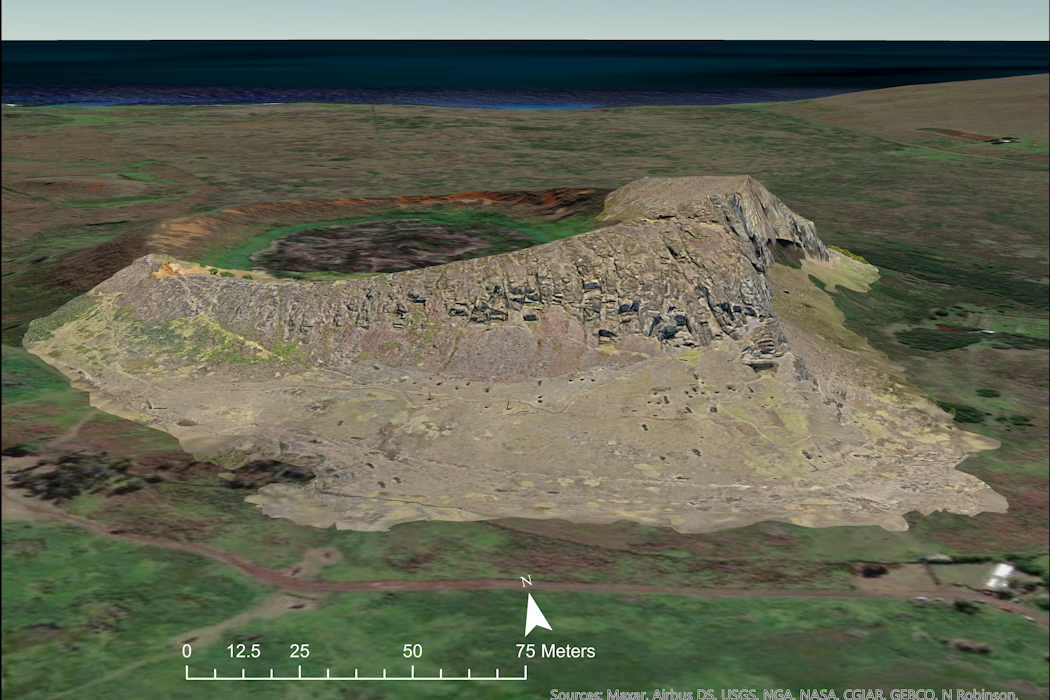
Scientists used drones to produce this 3D model of Rano Raraku, the volcanic crater where 95% of Rapa Nui's giant statues were carved. Lipo et al., 2025, PLOS One, CC BY

Rapa Nui, also known as Easter Island, is often portrayed in popular culture as an enigma. The rationale is clear: The tiny, remote island in the Pacific features nearly 1,000 enormous statues – the moai. The magnitude and number of these monuments defy easy explanation.

Since European ships first encountered these stone giants in the 18th century, outsiders have branded the island as fundamentally mysterious, possibly beyond archaeologists’ ability to explain. This characteristic is part of what makes the island famous. Tour operators market the inexplicable. Documentaries promise unsolved puzzles. Popular books ask how “primitive people” could possibly move 70-ton megaliths.

Sign up to read this article
Read news from 100's of titles, curated specifically for you.
Already a member? Sign in here
Related Stories
Top stories on inkl right now
One subscription that gives you access to news from hundreds of sites
Already a member? Sign in here
Our Picks
Fourteen days free
Download the app
One app. One membership.
100+ trusted global sources.







