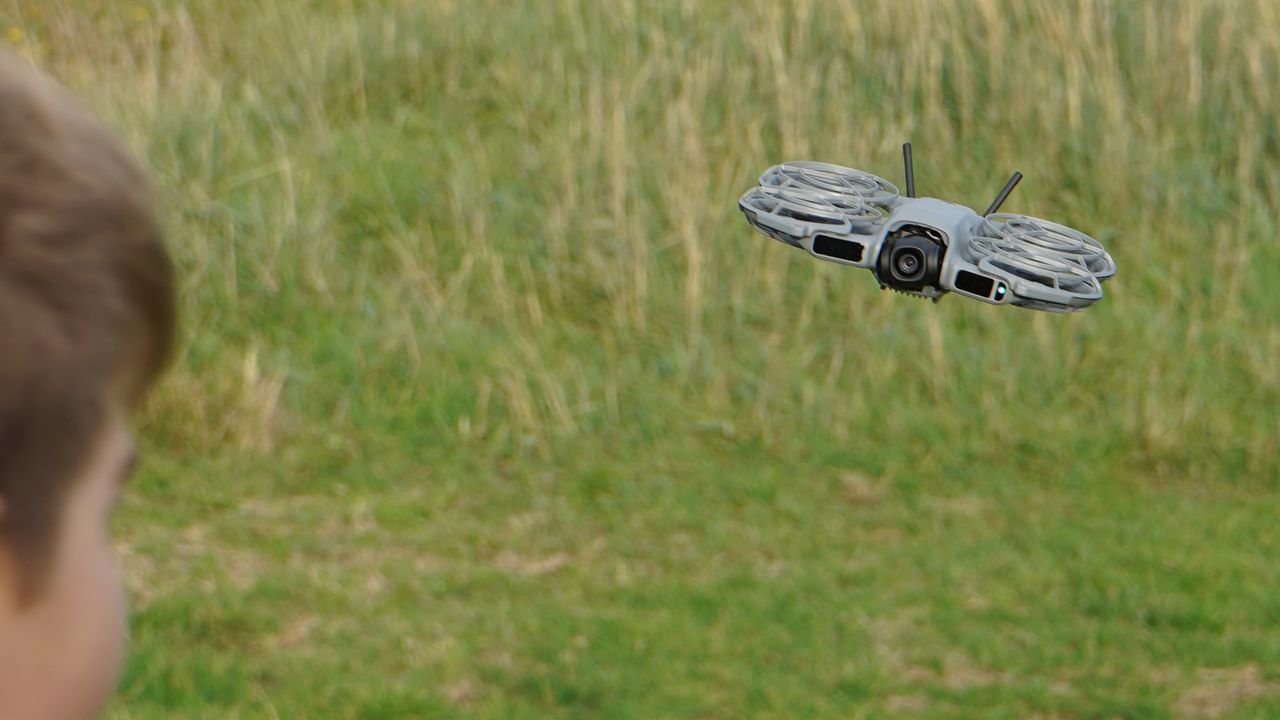
Flying drones is great fun, but there are better first drones than others. I'm a drone expert and some of my work involves flying drones that cost the same as a family car. It won't surprise you to learn that I chose something a lot cheaper to engage my son's enthusiasm for the experience. This time of year you can get drones that cost less than a delivery pizza...
Now this is where I started my boy off for several reasons. The controller uses the same scheme – called 'Mode 2' for reasons best known to the drone community – as serious drones, but the device is a lot cheaper. The remote is also a little smaller in the hand, which is nice for a child of age 6 to 10 (although I was perfectly able to fly it too).

As I've often said, more expensive drones just add extra automatic features, like GPS, or sensors for keeping level, and even avoiding objects. Not having them mean you have to be better at flying. Being tiny and light mean you can't even damage a vase if you hit it (believe me, he definitely tried hitting a few) so this is a great place to start ANY drone flying career.
Next step these days might be the last one – a 'selfie drone' like the DJI Neo or the DJI Neo 2.
The reason is my pick is that it is still relatively lightweight, but DJI seem to have chosen this drone to show their full technological hand. It has the capability to use AI tracking and follow the subject, so, for example, my son enjoys running away from it and the drone follows him with its AI and records him as it does so.
Should he get bored of that, it is possible to buy a 'real' traditional remote controller, and he can learn to fly 'properly' (from my 'old school' perspective). He, however, seems perfectly happy with the 'gesture controls' on the Neo and especially Neo 2, waving his arms apart to tell the drone to get nearer or further!
And finally... the slightly more grown-up drone?
The ultimate ambition of many can still be achieved with a DJI Neo – FPV, which stands for First Person View, mode. It's an upgrade that involves adding goggles that let the operator feel as if they're inside the drone.

There are lots of great ways to get into FPV drones, and one of the best – which is a bit more in touch with the roots of the drone world – is the BetaFPV Cetus kit which gives you everything you need for surprisingly little investment.
If you're really committed to maximum fidelity, though, then the technology in the DJI Avata 2 – the same wand controller as the Neo, and digital goggles, but a much more powerful drone – might be the way to go. Personally, I'd suggest this is more of a second or third FPV drone, but in truth, my son was capable of piloting this (supervised) because the DJI's wand controller is very easy to use. And FPV must always be supervised because someone needs to watch the drone and the pilot cannot because they have a screen in the way of their eyes, so it is, by definition, a social activity. Beat that, video games!
You might also like
Check my guides to the best drones for kids and the best drones for beginners.