
I’ve seen the future of driving. Or at least, I’ve seen a version of it.
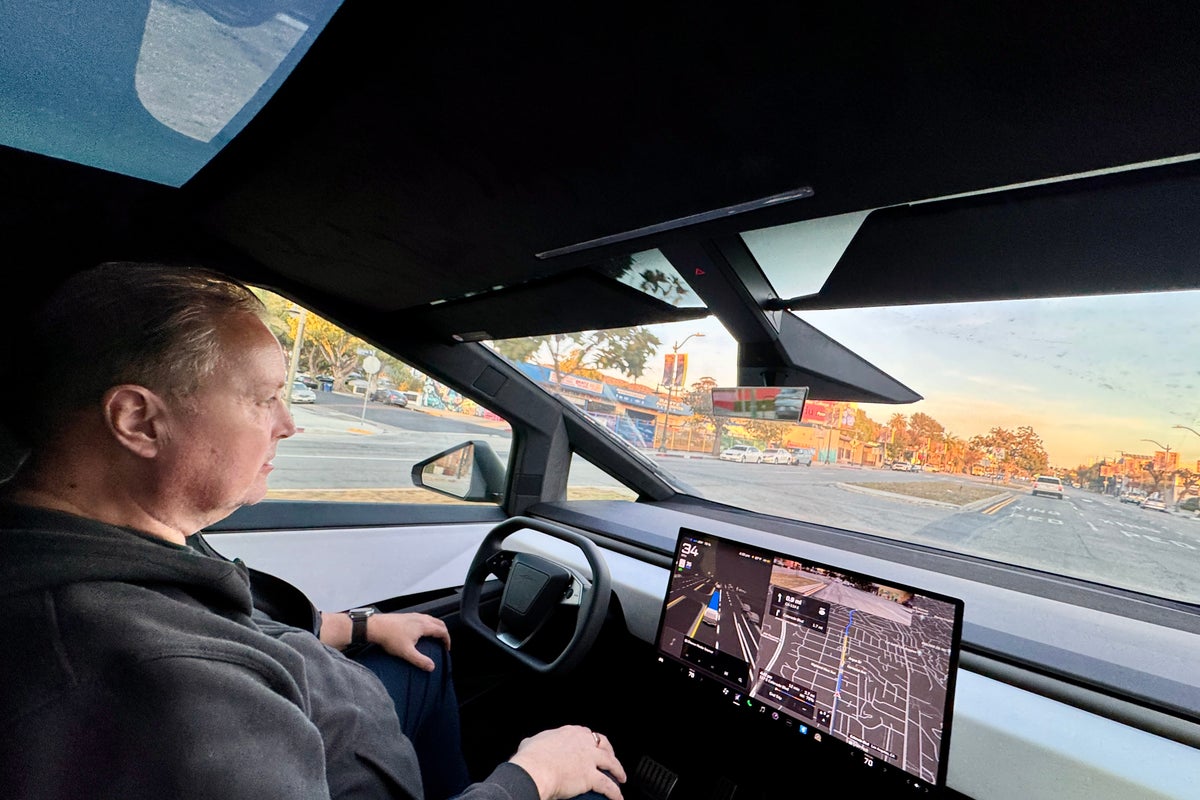
While in the US a few months ago, I climbed into a Tesla Model Y, pressed a button marked Full Self-Driving, and watched the car do something that still feels faintly unbelievable. From the fourth floor of a Scottsdale, Arizona car park, it drove its owner and I – smoothly, confidently, uneventfully – to a driveway some 45 miles across town. Out of the car park, across junctions, onto motorways, through traffic lights – the lot.

The driver was an old family friend who, at 85-years-old, still loves his independence but would freely admit that his confidence behind the wheel isn’t what it once was. In this case he was, of course, still responsible for the car with his eyes on the road and hands ready to take over. But there’s no escaping the fact that the technology is extending his mobility in a way that would have been unthinkable just a few years ago.

Back home, the contrast couldn’t be starker. My dad, now 89, has recently handed in his driving licence. Not because he wants to, but because he feels he should – he just doesn’t feel comfortable being in full control of a car. And his question to me is painfully simple: why can’t he have what my friend in the US has? Why isn’t this self-driving technology available here? Why, in 2025, does giving up driving still mean giving up independence?
Those questions sit at the heart of the driverless car debate – and they’re why I sat down with Tom Leggett, Vehicle Technology Manager at Thatcham Research, to strip away the hype and get to the truth about where autonomous driving really is, and where it’s going next.
There are few people better equipped to discuss self-driving than Tom. As part of the team at Thatcham, Tom is testing and discussing self-driving on a daily basis – and specifically the level of risk that car makers and the insurance industry will be exposed to.
Before we get into robotaxis, Waymo’s London trial and Chinese tech giants, it’s worth dealing with the elephant in the room: Tesla’s Full Self-Driving. Or, as it is currently stylised in the US, UK and elsewhere, “Full Self-Driving (Supervised)”.
Leggett doesn’t mince his words. As impressive as it is, especially during my passenger ride in Arizona, he’s clear that it’s not actually self-driving in the way most people understand the term. As he puts it: “Tesla full self-driving – bracket supervised – is not actually going to be classified as automated in the UK.” In fact, he goes further, suggesting that the terminology itself could be problematic here.

That, in a nutshell, is the communication problem. The system is hugely capable, but legally and technically it’s still driver assistance. You must watch the road. You remain responsible. Liability stays with you.
And yet, as I’ve seen first-hand, it could keep older drivers mobile for longer. That tension – between what the technology can do and what it’s allowed to be called – is only going to grow.
Part of the confusion comes from the alphabet soup of “levels” that get thrown around. Level two. Level two plus. Level three. Four. Five. It’s enough to make anyone switch off.
Leggett breaks it down simply. Level two is what we’ve had for years: a combination of adaptive cruise control that keeps a pre-defined distance from the car in front, and in the centre of your lane. Level two plus – a term engineers hate – adds hands-off driving, but your eyes must stay on the road. Think Ford’s BlueCruise, where hands-free driving is allowed with the system active, but you must pay full attention, and remain entirely responsible for the vehicle.
“Level two plus, that all engineers in the industry hate as a term, is basically that same functionality as level two – it simply allows the driver to remove their hands from the wheel for extended periods of time,” explains Leggett.

The big step comes with level three. This is where you can take your eyes off the road, and crucially, where responsibility and liability transfer away from the driver.
“So level three gives us eyes off… And this is the really, really super important point. Liability transfers – not only responsibility – but liability.”
That handover is also why many manufacturers are nervous. If the car suddenly asks you to take back control after you’ve been watching Netflix for an hour, how quickly can you re-engage? As Leggett says: “Nobody really knows.” And, therefore, nobody knows who’s really liable if the worst should happen. It’s one reason some brands are skipping level three altogether and sticking with advanced driver assistance that keeps the driver legally on the hook, according to Leggett.
But if level three is complicated, level four is conceptually simpler. You’re not a driver at all – you’re a passenger. No steering wheel is required and there’s no expectation that you’ll intervene.
“Level four is you, as the user of that vehicle, have no means nor ability to control that vehicle… that’s where the robotaxi theme comes in,” says Leggett. Crucially, it also means that somebody other than you is liable in the case of an accident.
This is also where companies like Waymo come in. Their cars operate in tightly defined, pre-mapped areas, following strict rules about where and when they can go. As I found on a recent trip to California, they can take you around downtown Los Angeles, no problem. But ask them to leave that zone – say, to head to the airport – and the answer is a firm no.
Level five – the idea of a car that can go anywhere, anytime, in any conditions – remains largely theoretical. As Leggett puts it: “Whether we actually ever get to level five is almost another question, and we’ll probably remain in the level four space for a very, very long time.”
So, when does all this actually happen? Here’s the headline-grabbing bit. Level four is coming to the UK – soon. “Level four is coming to the UK. We believe by the middle of next year, so let’s say June,” says Leggett.

Waymo has arrived in London, with the company’s white Jaguar I-Pace cars already spotted on the capital’s streets and 24/7 testing to take place ahead of customer services due to start later in 2026. Others, including Uber and Lyft, have also confirmed London trials and won’t be far behind.
Expect small fleets at first, but covering a relatively large area. Waymo says it’ll be testing across 20 of London’s 32 boroughs, typically operating around the clock “to ensure our technology can safely handle all of London’s road conditions,” the Google relative says. This isn’t about replacing your car just yet; it’s about testing public acceptance as much as the technology itself.
When it comes to privately-owned autonomous cars, while Tesla dominates the conversation, it is yet to make good on its many promises of a commercially available self-driving vehicle. Elon Musk said in 2017 that Teslas capable of acting as a driverless taxi, earning money for their owner while they worked or slept, were just two years away. Nine years later – and with these claims still yet to become a reality – Leggett now believes China is quietly ahead. “China’s ahead, yes. When it comes to privately owned automation at least,” he says.
In China, automation is treated as a luxury feature rather than a bold promise of robo-taxi riches. The technology already exists; what’s still unclear is whether there’s a sustainable business case outside dense cities.
I floated a slightly mad idea during our chat: a future where your car lives in a “car hotel”, summoned on demand like an obedient dog. Leggett’s response was blunt. “If it happens in my lifetime, I’d be very surprised.”
Private ownership, he believes, isn’t going anywhere soon. We like our cars. We like knowing nobody’s left an empty crisp packet on the back seat. Shared mobility has limits – and human preferences matter.
“Driverless is not humanless,” Leggett says, pointing out that for many people – particularly those with disabilities – it’s the first and last few metres of a journey where help matters most.
This is the part that really sticks with me. My dad gave up his licence not because he wanted to stop driving, but because life intervened. It was the same situation with Leggett’s father who couldn’t drive for a year after a major illness.
“For him, that was devastating,” said Leggett. “He's been retired for many years and his whole life was around him being able to play golf with his mates. Suddenly that was unavailable to him. I then opened up the world of Uber to him and it changed everything. It meant he could get there when he wanted. He was picking up his mates on the way to the golf, so they didn't have to drive, so they could all have a drink at the end and then go home.
“That, for me, is the way we can see things going. Now, obviously Uber is just a taxi service, right? And frankly, my dad wouldn't have cared whether the car drove itself or whether someone else drove the vehicle. So, I suspect the need to physically drive a vehicle yourself as we get older will diminish because there'll be way more access to it.”
Future mobility will make giving up driving less traumatic, then – not because cars will drive themselves everywhere, but because access will be easier.
Leggett added: “I suspect as we get older, people will be giving up their licences a lot more voluntarily because they go, ‘actually, I don’t need to drive myself’.”
Driverless cars are still coming, though – but not in the way many people imagine. Robotaxis will appear in pockets of UK cities within the next year or two. Advanced driver assistance will quietly get better, at maintaining safe distances and keeping our cars in their lane. But fully autonomous private cars, everywhere, all the time? Not anytime soon.
For my dad, that may come too late. For me – and for all of us thinking about how we’ll get around as we age – the question isn’t whether cars will drive themselves, but whether technology, regulation and common sense can combine to keep us moving for longer.
Best plug-in hybrid cars: here’s my list of the top PHEVs to buy in 2026
I’ve been driving the new Tesla Model Y Standard, here’s my honest review
Range Rover Evoque review: Classy SUV is not the force it once was, but still appeals
Uber and Lyft team up with Baidu to bring fully driverless taxis to London in 2026
Tesla Model Y Standard review – first UK drive of new cut-price Model Y
Alpine A390 review – F1 team’s new SUV promises fun for the family
Living with an electric Hyundai Ioniq 9: your move, Range Rover







