
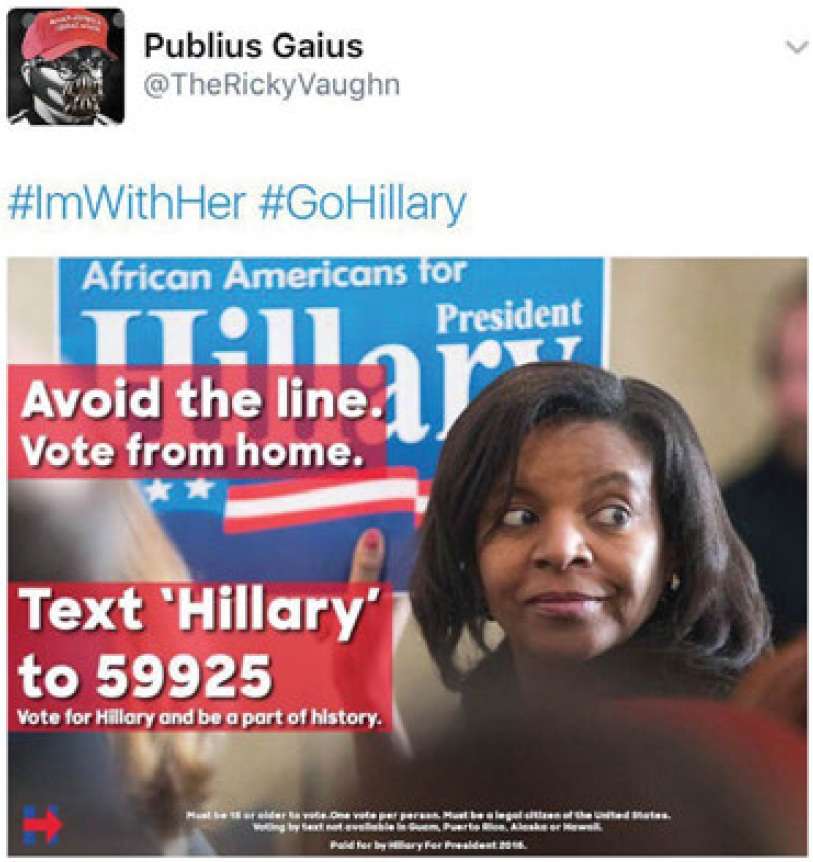
A short excerpt from today's long decision in U.S. v. Mackey by Second Circuit Judge Debra Ann Livingston, joined by Judges Reena Raggi and Beth Robinson:
On November 1 and 2, 2016, Defendant-Appellant Douglass Mackey … posted or reposted three "memes" on Twitter falsely suggesting that supporters of then-candidate Hillary Clinton could vote in the 2016 presidential election by text message. Based on these posts, a jury … convicted him of conspiring to injure citizens in the exercise of their right to vote in violation of 18 U.S.C. § 241.Mackey argues on appeal that the evidence was insufficient to prove that he knowingly agreed to join the charged conspiracy. We agree….
The parties do not dispute either (1) that Mackey posted the memes or (2) that his doing so independently would not be a crime under Section 241. Section 241 criminalizes only conspiracies between "two or more persons." As a result, the mere fact that Mackey posted the memes, even assuming that he did so with the intent to injure other citizens in the exercise of their right to vote, is not enough, standing alone, to prove a violation of Section 241. The government was obligated to show that Mackey knowingly entered into an agreement with other people to pursue that objective.
This the government failed to do. Its primary evidence of agreement, apart from the memes themselves, consisted of exchanges among the participants in several private Twitter message groups—exchanges the government argued showed the intent of the participants to interfere with others' exercise of their right to vote. Yet the government failed to offer sufficient evidence that Mackey even viewed—let alone participated in—any of these exchanges. And in the absence of such evidence, the government's remaining circumstantial evidence cannot alone establish Mackey's knowing agreement. Accordingly, the jury's verdict and the resulting judgment of conviction must be set aside….












