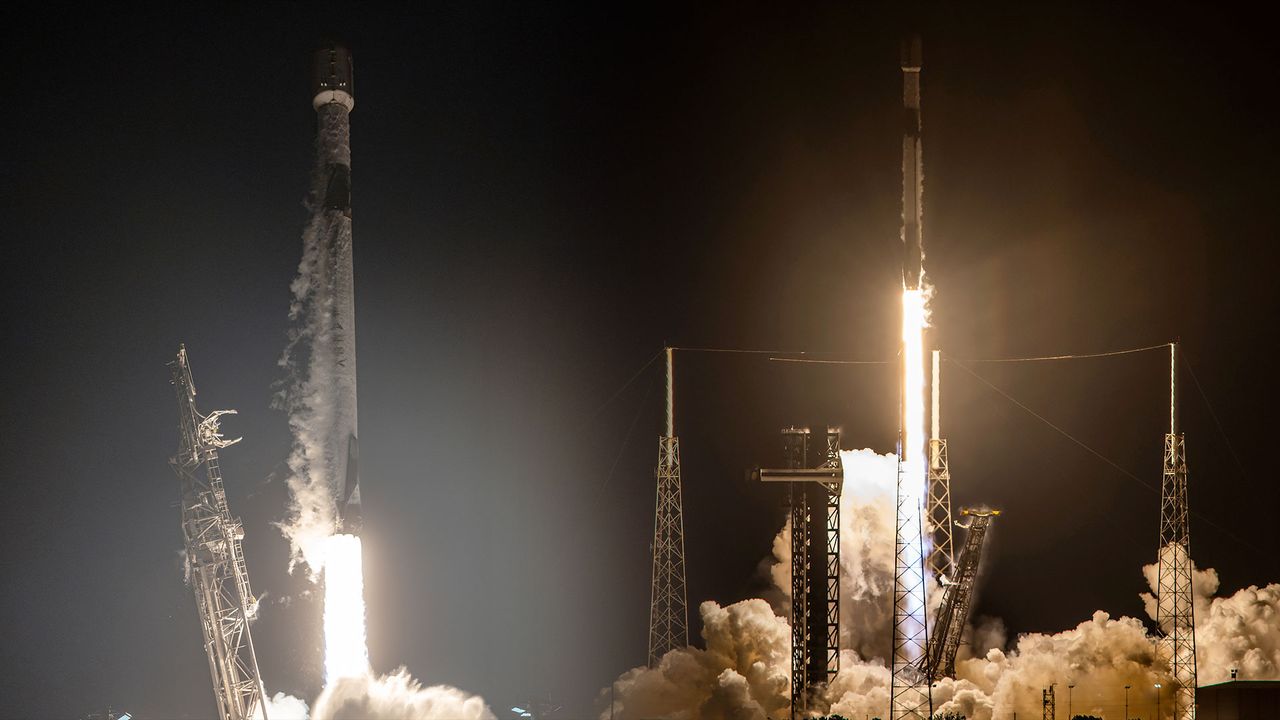
SpaceX added a 53 satellites to its Starlink megaconstellation over the course of two launches in as many days.
First up was a Valentine's Day (Saturday, Feb. 14) liftoff of 24 satellites (Group 17-13) from Space Launch Complex 4 East (SLC-4E) from Vandenberg Space Force Base in California.. The Falcon 9 rocket launched at 8:59 p.m. EST (0159 GMT on Feb. 15 or 5:59 p.m. PDT local time).
Then early Monday morning (Feb. 16), another Falcon 9 with 29 Starlink units (Group 6-103) took off from Space Launch Complex 40 (SLC-40) at Cape Canaveral Space Force Station in Florida. That liftoff occurred at 2:59 a.m. EST (0759 GMT).

SpaceX confirmed a successful deploy for both missions about an hour after their respective liftoffs.
Crew-7 | CRS-29 | PACE | Transporter-10 | EarthCARE | NROL-186 | Transporter-13 | TRACERS | NROL-48 | COSMO-SkyMed Second Generation FM3 | 11 Starlink missions
The first stages from both Falcon 9 rockets landed safely on drone ships positioned in the Pacific and Atlantic Oceans. The touchdown on "Of Course I Still Love You" on Saturday marked the completion of Booster 1081's 22nd flight. Booster 1090, which landed on "A Shortfall of Gravitas," finished its 10th reuse.
O3b mPOWER-E | Crew-10 | Bandwagon-3 | mPOWER-D | CRS-33 | 5 Starlink missions
The Starlink service provides broadband internet service to underserved areas around the world. The network, which now includes more than 9,600 active units, also enables cell-to-satellite and in-flight wifi on select providers.
Monday's launch was SpaceX's 19th Falcon 9 flight of the year and 602nd in history.