Get all your news in one place.
100's of premium titles.
One app.
Start reading
Space
Space
Science
Anthony Wood

Don't miss Jupiter and Venus meet in a dazzling conjunction tonight: Here's where and when to look

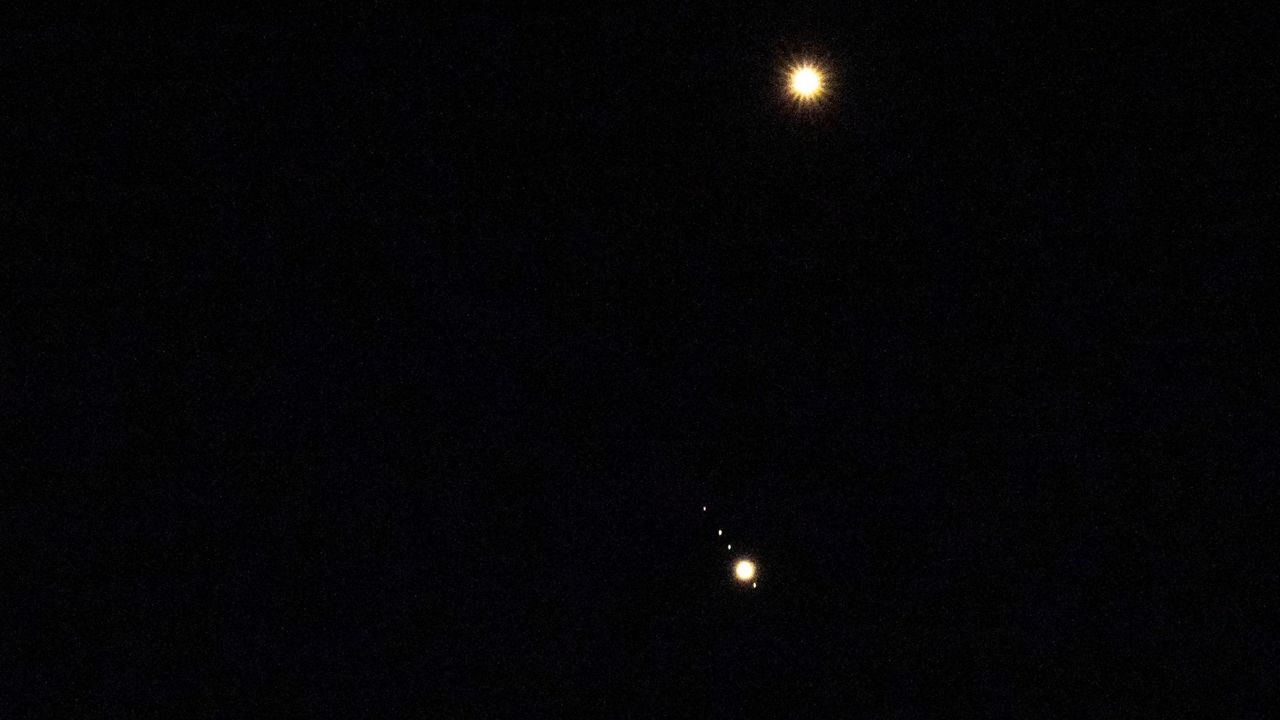
Venus is pictured shining brightly above Jupiter in a black sky. A number of small star-like objects can be seen in a line surrounding Jupiter, representing its four largest Galilean Moons.

Get ready for a spectacular sight tonight (June 9), as Jupiter and Venus make a close approach in the evening sky, while Mercury shines close to the western horizon in the glow of the setting sun.

Stargazers in the U.S. will see the bright light of Venus glowing less than 20 degrees above the horizon at sunset — roughly the width of two clenched fists held at arm's length — with Jupiter to its lower left. Mercury, meanwhile, is more challenging to spot, as it shines approximately 10 degrees below and to the lower right of the pair, requiring a clear view to the west.

Venus and Jupiter will be separated by less than 2 degrees in the night sky — close enough to share the field of view of a pair of 10x50 binoculars. You may also be able to spot Jupiter's four Galilean moons — Io, Europa, Callisto and Ganymede — appearing as tiny star-like points of light surrounding the gas giant.

The following nights will see Venus rise above Jupiter as it tracks a path toward the heart of the nearby constellation Cancer, where it will shine with the open star cluster Messier 44 — also known as Praesepe or the Beehive Cluster — on June 20.

Celestron NexStar 4SE

(Image credit: Amazon)

The Celestron NexStar 4SE is ideal for beginners wanting quality, reliable and quick views of the night sky. It's sturdily built, quick to set up and automatically locates night sky targets and provides crisp, clear views of them. For a more in-depth look at our Celestron NexStar 4SE review

Jupiter, meanwhile, will be progressively harder to spot following its rendezvous with Venus on June 9, appearing fractionally lower on the horizon with each passing night. By early July, the gas giant will be a challenge to spot in the glow of the setting sun, and won't be seen again until mid-August, when it reappears in the eastern morning sky.

Want to get a closer look at the planets? Then be sure to read our roundup of the best telescopes available in 2026. If you're a photographer, then you may also want to read our guide to the top smart telescopes for capturing the night sky, along with our picks of the most capable cameras and lenses for astrophotography.

Editor's Note: If you would like to share your astrophotography with Space.com's readers, then please send your photo(s), comments, and your name and location to spacephotos@space.com.

Sign up to read this article
Read news from 100's of titles, curated specifically for you.
Already a member? Sign in here
Related Stories
Top stories on inkl right now
One subscription that gives you access to news from hundreds of sites
Already a member? Sign in here
Our Picks
Fourteen days free
Download the app
One app. One membership.
100+ trusted global sources.