Get all your news in one place.
100's of premium titles.
One app.
Start reading
The National (Scotland)
National
David Pratt

Donald Trump’s fuelling of Falklands tensions is a dangerous ploy

Steel helmets abandoned by Argentine armed forces who surrendered at Goose Green to British Falklands Task Force troops (Image: PA)

The Argentine president’s forceful speech about recovering the “Malvinas” had Washington’s hallmark all over it, writes Foreign Editor David Pratt

EARLY in 1983, roughly eight months after the war ended, the Argentine writer Jorge Luis Borges made a now-famous – some say infamous – observation.
“The Falklands thing was a fight between two bald men over a comb,” Borges remarked, reflecting on the 10-week conflict between Britain and Argentina that claimed 907 lives.

Borges, however, was not being flippant when he made the remark, born as it was out of his disdain for the militarism and jingoistic fervour on both sides that underpinned this nasty little war in the South Atlantic.

Brief and bloody as it was, the war did mark a significant political turning point in Britain – something highlighted by one of its most fervent opponents at the time, Labour MP Tony Benn.

“We have just come to the end of an era,” was how Benn summed it up in his diaries.

His assessment proved accurate, for what followed was a realignment of the British public mood towards “Thatcherism”, a rise of mainstream jingoism and a marginalising of progressive and socialist dissenting voices.

Whether one agrees or disagrees with such an assessment, what’s certainly in no doubt is that today, 44 years on, the war over the Falklands, or Las Islas Malvinas, as Argentina calls them, still has the power to trigger passions and reshape the geopolitical landscape.

That much was evident last week as Argentina’s president Javier Milei put his country’s claim to the Falklands back at the centre of the political agenda.

To understand why Milei did so and why he chose this particular moment, the first thing to recognise is that there are lots of moving parts to this whole affair, not least Milei’s own struggling domestic approval ratings.

The Malvinas cause, after all, has always been close to the heart of many Argentinian voters, and playing a long-trusted nationalist card could serve Milei well, ahead of a difficult election next year.

“The islands are ours, they were taken from us, and they are indispensable for Argentina in the coming decades,” Milei told those same voters last Thursday in a national address. “Argentina won’t stand by with its arms crossed.”

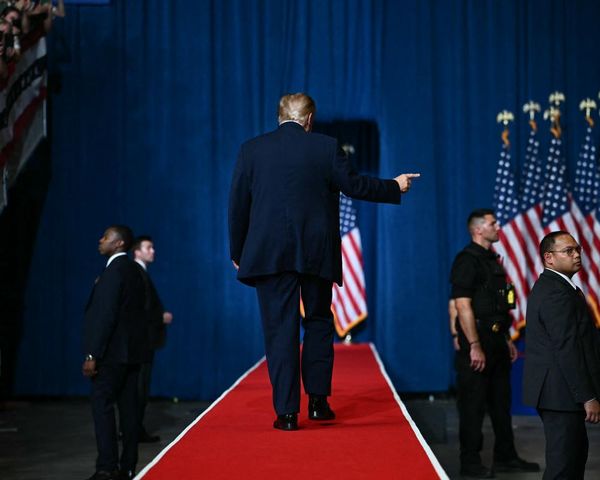
But there is another equally significant and inextricably connected factor at play here. It comes in the shape of US president Donald Trump’s favourable disposition towards Milei, as well as Washington’s renewed focus towards Latin America.

The timing is everything here, not least in the way this story unfolded last week. For his part, Milei had pre-announced his intention to hold the address earlier in the week, but coming as his televised speech did on Thursday, just hours after an exclusive interview with Trump was broadcast by GB News, it’s hard to avoid the conclusion that a degree of political orchestration was at play.

To begin with, even prior to Trump’s interview, he had initially set the hare running over the issue by telling reporters he was “reviewing” the US stance on the Falklands dispute. But by the time Trump’s full interview aired on GB News a bit later, he was explicitly casting doubt on US military backing for Britain, noting that the Falklands are “a long way away” and criticising the UK for its lack of support in America’s war on Iran.

Cue then Milei’s “Cadena Nacional” – nationwide broadcast – just a few hours later in which he claimed that the “winds of change” are in Argentina’s favour.

“There are winds of change in the world that are favourable to our claim,” Milei said in the address, highlighting Trump’s remarks.

He then vowed to deploy “all the state’s tools – diplomatic, economic, judicial and legal – to deter state and non-state actors who violated [Argentina’s] sovereignty” over the Malvinas.

“The Malvinas Islands are Argentine by history and by right; there is no question about it,” Milei stated at the start of his address, which all free-to-air channels were obliged to run, with stations compulsorily having to broadcast the transmission in its entirety.

But no sooner had Milei’s broadcast concluded than reactions from across Argentina’s political spectrum – especially opposition ranks – pointed to its content as having the Trump administration’s hallmark all over it.

Referencing General Leopoldo Galtieri, the Argentine military dictator who ordered the invasion of the Falkland Islands in April 1982, some opposition parties accused Milei of trying to “Galtierise” the issue, and warned that the islands were being used as “a bargaining chip” between the US and the UK.

“This is libertarian nationalism, with all its overreactions and delusions of grandeur,” said Hernán Reyes of Argentina’s centre-left Civica-ARI coalition party.

“There is no foreign policy, only obedience to Trump, who of course thinks of his own interests, not ours. Milei is not a credible figure.”

Miriam Bregman, of the Frente de Izquierda (Leftist Front) party and one of Milei’s strongest critics, was characteristically more forthright about the content of Milei’s address, saying that it had been “written by the Pentagon”.

Meanwhile, the left-leaning Página 12 newspaper said Milei had “swapped being a kelper” – a slang term for a native or inhabitant of the Falklands – “to become a malvinero”.

Milei, until recently an avowed anglophile and open admirer of former British prime minister Margaret Thatcher, had abandoned his long-standing admiration for her, the paper said, and had “like Galtieri, called for national unity”.

Milei’s geopolitical alignment with the United States had led him to an “unthinkable” position, Página 12 insisted.

While he had ignored the islands issue for three years, declaring his admiration for Thatcher and “support for the self-determination of a planted population”, he had now been forced by the Trump administration to set out a defence of sovereignty agenda that had never been a part of his government’s platform, Página

12 concluded.

Even Argentine war veterans like Ramón Garcés, now a political scientist, were strongly critical of Milei’s address and flagged the extent to which he believed US influence and manipulation were behind it.

Speaking to the Argentine news outlet Crónica, Garcés said that the United States “can do whatever it likes by following the Monroe Doctrine, which states that ‘America is for Americans’, because for the United States, the only Americans are themselves”.

Garcés argued that the current Argentine administration’s geopolitical shift allows a deep penetration of US military and economic interests in strategic regions like Tierra del Fuego. He went on to draw a direct comparison to other

foreign interventions, stating: “Just as it [US] entered Venezuela without asking permission to loot oil, here it does so with permission and joy because the president’s government is allowing it.”

Strong as the chorus of criticism towards Milei was, there were many too, of course, very much in the Argentine president’s camp. Some were ready to lay the blame for the latest crisis solely at the feet of the UK or see Milei and Trump’s collaboration as positive for Argentina.

Patricia Bullrich, a prominent conservative politician and head of Milei’s ruling La Libertad Avanza bloc in the Senate, blamed Britain for the heightened tensions in the dispute: “The conflict we have over the Malvinas escalated the moment the United Kingdom decided to explore for oil. This, in a disputed territory, is unacceptable. They are stealing our oil. Exploration is due to begin in December; are we going to just wait until they start?”

Others within Argentina’s politically conservative ranks were also keen to put a positive spin on Milei and Trump’s collaboration. Among these was the newspaper La Nación, which stressed that Milei’s strategy of “an alliance with Donald Trump has borne fruit”.

Trump’s hint of a change in the US stance on the islands was a reflection of Washington’s re-evaluation of the South Atlantic and “Argentina’s role as a trustworthy ally in the event of a global conflict”, La Nación concluded.

But the paper also warned of Trump’s capacity to change his mind in an instant, reminding Argentinians that “what is not known is whether the current discord [between the US and UK] will not result in sudden reconciliation, as is so often the case when Trump is involved”.

Some commentators insist that what is primarily at play here is Trump’s desire for payback and revenge – especially against the UK, which, under former prime minister Keir Starmer, declined to support the US president’s decision to go to war with Iran.

Supporting this interpretation is the claim that it is among measures drawn up by the Pentagon to punish Nato allies it believes have failed to support US interests in the Middle East war.

AS proof, observers point to an internal Pentagon memo leaked in April that already raised the prospect of using a review of the stance on the Falklands as an instrument of diplomatic pressure on alliance partners.

According to Reuters reporting then, based on an internal email, the proposal formed part of a wider review of US diplomatic support for European “imperial possessions”, conceived as a way to penalise allied governments regarded as insufficiently supportive of the military campaign against Iran.

This was followed up by UK press reports last week, citing a senior Pentagon official saying Britain would receive “special attention” in the US review of burden-sharing within the alliance, “because it has so much potential”, and that efforts would continue to “incentivise and enable the UK to step up in a major way”.

Some Latin American regional analysts, however, say this might only be part of the explanation for Trump and Milei’s latest cosiness.

The current US administration has long viewed Milei as a regional “friend”, and Argentina has essentially integrated its economy into the US sphere to isolate America’s rivals, particularly China.

The region is also of key interest to a US president driven by the contest for access to valuable natural resources that one Financial Times commentator described as “Trump’s new ‘great game’: mining, mapping and mercantilism”.

Recent US moves over Panama and Venezuela bear this out and Washington is keen to foster closer security and political co-ordination with right-leaning governments in countries like Argentina, Ecuador and El Salvador.

Adding to the Trump-Milei pact is, of course, concern and interest in the fact that the Falklands’ first commercial oil project, the Sea Lion oil field, which lies north of the islands and holds an estimated 1.7 billion barrels of oil, is set to start production in 2028.

This will be led by the Israeli company Navitas alongside its British partner, Rockhopper. Milei has claimed the project violates a UN call for neither Argentina nor the UK to take unilateral action in the territory.

“If we do not act firmly and swiftly today, in a few months, they will have the material capacity to seize the oil reserves that lie beneath our sea,” Milei said in his national broadcast last week.

All this focuses the minds of the Trump administration, which has one eye on resources as well as greater control over the South Atlantic, whose proximity to Antarctica and the Magellan Strait gives it strategic importance.

To that end, Argentina is actively building a large Integrated Naval Base in Ushuaia, Tierra del Fuego, aiming to transform the city into the most critical logistics hub in the region.

In Milei’s address, he also announced a major budget injection for this via an emergency decree to accelerate the long-delayed project, reinforcing telecommunications and naval capabilities.

Milei has strongly framed the base as a strategic partnership with the US to secure the South Atlantic and counter Chinese influence in the region, something Washington welcomes.

While Argentine officials are at pains to stress that the base will remain strictly under their sovereignty and operation, some security analysts seriously doubt it will be that clear-cut and a US military presence is almost certain, at least under

Milei’s watch.

As it currently stands, Washington’s official position over the Falklands, and held for decades, is supposedly one of neutrality on sovereignty while recognising British administration of the territory.

Should Trump decide to make a reversal on America’s position, it would represent a huge diplomatic blow for the UK and what remains of its so-called “special relationship” with the US.

But with US engagement in Latin America deepening by the day for economic and strategic reasons, Trump might think such a move is worth making. Should he do so, it certainly comes with risks and an unpredictable outcome.

Sign up to read this article
Read news from 100's of titles, curated specifically for you.
Already a member? Sign in here
Related Stories
Top stories on inkl right now
One subscription that gives you access to news from hundreds of sites
Already a member? Sign in here
Our Picks
Fourteen days free
Download the app
One app. One membership.
100+ trusted global sources.