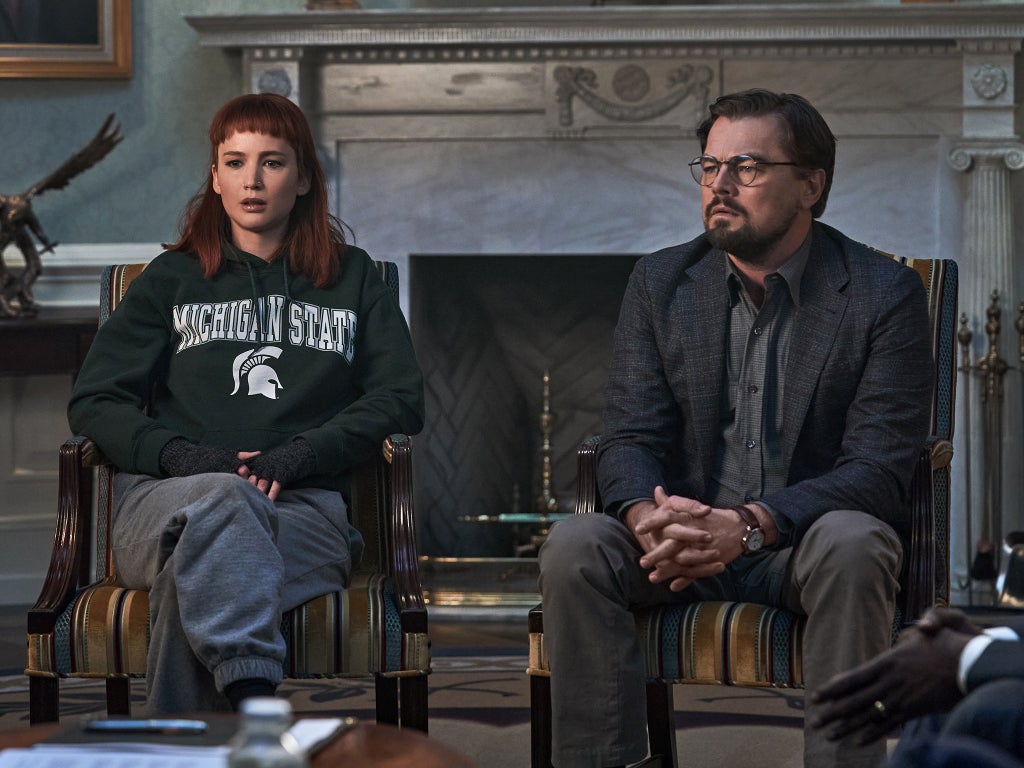
If you saw Don’t Look Up when it was released on Netflix last Christmas, I have some surprising news for you. There is a very good chance that since you last watched the film, director Adam McKay has surreptitiously edited the name “Bob Monkhouse” into his timely satire about hope and despair at the end of the world. The inclusion of a gag by the urbane stand-up genius and British TV icon isn’t the main reason the film deserves to win Best Picture at this Sunday’s Oscars, but it surely has to count in its favour. Would Licorice Pizza have been more fun if at some point Cooper Hoffman had turned to the camera and said: “They laughed when I said I was going to be a comedian. They’re not laughing now”? Of course it would.
Monkhouse earned his belated Don’t Look Up credit thanks to another of his perfectly crafted epigrams: “I want to die peacefully in my sleep like my grandfather, not screaming in terror like his passengers.” When the doomsday comedy was unleashed on the world, that apposite line appeared on-screen credited to American author Jack Handey, who promptly wrote to McKay to tell him the joke wasn’t one of his. It turns out that in the midst of making a film that’s in part about the spread of mass stupidity through online misinformation and distraction, McKay had made one of the oldest school boy errors on the internet: believing something he read on a quote site. Earlier this month, the director revealed in an interview with the World Economic Forum’s Radio Davos – which sounds like a satirical invention, the sort of elitist podcast that should be interviewing Don’t Look Up’s softly-spoken tech villain Peter Isherwood – that he’d fixed his blunder by quietly nipping into the back end of Netflix. “The one nice thing with streaming is we were able to just flip it,” said McKay. “Jack Handey was happy, and hopefully the Monkhouse estate is proud.”