The U.S. military has a range problem. None of the tactical aircraft used by the U.S. Air Force, Navy and Marine Corps can fly far enough, with a useful payload, to take off from major U.S. bases and strike the most urgent targets in the likeliest war zones without the help of a lot of vulnerable aerial tankers.
The Pentagon’s sharpening focus on possible conflict with China has only underscored this tyranny of distance. The big American air bases in Guam and Okinawa respectively are 2,000 and 1,300 miles from the disputed Spratly Islands in the South China Sea.
The U.S. Marine Corps, for one, is trying hard to cross this vast expanse. The amphibious branch plans to send young Marines on risky missions setting up quick-and-dirty airfields on small islands, many hundreds of which dot the western Pacific Ocean.
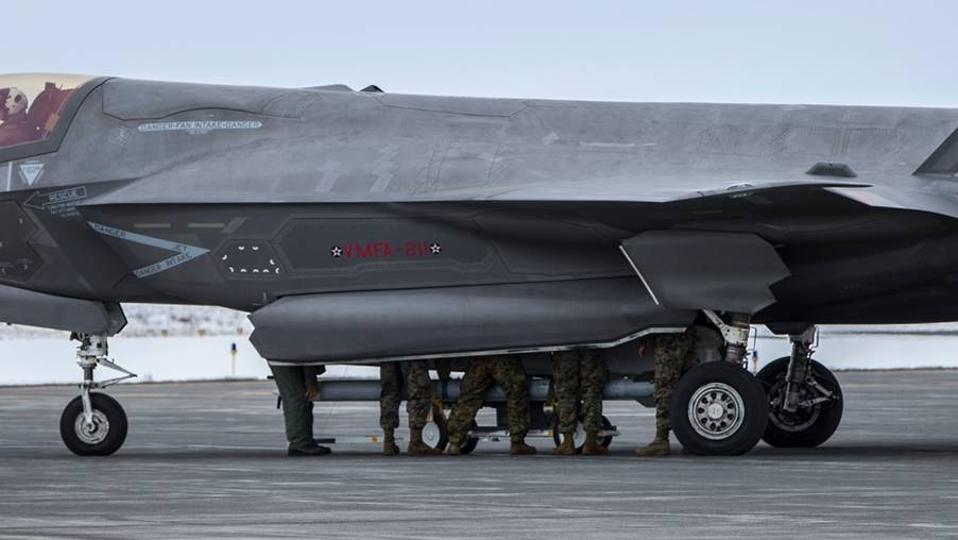
The impromptu air bases would function as temporary refueling and rearming stops for the Corps’ F-35 stealth fighters, hopefully allowing the short-legged jets to travel farther than builder Lockheed Martin intended.
Marine Fighter-Attack Squadron 211 and its parent 3rd Marine Aircraft Wing rehearsed this long-range-strike technique starting late last month as part of Exercise Winter Fury ’22. “We’ve got to find every advantage we can out there,” said Lt. Col. Andrew D’Ambrogi, commander of VMFA-211, an F-35B jump jet unit in Yuma, Arizona.
Thirty years ago this method of projecting air power might not have been necessary in some scenarios. The Marines operated subsonic A-6 attack planes that could haul a useful bomb load a thousand miles on a single tank of gas. The supersonic F-35 can fly only half as far.
The recent exercise revealed how a lot of Marines, working together, can stretch the F-35’s legs. It all started on Jan. 31, when a California-based Marine infantry company flew in a gaggle of V-22 tiltrotors to Grant County Municipal Airport in snowy Moses Lake, Washington.
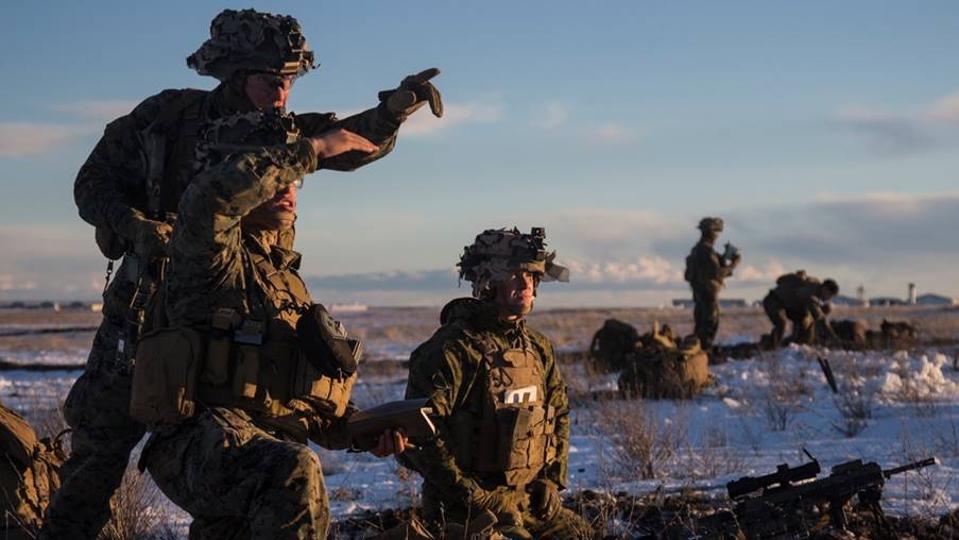
The infantry took control of the airfield and set up a security perimeter, making it safe for personnel from Marine Wing Support Squadron 373 to deploy. The support troops brought along aviation fuel, refueling gear and AIM-120 air-to-air missiles.
The F-35Bs took off from Yuma, topped off their tanks from Marine KC-130 tankers then flew the roughly 1,200 miles to Moses Lake, where they refueled, loaded up a pair of AIM-120s each and flew back to Yuma—fast enough, planners hoped, to dodge a retaliatory missile barrage.
“There’s enough threats out there that what it really comes down to is time-criticalness—how much time I can spend in one location,” D’Ambrogi said. The idea is for Marines to jump from island to island, setting up new airstrips faster than the enemy can find and attack them.
The Marines aren’t assuming they’ll always avoid incoming rockets. They might have to take a few hits and keep working. As part of Winter Fury ’22, the 3rd MAW blew up an unused part of the airport tarmac—then repaired it.
It’s possible for an F-35B with its downward-blasting lift engine to use a damaged runway, of course. “I don’t need a whole lot of distance to take off from,” D’Ambrogi said. An F-35B, in theory, can launch and land vertically, although that burns a lot of gas. It’s better to use a few hundred feet of runway.
There are a lot of moving parts in these temporary airfield ops. Infantry, support troops and V-22, KC-130 and F-35 aircraft—and their crews, of course. Leapfrogging F-35s across pop-up airstrips, right ahead of enemy missiles attacks, is a daunting command challenge.
“It’s not so much how it’s designed, it’s the human element in command—and understanding who needs to know what and when,” D’Ambrogi explained.
The standard right now is to set up and use a new airstrip within 72 hours of the word “go,” D’Ambrogi said. But, he added, 3rd MAW probably could do better in a crisis. “We can tighten that up pretty good.”