Get all your news in one place.
100's of premium titles.
One app.
Start reading
Euronews
Euronews
Gavin Blackburn

Doctors Without Borders slams 'deliberate' Russian destruction of Ukraine's hospitals

Doctors Without Borders (MSF) condemned what it called Russia's "deliberate strategy to destroy the healthcare system" in Ukraine on Monday, documenting a consistent pattern of attacks throughout the war.

MSF said that between April 2022 and December 2025, it had documented more than 20 attacks on facilities associated with the medical charity.

Russia has launched "relentless attacks on healthcare facilities and medical staff in Ukraine," MSF said in a statement.

These "appear to constitute a deliberate strategy to destroy the healthcare system and collectively punish the population, rather than being an incidental consequence of Russia's invasion," it said.

The World Health Organisation (WHO) recorded 2,815 attacks on healthcare in Ukraine between the February 2022 full-scale invasion and the end of 2025, with the vast majority involving violence with heavy weapons, and 2,319 attacks impacting facilities.

The totality of the attacks resulted in 224 deaths and 902 injuries, the WHO said, which records attacks but does not attribute blame.

Medics help a woman take a seat inside the MSF medical train in Pokrovsk, 14 February, 2023 (Medics help a woman take a seat inside the MSF medical train in Pokrovsk, 14 February, 2023)

Meanwhile, Ukraine's health ministry says that Russian forces have damaged or destroyed more than 2,500 medical facilities during that same period, with 327 completely destroyed.

"These attacks are too consistent, too frequent and too precise to be accidental," Robin Meldrum, MSF's country coordinator in Ukraine, said in the statement.

"When hospitals are struck repeatedly, when ambulances are targeted with precision drones, when medical workers are killed whilst en route to delivering medicines in clearly marked vehicles - this is no coincidence.

"This is a pattern; patterns are driven by intent."

Rising drone attacks

Attacks on medical infrastructure have created a crisis in access to healthcare for people needing non-emergency treatment or treatment for chronic conditions, MSF said.

The medical humanitarian organisation said this directly translated into suffering and even death from manageable conditions like cardiovascular disease, diabetes and epilepsy.

Healthcare facilities that remain operational are severely understaffed, with the number of doctors in an MSF-supported hospital in Kherson falling by 66% since 2022.

Meanwhile MSF teams in eastern and southern Ukraine are working under the "constant threat" of First-Person View (FPV) drone attacks, which allow operators to identify and strike targets with precision in real time.

Rescue workers try to put out a fire of a residential building burning after a Russian drone attack on Zaporizhzhia, 12 July, 2026 (Rescue workers try to put out a fire of a residential building burning after a Russian drone attack on Zaporizhzhia, 12 July, 2026)

It said that on 29 September last year, a nurse and a director from an MSF-supported health centre were struck by a Russian FPV drone in Lyman as they delivered medicines in a clearly marked vehicle.

The non-governmental organisation said its medical staff near the front line were witnessing how drone warfare is rapidly outpacing the medical response.

"Whereas injuries were once predominantly caused by artillery, drone strikes now account for a growing proportion of trauma cases," it said.

These attacks result in multiple victims with multiple simultaneous wounds, higher infection rates and rising rates of sepsis, it added.

MSF called on all parties to uphold their obligations under international humanitarian law and urged states with influence over Russia to demand an end to attacks on health facilities.

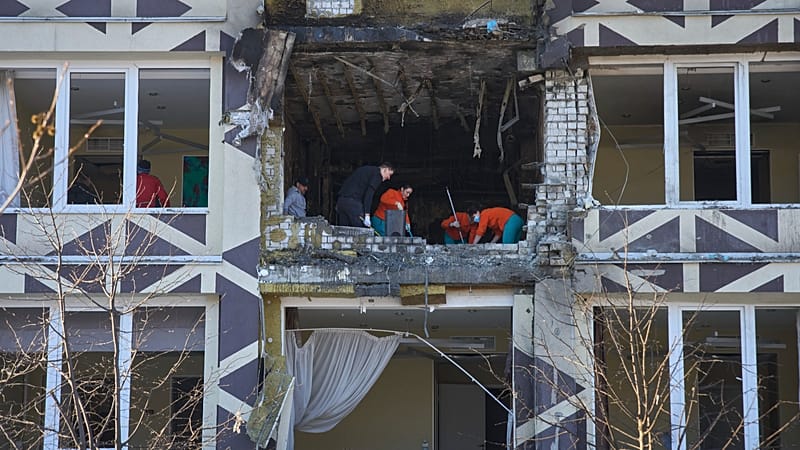
Rescuers evacuate a resident from an apartment building destroyed by a Russian drone attack on Zaporizhzhia, 12 July, 2026 (Rescuers evacuate a resident from an apartment building destroyed by a Russian drone attack on Zaporizhzhia, 12 July, 2026)

It also called on the UN Security Council to investigate and publicly condemn attacks on healthcare.

MSF had the equivalent of 414 full-time staff in Ukraine in 2024, with a budget of €15.6 million.

It carried out 75,400 outpatient consultations and 1,150 surgical interventions.

Sign up to read this article
Read news from 100's of titles, curated specifically for you.
Already a member? Sign in here
Related Stories
Top stories on inkl right now
One subscription that gives you access to news from hundreds of sites
Already a member? Sign in here
Our Picks
Fourteen days free
Download the app
One app. One membership.
100+ trusted global sources.