Get all your news in one place.
100's of premium titles.
One app.
Start reading
Golf Monthly
Golf Monthly
Sport
Michael Weston

Do You Know The Stories Of Augusta National's Three Famous Bridges?

Famous golf bridges Augusta.

Augusta National is a bit like Disneyland in the sense that it's hard to know where to head to first when you arrive and make your way through the gates for the very first time.

It's a club with a long and storied history, many of which still give us a lot of great pleasure despite having heard them many times before.
Do you head (remember, don't run) straight to Amen Corner? Do you put your chair down by the side of the 1st tee? Maybe you should visit the famous Masters shop without delay.

Or do you go landmark spotting?

On the list, there are several to tick off: Ike's Pond, Record Foundation, Par 3 Fountain, Arnold Palmer Plaque, Founders Circle, Magnolia Lane, and Jack Nicklaus Plaque.

And, of course, we also have three famous bridges - and you cannot visit the Masters without viewing Hogan, Nelson, and Sarazen.

If, like me, you've been watching the Masters for several decades, taking in the view of these historical landmarks is a pinch-me moment - and well worth several photographs (just not during competition days, obviously).

Hogan Bridge

Tiger Woods crossing the famous Hogan Bridge (Image credit: Getty Images)

Hogan Bridge, which takes golfers to the famous 12th green, crosses over Rae's Creek, and is one that players always hope to walk across with a smile on their face, having successfully avoided the water.

The plaque at the foot of the bridge says: "This bridge dedicated April 2, 1958, to commemorate Ben Hogan’s record score for four rounds of 274 in 1953. Made up of rounds of 70, 69, 66 and 69, this score always stands as one of the very finest accomplishments in competitive golf and may even stand for all time as the record for the Masters Tournament."

Nelson Bridge

Caddies have to have their wits about them when crossing Nelson Bridge (Image credit: Getty Images)

Nelson Bridge is of course named after another great, Byron Nelson, who won the Masters in 1937 and 1942.

Located in a remote part of Amen Corner, it offers wonderful views of the 11th and 12th holes and leads players to the par-5 13th, the final step of this famous and much-loved three-hole stretch.

The plaque at the foot of the bridge says: "This bridge dedicated April 2, 1958, to commemorate Byron Nelson’s spectacular play on these two holes (12-13) when he scored 2-3 to pick up six strokes on Ralph Guldahl and win the 1937 Masters Tournament. In recognition also to Guldahl, who came back with an eagle 3 on 13 to gain winning position in 1939."

Guldahl finished runner-up at Augusta National in 1937 and 1938.

Sarazen Bridge

Scottie Scheffler walks across Sarazen Bridge to the 15th hole green (Image credit: Getty Images)

Gene Sarazen hit a shot so special en route to winning the Masters in 1935 that they built a bridge to honor it.

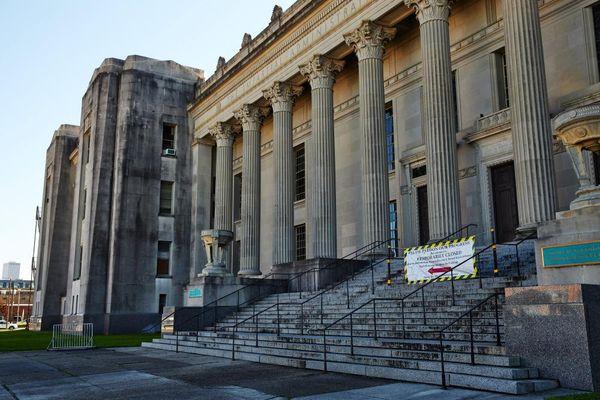
Located close to the 15th green, the plaque reads: "Erected to commemorate the 20th anniversary of the famous “double eagle” scored by Gene Sarazen on this hole, April 7, 1935, which gained him a tie for first place with Craig Wood and in the play-off won the second Masters Tournament. Dedicated April 6, 1955."

Here's a fuller version of the story: Sarazen was trailing Wood by three. Arriving on the 15th, he desperately needed something special.

His second shot on the par 5 was that moment of magic, and would become known as "the shot that was heard around the world".

Left to right: Gene Sarazen, Bobby Jones And Chairman Clifford Roberts At The Sarazen Bridge Dedication Ceremony In 1955  (Image credit: Getty Images)

With his ball 235 yards from the hole, Sarazen struck a 4-wood, the ball landing on the green before rolling into the hole for an albatross.

Wood’s advantage was wiped out, and that left the two to fight it out over a 36-hole play-off, which Sarazen won, making him one of just three players to this day who won The Masters on debut.

Sarazen Bridge, which spans the pond in front of the 15th green, was designed by architect H. Lowrey Stulb and, on 6 April 1955, was named in honor of what remains one of the game's most extraordinary moments.

Sign up to read this article
Read news from 100's of titles, curated specifically for you.
Already a member? Sign in here
Related Stories
Top stories on inkl right now
One subscription that gives you access to news from hundreds of sites
Already a member? Sign in here
Our Picks
Fourteen days free
Download the app
One app. One membership.
100+ trusted global sources.