
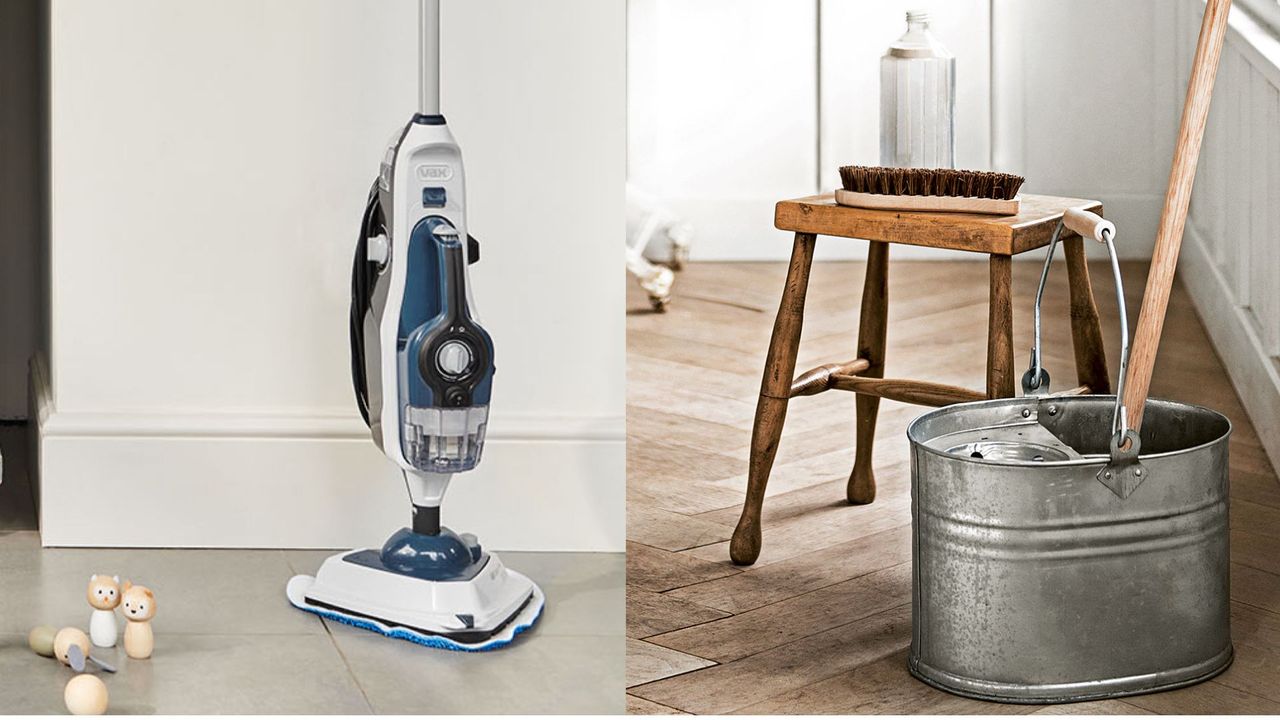
Until quite recently, if you wanted to give your hard floors a 'proper clean', there was only one thing to reach for – your trusty old mop and bucket. And for many, this remains the go-to option for eliminating muddy footprints, spilt drinks and sticky jam patches from kitchen floors. If it ain't broke, as the saying goes...
But the best steam cleaners now promise too much for us to ignore them. They claim to melt away grime using little more than tap water and without any backbreaking scrubbing. No bucket, no waiting for the kettle to boil, no wringing, slopping and sloshing, and no pond-deep puddles left behind. They vow to sanitise, refresh and generally make your floors look like new, all with little to no detergent.

But does high-temperature steam truly outshine good old-fashioned elbow grease, or is the mop still the unsung hero of everyday spills? Are steam cleaners really worth it? It's time to clear the floor and settle the matter with the help of three cleaning experts.
Steamer cleaner vs mop: Which is more hygienic?
We put this question to our experts, and all agreed that steam was more hygienic as a cleaning solution. "Traditional mopping relies on water, detergent and physical agitation to remove dirt, which works well for routine cleaning, while steam adds the benefit of heat-based hygiene," says Atit Chopra at Beldray.
"Steam cleaners are often considered more hygienic because they use high-temperature steam to sanitise surfaces, rather than relying solely on water and cleaning solution," Atit continues. "Steam is typically emitted at temperatures of around 100˚C at the nozzle, which is hot enough to kill common household bacteria and germs without the need for chemical disinfectants."
"Unlike mopping, which can spread dirty water around, steam cleaners use fresh water from an internal tank to produce hot steam, effectively sanitising a variety of surfaces to provide a reassuring, antibacterial clean," agrees Colton Faddis at Vax.
"Using a steam cleaner also has the additional benefit of a quick dry time once you are finished cleaning, helping to protect against the re-growth of bacteria," he adds. "This may not always be possible when using a mop and bucket." We found this to be a huge benefit while testing steam cleaners.

Karcher cites independent scientific tests by cleaning equipment experts on its website, which say: "when used properly on hard surfaces, steam cleaners can eliminate up to 9.999% of enveloped viruses (such as flu or coronavirus) and 99.99% of common household bacteria during cleaning."
And because steam particles are so teeny tiny, and are blasted out with such force, they can get into the nooks and crannies that mops and cloths can't.
However, we'd caveat that when you use a standard mop, you can use the sanitising chemicals of your choice, including disinfectants. Some steam cleaners will allow you to add anti-bacterial cleaning solutions to their water tanks, but you may be limited to the manufacturer's own-brand products, which are generally more expensive.
It's worth noting how excited we are to test the new DysonPencilWash Vacuum to see if you really can have the best of both worlds.
Steamer cleaner vs mop: Which is better at cleaning?
If you're looking at cleaning the house both quickly and properly, you will have two big concerns – cleaning power and budget. So let's start with cleaning power. And here, a steam cleaner undoubtedly comes out on top.
"A steam cleaner is more effective at breaking down stubborn grime. The combination of heat and moisture helps to soften dried-on spills, grease and sticky residues much faster than cold or warm water alone," says Atit.
"The microscopic steam particles penetrate porous surfaces and grout lines, which can be more difficult to reach with a standard mop. Because the steam is delivered under pressure, it helps dislodge dirt from textured flooring, tiles and sealed hard floors more efficiently, often reducing the need for repeated passes."
Another bonus of a steam cleaner is that, unlike mops, "Steam cleaners are ideal for those homes where the floors are sealed. Hard floors, including tiles, laminate and vinyl flooring can be cleaned with steam," says Colton. "Plus, steam cleaners may be used for cleaning carpets if lightly soiled. That said, for a deeper clean, we would recommend using a carpet cleaner."

Our edit of the best steam cleaners

This is the steam cleaner that will leave every spot in your home sparkling. It comes with 17 attachments – a nozzle for cleaning the hob, a scrubbing brush, a window tool and even a glider to steam carpets. Again, I'm testing this at the moment, and I am loving its versatility.

Inexpensive, but nevertheless effective, this gave impressive results in our tester's home. At this price, don't expect handheld functions or myriad attachments – but you do get a decent floor cleaner with a quick 30-second heat-up time and a glider so you can use it on

Perfect for polishing your floors and getting into the grout, the Karcher comes with plenty of accessories that will do your deep cleaning for you. The flexible mop pads are brilliant at lifting dirt and drying floors and we found the slim accessories to be very satisfying when cleaning the bathroom.
Steamer cleaner vs mop: costs
After cleaning power, it's likely budget is going to be your next biggest consideration. And here, perhaps expectedly, mops win hands down. You can pick up a basic mop and bucket for £15 or less. That said, handy features like a pedal-operated spin feature that helps you wring the mop head are worth paying a little more for.
Even a decent budget steam cleaner will set you back £30 plus, and for an all-singing and dancing model (detachable handheld, oodles of tools or lots of power), you're looking at paying between £150 and £400.

Steamer cleaning vs mopping: how quickly can you start cleaning?
If you’re in a hurry and want to hit the floor fast, a mop will likely get you there first. Fill your bucket with water, throw in some detergent, wring out and get going. You could slow yourself down if you plan to use boiling water from the kettle, but otherwise, it's all pretty quick.
With a steam cleaner, you'll need to plug it in, fill the water tank, and then wait it until it produces steam. Depending on the model, that last step can take a few minutes.
But once you get going with a steam cleaner, you'll be able to clean on without any wringing out. As you're not exposing the cleaning pad to dirty water, it's also likely you'll have to change the water less often.
In conclusion, a mop might get you there a little bit faster, but will take longer to tackle the job. And if you find a steam cleaner that's quick to get going, it's a win-win. "A steam cleaner with a rapid heat-up time is perfect for busy homes," says Colton. "Our VAX Steam Fresh Total Home takes only 30 seconds to heat up and allows you to kill 99.9% of bacteria whilst cleaning."
Steamer cleaner vs mop: Which is easiest to use?
When it comes to ease of use, steam cleaners generally take the edge over traditional mopping, but any winner depends on what you mean by 'easy to use'.
Steam cleaners are straightforward to handle once you’re set up. You fill the tank with water (and maybe a drop of detergent if allowed), wait a few minutes for it to heat up, and then simply guide the machine over the floor.
There’s no need for buckets, wringing, scrubbing or dealing with dirty mop water. Plus, many models are lightweight and simple to manoeuvre. If lifting a heavy bucket of water to and from the sink is a struggle, a steam cleaner makes a lot of sense. Steam mops tend to be corded, so you don't need to worry about charging times, but they may be a little heavier to lug from their storage space.
Mopping is ultra-simple in concept: dip, wring, swish, repeat. But in practice, it can feel more labour-intensive. Carrying and emptying buckets, changing water when it gets grimy, and wringing out a heavy mop can be physically tiring and a bit messy. And if you like to use super-hot water, you may want to wait for the kettle to boil several times. Unless, that is, you have a boiling water tap.
"For steam cleaners, I love something lightweight with a good swivel head, so you can glide around the kitchen and hall without straining. I use it on days when I want a quick, hygienic refresh," says professional cleaner Lynsey Crombie.
"For manual mops, I’m a fan of microfibre flat mops," Lynsey adds. I pair them with my favourite floor cleaner, and they tackle grime like a pro. Plus, I can use them on any surface, including those tricky corners that steam cleaners just can’t reach."
Steamer cleaner vs mop: Which is more environmentally friendly?
Not surprisingly, our experts from both Beldray and Vax Steam cleaners believe their steamers provide an eco-friendly alternative to traditional cleaning methods.
"From an environmental perspective, steam cleaners primarily use water to clean and sanitise surfaces, which can significantly reduce the need for chemical floor cleaners and single-use plastic bottles," says Atit at Beldray.
"The amount of water used by a steam mop also tends to be less than what you would use with a mop and bucket," adds Colton. "This gives the added benefit of a quick dry time, meaning busy home life can resume in no time at all. Plus, with a traditional mop and bucket, dirty water and mess can be spread around which there is no need to worry about with a steam cleaner".
"In addition, steam cleaners tend to come with washable microfibre pads which are used to remove dirt and grime. As these can be reused, this reduces the amount of waste produced from alternatives such as disposable mop pads or kitchen roll."
But mops don't use any electricity and, if they have a metal or wooden handle, are more easily recycled. These days, even most manual mops come with replaceable parts so you don't need to replace the whole thing each time the head wears out. So it's maybe not as clean cut (excuse the pun) as you'd imagine.
Steamer cleaners vs mopping: What detergents can you use?
One of the joys of steam cleaners is that because the steam kills bacteria through its intensity of heat, you don't technically need anti-bacterial or industrial cleaning products. However, some people still like to use them, especially to make a room smell fresh. Which can be an issue.
"With steam cleaners, you’re often limited in what cleaning products you can use," says Lynsey Crombie. "Most recommend just water, or a tiny splash of a mild floor cleaner. If you love a specific floor detergent, you might find steam cleaning a bit restrictive."
If you decide to use a non-recommended detergent in your cleaner, you run the risk of voiding your guarantee, too.

"Manual mops give you freedom to use whatever cleaner works best for your floors from my go-to multi-surface sprays to those specialist floor solutions I swear by," says Lynsey.
Some steam cleaners do offer the option to combine the cleaning power of hot steam with a solution. "This can help to break down grease and grime more effectively than steam alone," says Colton. "Our VAX Citrus Burst Steam Cleaning Solution removes odours, leaving your home smelling fresh and hygienically clean." But do expect to pay more for them than an off-the-shelf supermarket option.
Are there any other ways that steam cleaners beat mops?
There are plenty if you ask Colton Faddis, Product Manager at VAX UK, especially if you buy one that can be converted into a handheld cleaner.
1. You can clean more surfaces with steam cleaners versus a mop
"A mop tends to be limited to mopping hard floors, whereas depending on the model you buy, a steam cleaner can be fitted with tools and attachments that increase its versatility in the home," says Colton. "These can be used to clean and kill bacteria on other types of surfaces, including bathroom and kitchen fittings and appliances."
"Cleaning pads should come with your steam cleaner as standard to steam clean hard floors and surfaces," he continues. "Some models will include heavier-duty cleaning pads for when you need to tackle dried-on stains and messes, and others can sometimes include a carpet glider to lightly refresh carpets and rugs.
If you want a versatile steam cleaner to clean more than just floors, look for models that include tools for cleaning upholstery, windows, tile grout and more. "You may find nozzles and hoses that can help you clean all manner of above-the-floor areas, such as removing smears from taps or the shower head, deep cleaning grime from inside the oven on top of the hob," says Colton.
Just be aware that there are certain things you should never use a steam cleaner on, before you get too carried away with your new gadget!

2. Steam cleaners are great if your have children and/or pets
"As steamers can be used with water alone, they are ideal for removing grime from floors and sanitising surfaces without the need for chemicals. This can be beneficial in homes where a family member or pet can be sensitive to chemicals," says Colton.
"Pet owners and those with young children may prefer to use a steam cleaner because there is no need to use detergent when using high temperature steam to remove dirt, sanitise highchairs and play areas,' says Colton. "This makes it safer for young children who can put toys and hands in their mouths."
3. You'll have less waiting around once cleaning is complete
"Another benefit of a steam cleaner is the faster drying time, due to controlled moisture release," says Atit. 'As well as the ability to neutralise odours by targeting the bacteria that cause them."
Steamer cleaner vs mop: The verdict
Before we suggest our winner, we'll let our experts give their opinion. "Honestly, it depends on what you’re cleaning," says Lynsey. "A steam mop is amazing for quick, hygienic cleaning, especially on hard floors like tile or sealed wood. The steam sanitises and lifts dirt without much effort, perfect if you’ve got kids, pets, or just don’t want to bend over scrubbing."
"I find a manual mop, on the other hand, more versatile. You can reach into awkward corners, under furniture, and control exactly how much elbow grease you use," she tells us. "For tough stains or sticky spills, nothing beats a manual mop. I often use both: steam for a speedy freshen-up and my trusty manual mop when I need that extra deep clean."
"Many households find that using both a mop for everyday cleaning and a steam cleaner for deeper sanitising offers the best of both worlds," adds Atit.
And that's what we'd suggest. While a steam cleaner is undoubtedly a time-saver and super hygienic, we'd always have a mop for those behind-the-loo cleans and 'just in case' scenarios. After all, what are you going to do if there's a power cut?!