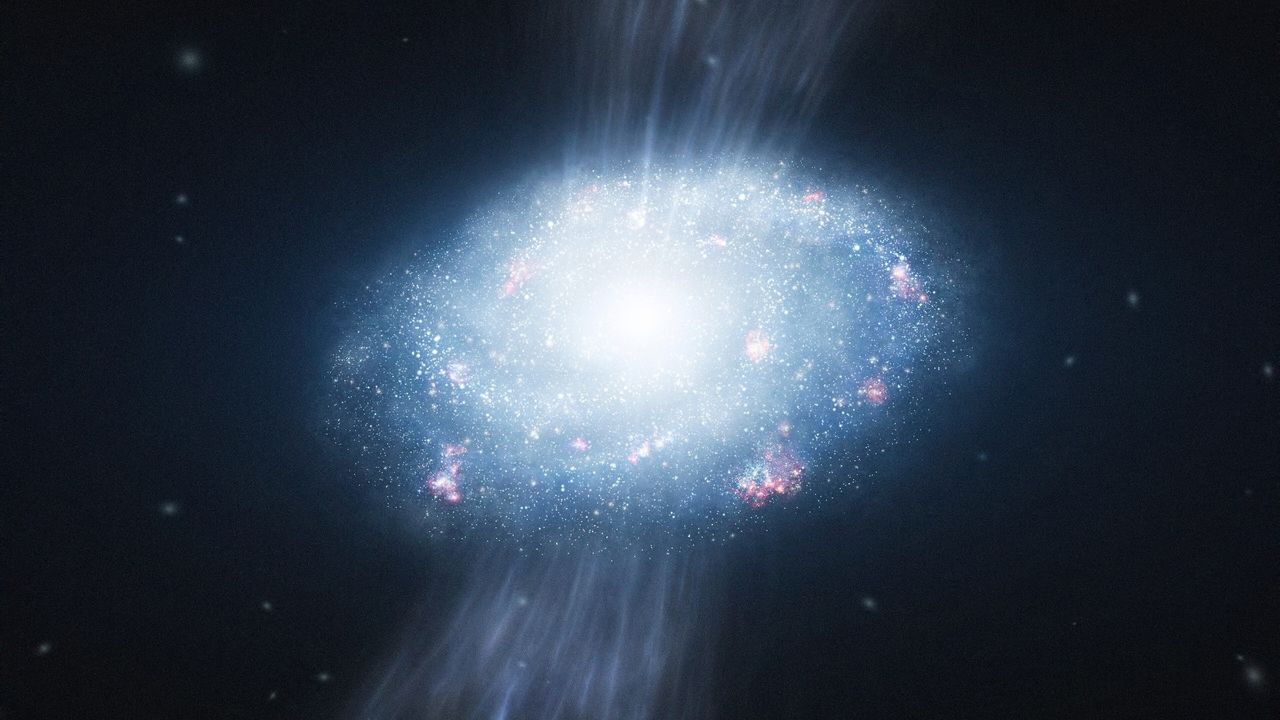
Galaxies don't grow forever. At some point, even the most prolific star-forming galaxies start to slow down, then stall, then settle into a long quiet retirement. Astronomers have known about this transition for a long time, but we haven't had a clean physical explanation for why it happens, and why it happens at the particular mass scale that it does.
A new paper led by Preetish Mishra of the Korea Institute for Advanced Study, along with an international team of scientists, makes a clear and testable proposal: that the slowdown in galaxy growth is caused by the birth of a stable cloud of hot gas surrounding the galaxy, and that cloud forms at a very specific mass: roughly 10^12.5 solar masses. Above that threshold, galaxies stop being efficient stellar factories, no matter how much raw material they have on hand.