Get all your news in one place.
100's of premium titles.
One app.
Start reading
Digital Camera World
Adam Juniper

DJI Osmo 360 II review –hands on with the latest 360° camera to enter the battle

DJI Osmo 360 II.

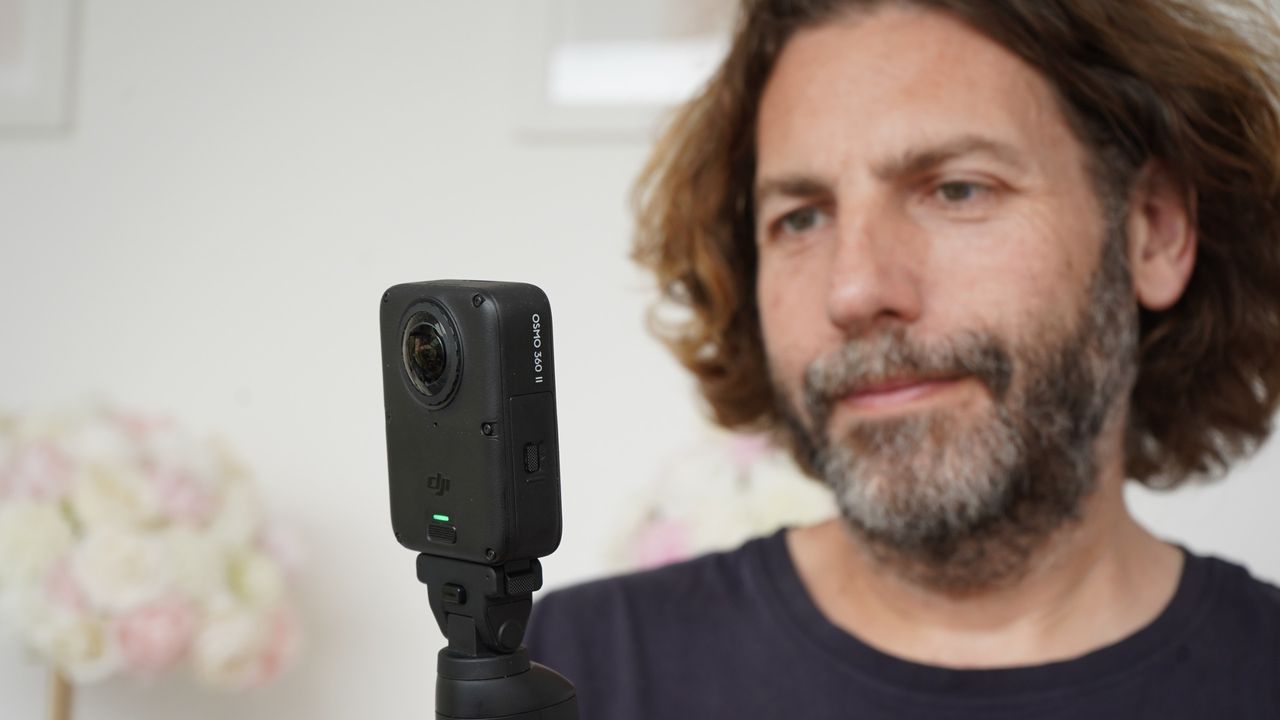
DJI's second offering in the 360-degree camera space is hot on the heels of arch-rival Insta360's X6. In theory DJI is still playing catch up – the X6 represented a 10th anniversary – but this camera has specs which could turn the eye of any 360-degree creator, not least the 10-bit recording across all modes and 1-inch image sensor.

Bringing the same 8K resolution for video as most other 360-degree cameras, there are a few boosts – including a 16K timelapse mode and, excitingly for many, 8K60fps (beating the Insta360 X6's maximum 8K50fps.

There is also some AI introduced in the software, with DJI Studio now including frame interpolation which can create up to 8K/480fps, or 64x slow motion in post, and on-camera AI boosting the night mode to a 'SuperNight 2.0'.

Is this enough to lift the camera to the top of our best 360-degree camera guide (after we've only just put the new X6 there)? Let's see...

(Image credit: Future)

DJI Osmo 360 II: Price

The Osmo 360 II launches in a Standard Combo for £509 / AU$929, and an "Adventure Combo" for £639 / AU$1,099. There are no US prices as the product will not be officially sold in the USA.

DJI Osmo 360 II: Specs

Video

8K60

'Vortex' mode

8K120

Stills

120MP

Timelapse

16K

Weight

183g

Dimensions

61×36.3×81 mm

Screen

2-inch

Memory

105GB + MicroSD

Sensor

Dual 1/1.1-Inch Square CMOS

(Image credit: Future)

DJI Osmo 360 II: Build and handling

The Osmo 360 II doesn't feel a million miles away from its predecessor in design, a squarer and more boxy design than Insta360's despite the recent ensquarification of the X series with the new shorter X6.

The case design features have changed a bit on closer inspection though. There is a bigger microphone guard on the 'front' (the side without the display) of the camera, and the case appears to be screwed together.

Insta360 X6, Osmo 360 II, Osmo 360 (Image credit: Future)

The rugged plastic is also an even darker black, whereas the Osmo 360 (1) had a smooth front – no screws in the corners – as well as a prominent white DJI logo on a very dark gray surface. The new 360 II features a gloss black logo on a matt black background, and it's that bit more black.

The base of both cameras features for contacts for pogo pins in accessories, and the standard DJI action camera connector.

This power-providing handle is on of the accessories I tested with the 360 II (and here is my wife using it). The handle doesn't just contain a battery, but remote controls for the camera too. (Image credit: Future)

The touchscreen side has also changed slightly, with red and gray physical buttons below the screens, but in essence we're looking at a camera with back-to-back lenses which have nearly 1-inch sensors. The marketing team tends to refer to them as 1-inch sensors since they are square, and the upshot is that they deliver as much size as a traditional rectangular sensor would in the same circumstances (and, until recently, that is how 360-degree cameras were made – simply losing a significant percentage of the chip's surface area because the optics resulted in their being disused).

The lens guard that is supplied with the camera is an effective solution. (Image credit: Future)

Like its predecessors, the camera has replaceable lenses, which should boost its appeal to action camera users.

DJI has also added the option for a double-rotate to initate shooting, which might make a lot of sense to gloved users (winter sports etc.)

DJI Osmo 360 II: Performance

When I powered up both cameras to test, the 360 II was notably faster, although the screen layout – with icons in each corner – seems remarkably unchanged.

This quick selfie taken with the 360 II shows good detail across the image, and the shading is excellent – with aspects of the black traffic lights and the cloud texture visible. (Image credit: Future)

Image quality – never really an issue on the previous model – is better here, and it was possible for me to detect evidence of the claimed 14.5-stop dynamic range, especially where light was mixed.

The desktop software still didn't feel as polished as Insta360's tools to me. It was able to find clips and download them, as well as tweak the lens effects, so to some extent I could just be being a stick in the mud.

I must admit that, in my testing (which, admittedly, was in different locations – York for this camera and New York for the X6), I felt that the Insta360 X6's microphone setup had the advantage when it came to operation without a worn wireless mic. This, however, is not a setup many folks should be using!

DJI Studio is the desktop editing software, and it is polished. (Image credit: Future)

DJI Osmo 360 II: First Impressions

I've taken the camera out on a couple of trips, both before the final firmware was released, so I cannot offer a full verdict yet – this page will be updated in the coming days.

What I can say is that the camera produces surprisingly good results, and feels as robust as I needed in my hands. I am just as confident about its ability in low light as I am with the Insta360 X6, and I can see that the color science is going to need further examination.

In both cases, the presence of a 10-bit recording mode means that 360-degree video can be used more freely with other professionally graded content, and that should mean 360-degree video can be part of something

It's also pleasing to see that DJI has stuck to the goal of keeping the camera robust

Sign up to read this article
Read news from 100's of titles, curated specifically for you.
Already a member? Sign in here
Related Stories
Top stories on inkl right now
One subscription that gives you access to news from hundreds of sites
Already a member? Sign in here
Our Picks
Fourteen days free
Download the app
One app. One membership.
100+ trusted global sources.