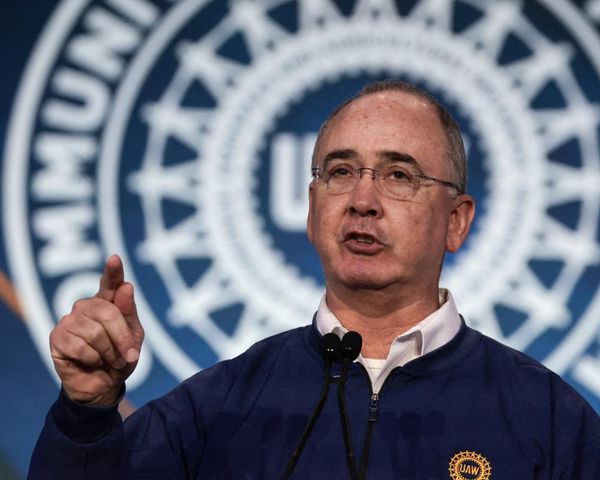
Sometime in the months after his shock defeat at last May’s federal election, Adam Bandt made a decision: his time in party politics was over.
Friends and colleagues had suggested the former Greens leader consider running for parliament again in 2028 – either returning to the lower house seat of Melbourne, which he held for 15 years, or putting up his hand for the Senate.

“I obviously gave that thought, but no,” he says from his new inner Melbourne office. “You have to be more than fully committed to do that, and I’ve climbed that mountain.
“I just can’t see it now.”
Instead, after a two-week camping trip in South Australia’s Flinders Ranges with his young family and a stint back at the bar as an employment lawyer, he contacted a global headhunter that had been contracted to find a new chief executive for the Australian Conservation Foundation, or ACF.
He says his pitch could be summarised as: “We need to build a movement that is so big that governments and corporations can’t ignore us, and in fact, they want to be associated with us.”
His appointment to that role, announced last September ahead of a January start, raised eyebrows in environmental and political circles. It suggested a significant change in direction for one of the country’s biggest and oldest campaign groups.
Election loss ‘hurt at a personal level’
The move came after a period spent coming to terms with a loss to Labor’s Sarah Witty that no one – not Bandt or the Greens, or the ALP – saw coming.
At the time, the election analyst Kevin Bonham said Bandt had been hit by a “perfect storm”: an electoral redistribution that pushed the seat into less Greens-inclined areas and a drop in both his primary vote and preference flow from Liberal and minor candidate supporters.
Bandt says others are better placed to conduct an autopsy of the result that cost both him and two Brisbane-based Greens their seats, and deflects on questions of the future of the party. Anecdotally, he says he heard from regular Greens voters who stressed they were determined to stop Peter Dutton becoming prime minister, and backed Labor on that basis.
The irony that the Greens campaigned on the slogan “keep Dutton out” is not lost on him.
“We tried to make it a central part of the campaign that the Greens would not support Dutton. We went and held a big rally up in Queensland to make that crystal clear,” Bandt says. “I don’t know what we could have done differently on that front.”
The 53-year-old says the defeat “hurt at a personal level”.
“You have a responsibility as a representative of the hopes and values of a lot of people in this country who want to see action on the things that matter to them. You’re kind of a custodian of that hope … I felt like I let people down.”
Sign up: AU Breaking News email
Distractions helped. It was the first election in which his primary school-age daughters, shared with his partner, Claudia, were conscious of the result, and in the aftermath he focused on them.
He also concentrated on his fitness and enlisted a sleep doctor so he could get some rest. Eventually, he narrowed down three options for his future working life, with climate and nature campaigning winning out over politics and the law.
Channeling Mamdani fever
Initial reaction to Bandt’s appointment was really a question: how would ACF under his leadership avoid being seen as an offshoot of the Greens, a party with which it has had no direct affiliation?
It was hard not to read as a change in direction. ACF’s previous chief executive, Kelly O’Shanassy, was considered a formidable backroom operator – politically connected and warmly regarded internally as a manager. But, like most leaders of environment organisations, she had a relatively low public profile.
And the ACF under her leadership had a rocky relationship with some Greens. The party’s founding leader, Bob Brown, made waves in 2023 when he returned his ACF life membership, accusing it of being too focused on deal-making with Labor and not aggressive enough in protesting its positions on climate and nature.
The foundation rejected this characterisation, pointing to its sharp criticism of the Albanese government over its approval of fossil fuel and forest-clearing development – including taking the government to court.
But the idea that Bandt’s hiring marked a shift has been reinforced by a social media campaign built based on his personality and profile that echoes the viral campaign of New York mayor and internet sensation Zohran Mamdani.
It began with activists sticking up posters asking “Have you seen Adam Bandt?” and has evolved into the new CEO smiling and chatting to the camera while calling for “a people-powered movement for a better world”.
WA ‘laid bare how power works’
His appointment comes amid competition for limited climate and environment funding. ACF has no shortage of supporters – more than 500,000 people have donated, attended a rally or signed a petition over the past two years – but only about 5,200 formal members.
Bandt downplays the idea ACF will be a substantially different organisation under his leadership. He says it was “clearly the most sophisticated nature and climate organisation in the country” in his time in parliament, and the view across the organisation before he came on, from O’Shanassy down, was the same as his – “nature and the climate aren’t winning fast enough and we need to step up”.
He says it’s no secret why. “One of the things I learned from my time in parliament is that big corporations have enormous power over governance,” he says. “We’d be there in the room negotiating with the government on steps forward to protect nature or take climate action only to then find that big corporations had pulled rank and managed to stop any good change from taking place.”
He says the Western Australian premier, Roger Cook, boasting of his intervention with Anthony Albanese on behalf of the WA mining and resources industry to stop a deal between Labor and the Greens on environment laws in late 2024 is an obvious example – but not an isolated case.
“It laid bare how power works, right? Governments listen to big corporations more than they do to nature and climate-conscious voters.
“At such a crucial moment in history for climate and nature, we need to alter that equation.”
The only answer, he says, is building support – on the web and the streets. As well as traditional methods, that means trying new things, including embracing his love of European electronic music.
“We need to be fun and be a movement that people want to be a part of,” he says. “We’re already lining up a few festivals where hopefully I get a DJ set.
“We need to understand that it feels good to be part of the movement to save nature and save the climate, and we’ll try a few experiments. Some things might work, some things might not, but there’s also a vision.”
Chris Bowen’s ‘important’ work
He stresses that ACF under his leadership will not be – and, as a registered charity, legally can’t be – a partisan organisation. Bandt says his Greens membership will soon lapse and he won’t hand out how-to-vote cards at elections.
He offers praise for the climate change minister, Chris Bowen, saying they “worked together and got a lot of legislation passed”, despite having differing views. “I think the work that he’s in charge of with the rollout of renewables … is really important work,” he says.
Where he diverges sharply from the government is over its continuing approval of coal and gas expansions for export, which the government has acknowledged are Australia’s biggest contribution to the climate crisis.
Bandt acknowledges that the evidence suggests a majority of Australians don’t have a major problem with that. He says his role, ultimately, is to change enough people’s minds.
“Our job is to communicate that these coal and gas exports are what are fuelling the climate crisis, and making your life harder, and destroying people’s chance of having a good summer and home insurance they can afford,” he says.
“We’ve got to start speaking more loudly and build up a movement around that.”