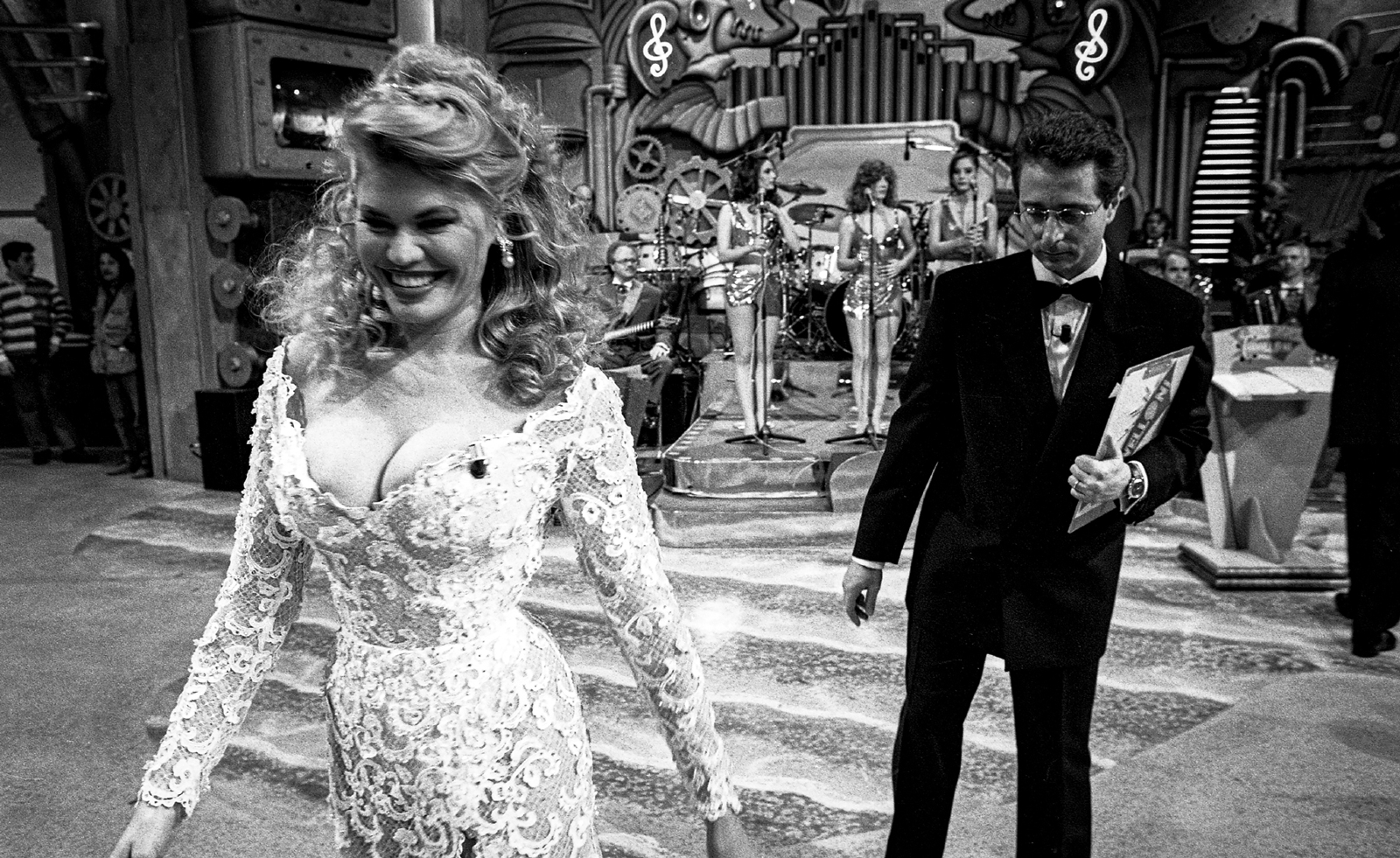
In his glossy 2018 feature Loro, director Paolo Sorrentino offers a contentious depiction of the late media tycoon-turned-political heavyweight Silvio Berlusconi, largely echoing the stylish veneer adopted by the controversy-laden Italian mogul (writing in The Guardian in 2019, Peter Bradshaw described the film’s lead, Sorrentino’s frequent collaborator Toni Servillo, as ‘such a smart and sympathetic actor that he surrounds Silvio with an aura that he doesn’t deserve’). In his new monograph Televisiva, Stefano De Luigi assumes a different position, interrogating Berlusconi’s legacy by focusing on how his empire reshaped Italian TV, and subsequently infiltrated the premiership.
‘I was living in France, so it was “how can I explain, to a foreign public, how it’s possible that this tycoon is taking political power in Italy”,’ the photographer says today, recalling the project’s beginnings following Berlusconi’s initial ascent to power in March 1994, having founded the centre-right party Forza Italia just a few months prior. ‘I thought, as a photographer, I need a place, an environment, I need something visual.’