Get all your news in one place.
100's of premium titles.
One app.
Start reading
The Economic Times
The Economic Times
Trending Desk

Discovered 29 years ago, asteroid bigger than Eiffel Tower to fly past Earth this weekend: Here's when and how to watch and should you be worried?

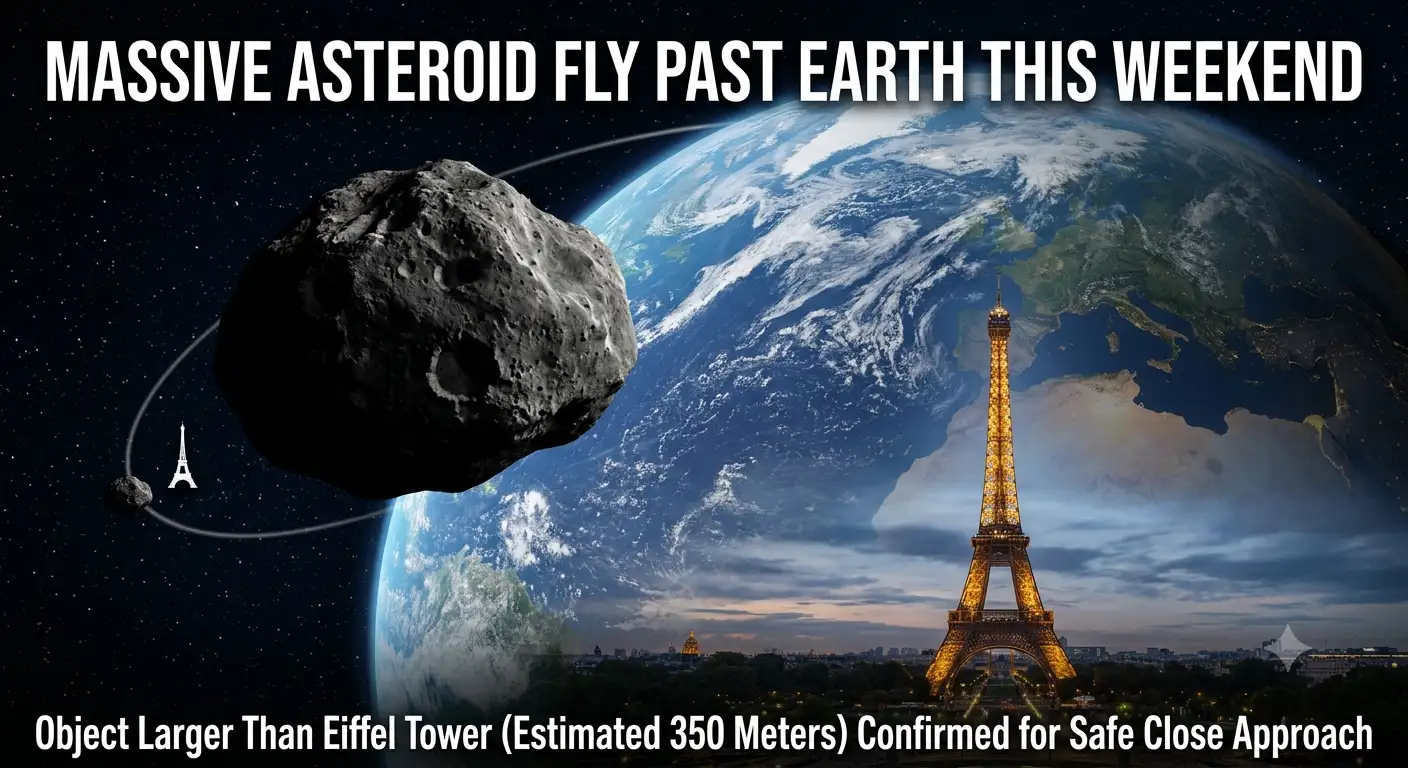
An asteroid estimated to be several times larger than the Eiffel Tower is set to make a close but completely safe pass by Earth this weekend. Known as (152637) 1997 NC1, the giant space rock is expected to fly by on June 27, 2026, at a distance of about 2.6 million kilometres (1.6 million miles), reports The Times of India. Though there is no risk of impact, its enormous size and relatively close approach have made it one of the most talked-about space events of the month.

ALSO READ: Ex-Google, Microsoft techie quit Rs 4.2 crore job, now runs Rs 21.7 crore halal BBQ business in Texas

Asteroid 1997 NC1: How big is it?

According to estimates from the European Space Agency (ESA), asteroid 1997 NC1 is between 710 metres and 1,600 metres wide. To put that into perspective, the asteroid is several times taller than the Eiffel Tower, which stands at 330 metres. However, scientists have pointed out that the asteroid's current trajectory poses no threat to our planet.

ALSO READ: World's most tattooed man who lived without electricity, running water or furniture

When will the asteroid make its closest approach?

The asteroid will reach its closest point to Earth at approximately 11:14 UTC on June 27. At that moment, it will still be about 2.6 million kilometres away, which is nearly seven times farther than the distance between Earth and the Moon.

Why astronomers are paying attention

Large near-Earth asteroid flybys happen regularly, but encounters involving an object this big are less common. Juan Luis Cano from ESA's Planetary Defence Office highlighted the significance of the event, saying:

"A close approach to Earth by an object this size only occurs every few years, although this time the bright nearby moon might impede its observability at closest approach."

The asteroid belongs to the Aten group of near-Earth asteroids. These objects spend much of their time orbiting closer to the Sun than Earth but periodically cross our planet's orbital path.

How long have scientists been tracking 1997 NC1?

The asteroid was first discovered in 1997 by the Near-Earth Asteroid Tracking (NEAT) survey. Since then, astronomers have continuously monitored its movement, refining calculations about its orbit with increasing precision.

Thanks to decades of observations, scientists can predict its future approaches with a high level of confidence. According to current projections, a similar close encounter is not expected again until 2088, making this year's flyby a relatively rare event.

How to watch the asteroid flyby live online

For most people, the easiest way to see the asteroid will be through an online livestream. The Virtual Telescope Project plans to broadcast observations on June 26 and June 27, beginning at 23:00 UTC on both nights.

The live sessions will be hosted by astrophysicist Gianluca Masi, who will guide viewers through the observations as the asteroid moves across the night sky.

Rather than appearing as a dramatic rock or glowing object, the asteroid will look like a tiny point of light slowly shifting against the background stars.

Can you see the asteroid with a telescope?

Under favourable conditions, yes. Astronomers estimate that asteroid 1997 NC1 could reach a brightness of around magnitude 10, making it too faint for the naked eye but visible through small telescopes.

Experts say a telescope with an aperture of around 100 mm should be capable of spotting it as a faint moving object. The key clue is not its brightness but its movement. Over a short period, careful observers may notice it changing position against the fixed star field.

Full Moon may make viewing difficult

One challenge for skywatchers this weekend will be the Moon. With a nearly full Moon lighting up the sky, many faint stars will be harder to see. The extra brightness can make locating the asteroid more difficult, especially from cities and suburban areas already affected by light pollution.

As a result, online telescope feeds may offer the clearest view for many observers.

Where will the asteroid appear in the sky?

Around the time of its closest approach, asteroid 1997 NC1 will move across several constellations, beginning in Lyra before travelling southward toward Norma.

It will also move surprisingly quickly across the sky for a telescopic object, covering roughly 40 arcseconds per minute. While that figure sounds technical, it means the asteroid's motion can become noticeable during a single observing session.

Should Earth be worried?

The short answer is no. Space agencies around the world have confirmed that asteroid 1997 NC1 will pass at a safe distance and poses no danger to Earth during this flyby.

Instead, the event offers a rare opportunity for astronomers and enthusiasts to observe a giant near-Earth asteroid as it makes one of its closest approaches in decades.

For skywatchers, it's a reminder of the countless objects moving through our cosmic neighbourhood—and how modern science keeps a close eye on them.

Sign up to read this article
Read news from 100's of titles, curated specifically for you.
Already a member? Sign in here
Related Stories
Top stories on inkl right now
One subscription that gives you access to news from hundreds of sites
Already a member? Sign in here
Our Picks
Fourteen days free
Download the app
One app. One membership.
100+ trusted global sources.