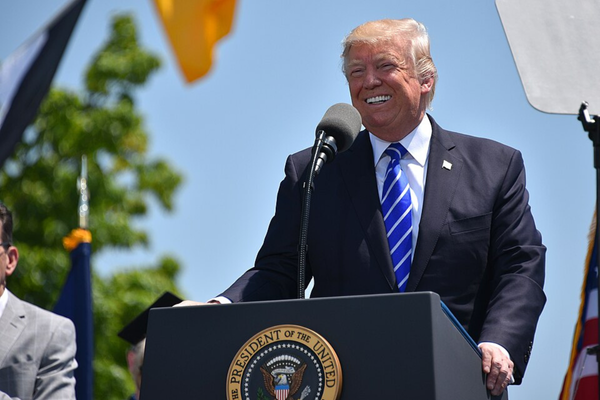
So deeply embedded in the realm of reality television is Donald Trump’s presidency that trying to apply any orthodox diplomatic measures of win or loss to his rumbustious appearance in Davos this week seems superfluous.
With his compulsive addiction to high-octane political drama, Trump had already achieved the improbable even before his arrival on Wednesday; transforming the normally somnolent Swiss Alpine resort into a unlikely setting for a high-noon confrontation with the US’s supposed European allies over Greenland.
The backdrop, lest it be forgotten, was the head-spinning prospect of turning the might of the US military against Greenland’s sovereign, Denmark – a founding member of Nato which last suffered an attack on its territory in 1940, when it was occupied by Nazi Germany.
The collective exhaling of breath by the august gathering at the World Economic Forum could be felt around the world when Trump announced that he was forgoing that option, even while stressing that it was open to him.
It is a measure of just how thoroughly the first year of Trump’s second presidency has turned global affairs inside out that averting a military attack that would have almost certainly spelled the death knell of Nato, arguably history’s most successful military alliance, can be hailed as a result.
Yet if so, in whose favour?
Trump, ever the exponent of the zero-sum calculus, presented it as a triumph for himself.
He was dropping his tariffs on eight European countries, planned as punishment for their opposition to his demand that he be allowed to annex Greenland after reaching a “deal” that allowed the US to step up its presence on the territory, so long as it did not encroach on Denmark’s sovereignty.
Yet details of the supposed agreement, struck with Nato’s secretary general, Mark Rutte, were vague to non-existent – and it all sounded suspiciously identical to rights the US has had in Greenland for decades and that Denmark had been publicly trying to call his attention to.
In fact, after Scott Bessent, the US treasury secretary, had acted as the courier for Trump’s maximalist demands in the previous days with crockery-breaking rhetorical fusillades that insulted, in turn, Denmark, President Emmanuel Macron of France, and the European Commission president, Ursula von der Leyen, the president’s eventual takeaway from Davos begins to look like a bit of a damp squib.
Trump seemed scarcely more successful in gaining sign-ups to his vaunted Gaza “board of peace” – a loosely defined enterprise whose functions he has gradually expanded to envision it replacing the United Nations. Yet he may have undermined its potential attractions by insisting on inviting the Russian president, Vladimir Putin, to join – despite his refusal to agree to a ceasefire in Ukraine.
Indeed, by any objective reckoning it could be argued that Davos was the venue where the much-abused Nato allies began to fight back – as evidenced by the fighting rhetoric of Macron, Von der Leyen and the Canadian prime minister, Mark Carney, who told the gathering the day before Trump’s arrival that the changes being wrought in the US’s relations with its allies signaled not “transition” but “rupture”.
Yet with the ever-capricious Trump, any perceived gain may turn out to be a mirage.
Was his demand for Greenland ever real in the first place? Or just a play to keep erstwhile allies – already maligned in the White House national security strategy for surrendering to “civilizational erasure” – off balance and vulnerable to a mercurial president’s every whim?
Domestically, some of Trump’s critics have surmised that the Greenland strategy is little more than a ploy to draw attention from the Epstein files, surely an enduring achilles heel.
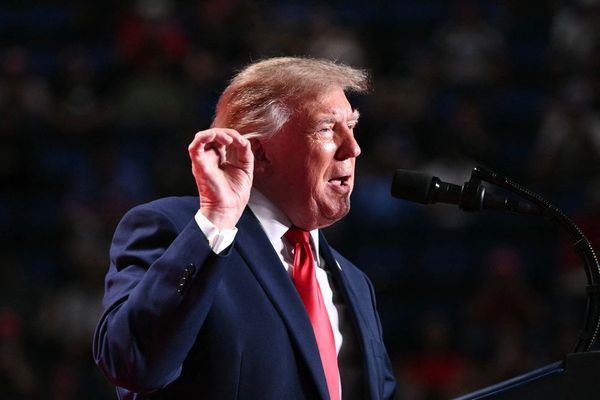
What was undoubtedly real to his audience in Davos was Trump’s malevolent, bile-filled contempt for countries that have for generations been considered America’s friends.
No one had ever done as much for Nato as he; the US would always be there for Nato, but he doubted Washington’s partners would be there for it in a crisis – overlooking the reality that the only time the alliance has invoked its article 5 requiring all its members to come to the defence of an ally was after the al-Qaida attacks of September 11, 2001.
Without the US military, said the man who avoided the Vietnam draft, all Europeans would be speaking German – oblivious to the fact that he was in a German-speaking region of a country with a nearly two-thirds German language majority.
At least three times in a meandering speech replete with false statements, he referred to Greenland as Iceland, a separate country whose sovereignty is recognized at the United Nations. The error was only exacerbated by attempts by the White House press secretary, Karoline Leavitt, to deny that he had made it, despite video evidence to the contrary.
Such glaring frailties, an increasing feature of Trump’s public appearances, make contriving a victory from his Davos appearance a stretch for all but his most ardent proponents.
Yet so mercurial is the nature of his second presidency that his Nato partners dare not regard the avoidance of disaster over Greenland as anything more than a respite before the next crisis.