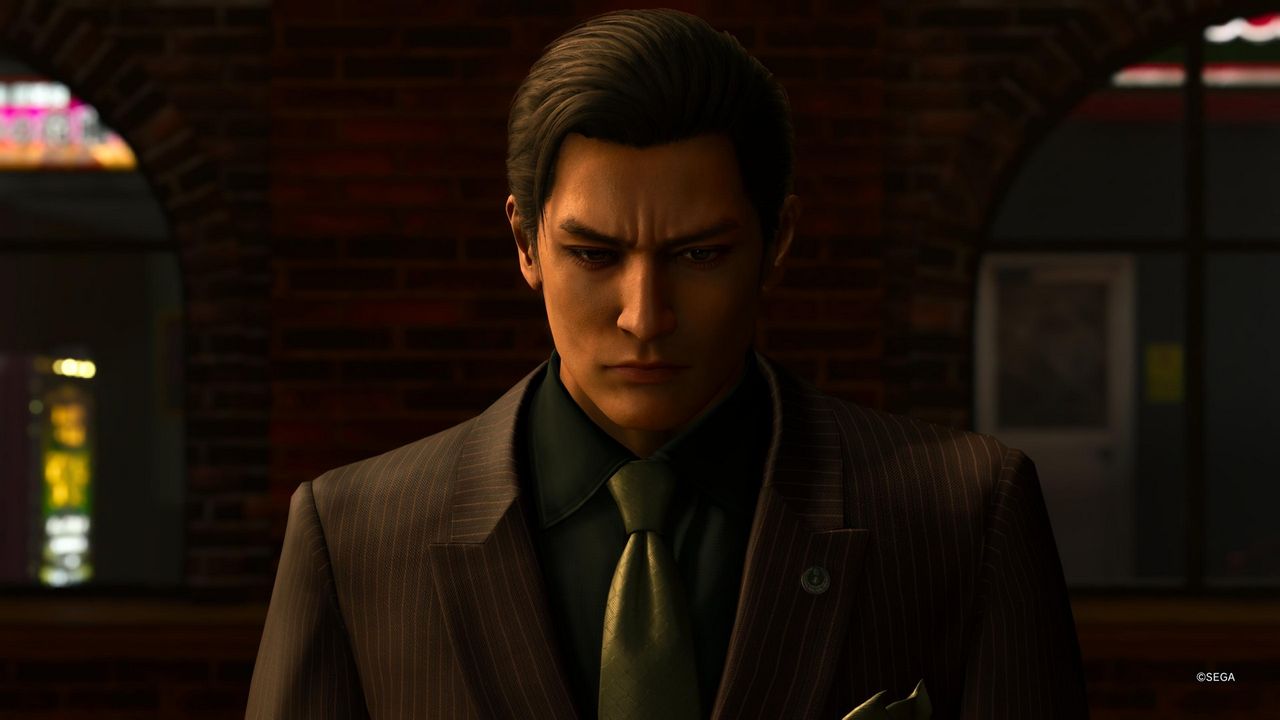
Yoshitaka Mine stands shoulder-to-shoulder with Kazuma Kiryu on Yakuza Kiwami 3 & Dark Ties' box for a reason. In this lavish remake of the PS3 classic, the enigmatic villain and foil for Kazuma Kiryu has been elevated beyond a mostly off-screen threat, new developments in the main game's revised script giving him more to do, and the titular Dark Ties campaign fleshing out his background via a (fairly barebones) prequel. Also, he is now Aerith from the hit JRPG Final Fantasy 7 Remake. There's now every chance Yakuza Kiwami 3 could have dramatic, time-shattering consequences for Yakuza Kiwami 4 and Yakuza Kiwami 5 should they happen.
Warning: Enter these spoiler Kamurocho gates at your own peril. I will be discussing the ending of Yakuza Kiwami 3 & Dark Ties, including changes made to the story compared to the original game.
Or, at least, that's the impression given by some of bizarre changes to Yakuza 3's story that, while they make me chuckle, I don't completely hate. You see, in the original game, Yoshitaka Mine has a taste of redemption before he ends up sacrificing himself, plummeting to certain death from a very tall hospital building. In Yakuza Kiwami 3, it's later revealed he survived by… apparently falling into some bushes?
There are bizarre changes to Yakuza 3's story that, while they make me chuckle, I don't completely hate.
"Is that important right now?" Mine literally tells someone else who is surprised by his survival. That person, Goh Hamazaki, is another of the game's villains – and one who, rather dramatically, stabs Kazuma Kiryu in the stomach in the original Yakuza 3 ending. It's an impactful and emotional finale, leaving Kiryu bleeding out in the street as Haruka pushes through the crowd to be with him, reflecting on the lives he's touched as his worries that he would never truly be able to leave Kamurocho before he dies are brushed aside, realizing that through his adopted children he's leaving something more hopeful behind.
But, though I love this ending, it's also a bit of a fakeout even in the original – after the credits there, a bandaged Kiryu is revealed to be alive and recovering at Morning Glory Orphanage with his kids – so it's hard to get too frustrated that Yakuza Kiwami 3 does away with it. But, not only does this stabbing in broad daylight not happen in Yakuza Kiwami 3, Yoshitaka Mine, through his new survival, actually prevents it.
Seven minutes

Hamazaki, we see, still lurks in a nearby alley, watching Kiryu, knife in hand, as the scene as we once knew begins to play out. But, just before he rushes out, Mine appears to urge him to stay his hand. It's not quite the level of Aerith foreknowledge that Final Fantasy 7 Remake features, but it does play with the idea that an in-game character is reaching out through the screen to affect and acknowledge a situation long-time fans thought they knew.
Though Mine had a taste of redemption, he's not fully reformed – he's a character who still has his own twisted sense of justice, and it's because of this that he wants to prevent the stabbing. This small change to Yakuza's plot means that time has effectively been altered through the Kiwami series. Sure, the remake entries for the first couple of games have their own changes and alterations, but none feel as if someone has grasped the reins to redirect them personally like this instance from Yoshitaka Mine.

What prompted Mine's survival? On a metatextual level, it seems to be positioning Mine and Hamazaki to join the Daidoji for use in future games (the same organisation Kiryu has been affiliated with across Like a Dragon Gaiden and Like a Dragon: Infinite Wealth).
Within the text, however, you could consider the fleshing out of Mine's backstory and how he grew to respect and obsess over Daigo Dojima through the Dark Ties campaign, to be the difference between him having the will to survive and perishing. It's a shame that the best part of Dark Ties is the lengthy series of cutscenes that bookend it, exploring this dynamic – far too much of the middle is all set-up as Mine works his way through the lower rungs of the Yakuza.
The best part of Dark Ties is the lengthy series of cutscenes that bookend it, exploring this dynamic.
This isn't the kind of series likely to explore Mine's relationship to Daigo as romantic, but there's always been a definite infatuation there. The form that it takes has always been, in the original Yakuza 3, a bit vague. I do at least appreciate Dark Ties taking a little bit of time to flesh this out, and to explore the mutual respect between the pair as the only true confidants each could ever have.

Them having their own special bar and off-screen heart-to-hearts does have an extreme whiff of doomed romance fanfiction about it. But, as a fanfiction enjoyer, I don't completely hate this take. To me, exploring this further in Yakuza Kiwami 3 means that, for Mine, he is also reflecting on his relationship with Daigo more deeply than he did in the original game, and provides ample impetus for him to survive, to fight to continue living for the only person who he ever really cared about, or who cared about him.
With that said, there's some elements of Dark Ties that don't quite mesh with Mine's arc as presented in Yakuza Kiwami 3. Where that side of the campaign shows Mine's mental state to be, his encounter with Kiryu on the hospital rooftop and his subsequent internal strife no longer gels as well for me. Not to mention, why he begins Dark Ties as a washed-up CEO who also happens to be a master fighter who can even handily beat up another of the game's villains Tsuyoshi Kanda – especially when one of Yakuza 3's most striking scenes specifically revolves around how Kanda underestimate's Mine's strength. But, that's enough griping from me.


In my Yakuza Kiwami 3 & Dark Ties review, I liked the new take on the original story well enough but said that "its overly edgy new chapter leaves me cold".
Back to the new ending of Yakuza Kiwami 3, Mine's conversation with Hamazaki even hints that, if we get remakes of the fourth and fifth games, the pair's influence as part of the Daidoji could dramatically alter their events. To be clear, I am not seriously of the opinion that they will change the events of those games that much, but I have to admit the fact I'm even considering it because of this new ending twist is definitely interesting.
Kiryu's lust for violence, Mine posits, will be our hero's own undoing. The love for his adopted children will become a prison if he's not allowed to act, and Mine suggests ensuring that this remains the case, that Kiryu is never called into action again. Of course, we as fans know that's exactly what happens across later entries, especially in the multi-protagonist games Yakuza 4 and Yakuza 5 where him coming out of retirement to help the other heroes is narratively a big deal. What would happen, I wonder, if Yakuza Kiwami 4 and 5 didn't feature Kiryu at all? What if, in this timeline, he didn't come to help?
I don't really think Sega or RGG Studio would be bold enough to really do it, but honestly it's the first time in a while I've been curious to see what will come next, and taking bigger swings with the remakes would be an interesting way to do it. Certainly, it's more interesting to me than simply bringing Mine and Hamazaki back as small villain roles in Yakuza 9, especially if that means once again dragging Kiryu into the fray alongside new hero Ichiban Kasuga. While the modern era Kiryu definitely deserves a rest, I say bring on bigger twists for the remakes set in the past – I've played the classics to death enough times as it is.
Check out our best Yakuza games ranking for more! Like a Dragon fans, please stop saying Kiwami 3 is a remake of the worst game in the series when Yakuza 4 is worse