Get all your news in one place.
100's of premium titles.
One app.
Start reading
Bangkok Post
Bangkok Post
World

Did Aristotle exist? China targets pseudo-history myths claiming West stole civilisations

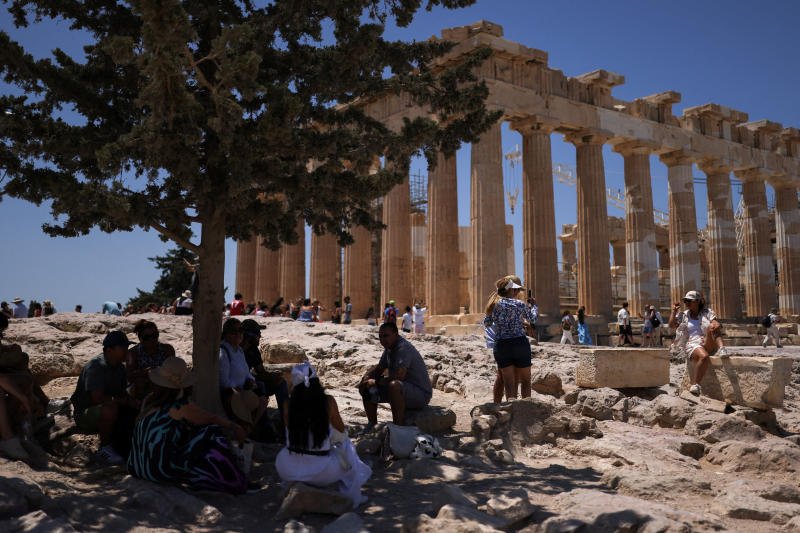
Tourists rest in the shade of a tree during their visit at the Parthenon temple atop the Acropolis hill, as a heatwave hits Athens, Greece, on June 27, 2025. (File photo: Reuters)

BEIJING — A provincial propaganda department in China has warned the public against subscribing to growing conspiracy theories on history, such as those stating that Aristotle and Ancient Greece never existed.

In a post on Wednesday, "Zhejiang Propaganda" - a social media account affiliated with the Zhejiang provincial publicity department - warned about the rise of the "pseudo-historical school" online. The school promotes conspiracy theories that deny Western history and claim key achievements of Western civilisation actually originated in China.

"[The] pseudo-historical school of thought has become a negative ideological trend that spreads through the internet and fractures social cognition," the post cautioned.

"Such claims appear to promote national confidence, but in reality, they reflect ignorance of exchanges between civilisations. In essence, they represent another form of cultural [insecurity]."

The official promotion of the concept has given rise to narratives about the strength of China and admiration for its rich history in the official sphere and in public discussion.

Some scholars argue that pseudo-historical theories reflect a growing trend in Chinese society to promote a less Western-centric view of history.

In December 2023, retired art history professor Huang Heqing - deemed by many to be among the most influential figures promoting this alternative history - addressed an online seminar that attracted more than 100,000 viewers.

Zhejiang Propaganda criticised proponents of pseudo-history for repeatedly claiming that the West had fabricated history to glorify itself, reducing the evolution of different civilisations to a contest over what was true.

"Aristotle is asserted to have 'never existed at all', while they also frequently cite the 'scarcity of paper in the ancient West and the difficulty of preserving it' to question the authenticity of ancient Greek works," it said.

An AI-generated image of a figure resembling a Greek philosopher dressed in a Chinese robe.

The post accused proponents of such views of drawing absurd, unfalsifiable conclusions based on a presupposed conspiracy theory.

"[They] also forcibly trace the achievements of Western civilisation back to China. They claim that the Industrial Revolution was entirely based on plagiarising the Ming dynasty's Yongle Encyclopaedia, and that calculus and the steam engine both originated in China before being stolen by the West," Zhejiang Propaganda said.

It said some believers even used similarities in the pronunciation of certain Chinese and English words to argue that Western civilisation originated in China. In one example, pseudo-historical school adherents believed the British originated in Yingshan county in Hubei province, because Yingshan sounded similar to England, according to the post.

"If evidence is presented, they say the evidence was fabricated; if documents are cited, they say the documents were altered by later generations … Any rebuttal based on historical facts is labelled an 'official narrative'," the post said.

The Chinese government has never expressed support for the narrative espoused by the pseudo-historical school and China's official textbooks contain almost no traces of it.

The first World Conference of Classics, jointly hosted by China and Greece and held in Beijing in 2024, received official support from Xi.

Proponents of pseudo-history often overlap with Han nationalists, with both groups holding views that diverge from the official Chinese narrative regarding the country's decline in modern history.

"Influenced by a narrow nationalist view of history, proponents of pseudo-history define dynasties like the Song and Ming as 'orthodox Han dynasties', which could undermine the foundations of the nation's history," Zhao Xianhai, a fellow at the Institute of Ancient History at the Chinese Academy of Social Sciences, told People's Daily Online in an article published on Thursday.

Han nationalists regard the Manchu-led Qing dynasty - China's last imperial power, which overthrew the Ming - as an invading colonial regime.

Zhao said historians should actively explain history in language accessible to the public to prevent the spread of such conspiracy theories.

China last year banned a series of influential social media accounts associated with the pseudo-historical school and Han nationalism.

Artificial intelligence (AI) was being used to churn out pseudo-historical content on an industrial scale, Zhejiang Propaganda noted.

"Generative AI has dramatically lowered the threshold for producing and spreading pseudo-historical content, making it possible to fabricate realistic-looking pages of supposedly ancient books and seals," the post said.

Sign up to read this article
Read news from 100's of titles, curated specifically for you.
Already a member? Sign in here
Related Stories
Top stories on inkl right now
One subscription that gives you access to news from hundreds of sites
Already a member? Sign in here
Our Picks
Fourteen days free
Download the app
One app. One membership.
100+ trusted global sources.