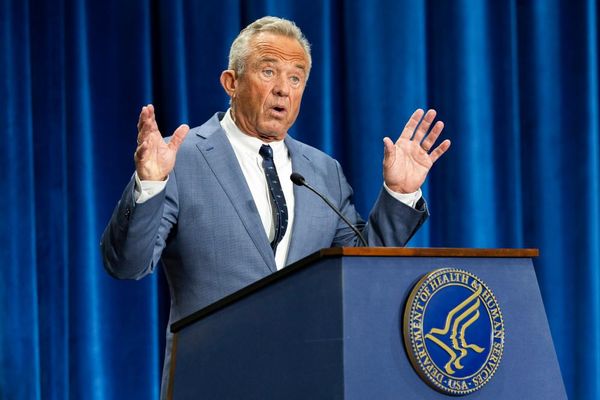
The Department of Homeland Security has paused plans to buy new warehouses for immigrant detention as newly installed Homeland Security Secretary Markwayne Mullin reviews contracts and proposals advanced under his predecessor, Kristi Noem.
Two anonymous senior DHS officials told NBC News that, though the purchases have been paused, DHS is still planning on developing facilities already purchased by the Department. They also said that the pause will give Mullin time to review Noem's policies before utilizing them.

In a statement to the outlet, the department said that "as with any transition, we are reviewing agency policies and proposals." NBC news also reported that warehouse purchases already completed are now under scrutiny, suggesting the review could extend beyond future acquisitions and into deals already signed.
The warehouse strategy had become one of the most controversial pieces of the administration's broader push to ramp up detention and deportation operations. Under Noem, DHS was pursuing a $38.3 billion plan to expand detention capacity to roughly 92,000 beds by acquiring eight large-scale detention centers that could hold 7,000 to 10,000 detainees each, along with 16 smaller regional processing centers.
The decision lands at the center of a politically and legally fraught fight over the administration's detention buildup. According to PBS, 11 warehouses have already been purchased in Arizona, Georgia, Maryland, Michigan, New Jersey, Pennsylvania, Texas and Utah, at a combined cost of $1.074 billion. But those efforts have triggered lawsuits in at least three states, while local leaders in several communities have complained they were not properly consulted before federal officials moved ahead with the projects.
The Associated Press reported that opponents questioned the moral implications of placing large ICE facilities in their neighborhoods and raised practical concerns over sewer, water, and other municipal systems. During his confirmation hearing, Mullin acknowledged those issues, saying the federal government must work with community leaders and consider whether cities have the capacity to handle additional waste and water demands.
In New Jersey, state officials sued the Trump administration on March 20 to block a proposed 1,500-bed immigration detention center that would convert a vacant warehouse into a federal facility. According to Reuters, New Jersey Governor Mikie Sherrill and Attorney General Jennifer Davenport argued that the plan failed to adequately address water, sewage, public safety, and environmental concerns, while also questioning whether the site was appropriate for detention at all.
Even in places where projects moved forward, plans have already been scaled back. Local news reported that in Surprise, Arizona, a warehouse once envisioned as a 1,500-bed processing center is now expected to be capped at 542 occupied beds, according to Mayor Kevin Sartor. AP also said eight other proposed deals, including in Kansas City, Missouri, collapsed after property owners chose not to sell.