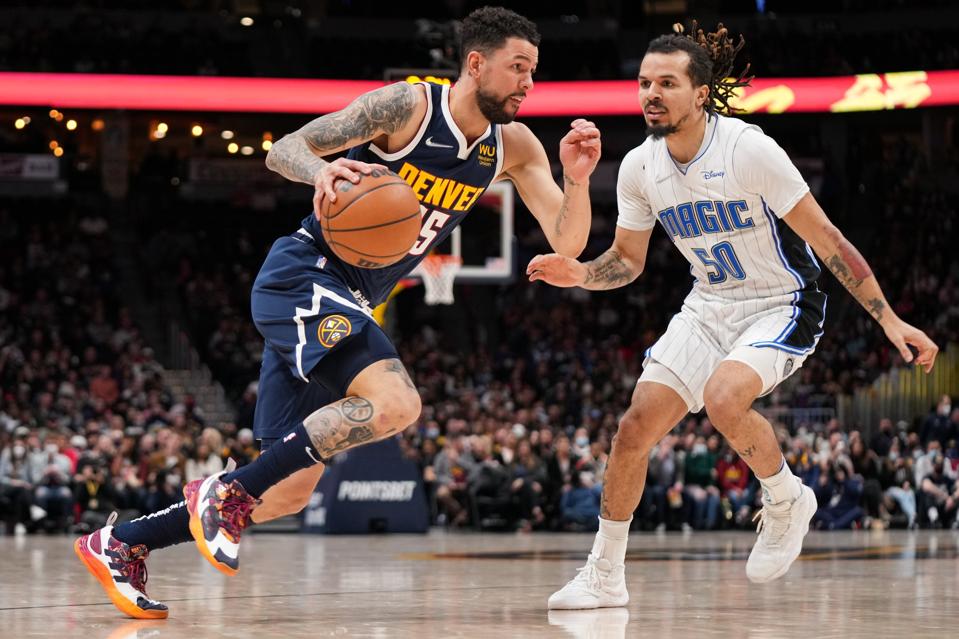
One year ago, it was unclear when or even if veteran journeyman guard Austin Rivers would find his way back into the NBA, as he bided his time at home waiting for his next chance after being traded at the deadline from the New York Knicks to the Oklahoma City Thunder, then subsequently waived.
After two months in limbo, he found a new home with the Denver Nuggets, who in late April last year signed him first to a ten-day contract, then converted him to a standard deal through the end of the season.
“There were times this past month I didn’t know where my life was headed,” Rivers said in his first postgame press conference following his Nuggets debut. Asked then how it felt to be back on the court, he replied that it was “amazing.”
“Sometimes you don’t know how great something is until it’s taken away,” Rivers explained. “I’ve been at home the past month just kind of looking for the right spot. And obviously this opened up, and it just made all the sense to me.”
Injuries to Denver’s top three guards in Jamal Murray, Will Barton and Monte Morris, all of which occurred that same month, swung the door of opportunity wide open for Rivers, and he wasted little time in making the most of it, as he started in all but one of their ten playoff games, including two big outings of 21 and 18 points respectively which helped Denver get over the hump to win their first-round series against the Portland Trail Blazers.
Now on the one-year, $1.7 million contract the Nuggets signed him to in free agency last offseason, Rivers is no longer team newcomer band-aid solution for injury woes, but a more permanent fixture on Denver’s roster. Even so, in a backcourt packed with guards, and in a season in which Rivers faced a December bout with COVID which got him sick enough that he “struggled breathing” on several nights, his role early in the season wavered.
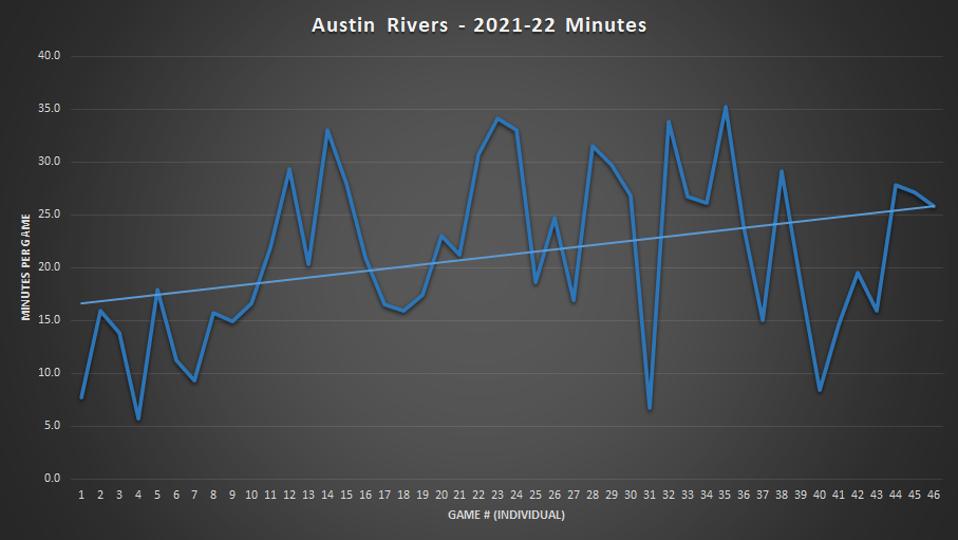
In the chart above, which does not include the games Rivers missed due alternately to health and safety protocols, injury or coach’s decision, it can quickly be seen both the extent to which his playing time has fluctuated, but more importantly that the overall trend has been toward increased minutes. In the early season before contracting COVID (games one through 18 on the chart), Rivers averaged 17.5 minutes, which has increased to 23.6 minutes since his return.
And while there may be some push-and-pull to this (it’s helpful for shooters to get into a rhythm if they have consistent playing time), part of the reason for this is that he’s found his way to better shooting efficiency over the course of the season. Rivers’ effective field goal percentage, which accounts for the higher value of three-point shots, is at 54.5% this season, which puts him in the 66th percentile for his position, according to Cleaning the Glass. And although this may not be an elite number, it’s perfectly respectable for a bench guard or wing, and puts him right on par with starter Will Barton (53.9%) and shooting specialist Bryn Forbes (54.1%)
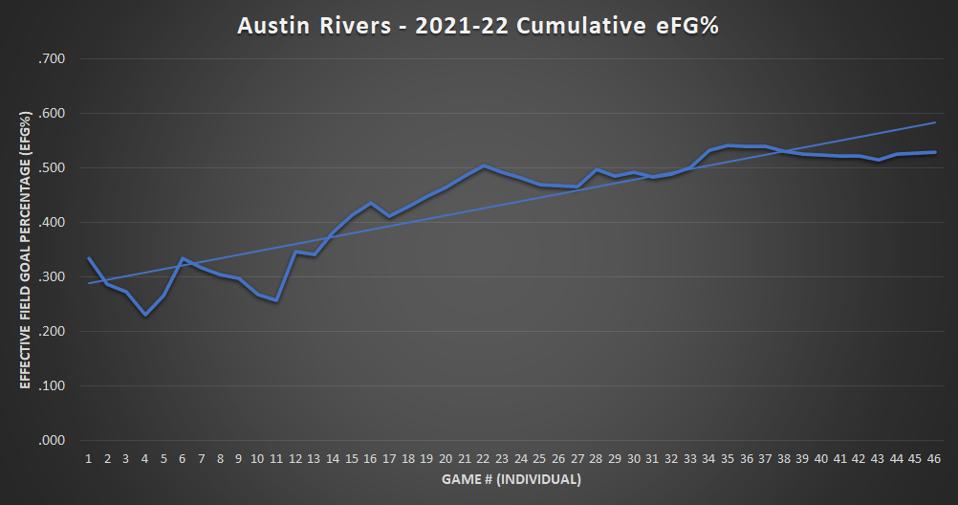
A good example of Rivers’ improved shooting consistency is a particularly hot three-point shooting spree he went on late in January, in which he drained 11 of his 16 attempts (or 68.8%) while averaging 3.7 makes in that span.
But another critical component of Rivers’ offensive game is his ability to proficiently attack the rim in ways that few other guards on the Nuggets roster are capable of (at least not until Jamal Murray returns, if that comes to pass), and for a team whose guards shoot the fourth-fewest attempts per game within the restricted area, per NBA.com, that’s a valuable skill.
Rivers has a deceptively diverse set of moves he uses to get to the basket, whether attacking closeouts or out of pick-and-rolls.
Here he first uses a jab step to get his defender tilting away from the baseline before driving in for the reverse layup, then deploys a crafty spin move off an excellent DeMarcus Cousins screen for a straight line drive to the rim.
And on this play, he completely shakes his man with a crossover, and again displays a nice finishing touch with the reverse.
But what really seems likely to keep Rivers squarely in head coach Michael Malone’s regular rotation both down the final stretch and in the postseason is the competency and tenacity he’s been showing on the defensive end of the court, with the most recent example being the job he did guarding Steph Curry of the Golden State Warriors last week, an effort that earned him the Nuggets’ Defensive Player of the Game chain.
While Rivers is more scrappy than lockdown, at his best he can relentlessly pursue his assignments and get them to work harder for tougher shots. And 1.5% steal rate that’s in the 69th percentile among wings reflects his ability to pick opponents’ pockets and get his hands into passing lanes for deflections and steals.
With Austin Rivers on the court, the Nuggets have outscored their opponents by 1.1 points per 100 possessions. Though nowhere near the dominant numbers of most of Denver’s starters (Jokic’s on/off number is a flat-out absurd plus-23.7, with both Morris and Aaron Gordon in plus-14 territory), that’s the best number among all Denver bench players, and the only one that’s in the plus. And as I wrote previously for Forbes on the Nuggets’ reserve unit, even when they simply do not hemorrhage points excessively while Jokic is off the court, Denver wins games at a high rate.
Rivers might periodically explode to help carry his team to a win, as he did twice in the postseason last year, but it’s his reliability as a two-way player who brings the full brunt of his effort on both ends to every performance, along with the character and leadership he provides to the Nuggets locker room, that really makes him a “Malone guy,” a player who the coach trusts and who he’s not afraid to put on the court in high leverage situations.
Despite the additions of Bryn Forbes and DeMarcus Cousins (though by contrast somewhat in part facilitated by the replacement of Facu Campazzo with Bones Highland as backup point guard), Rivers provides a complementary, Swiss Army Knife set of skills of the bench that makes him an easy fit with nearly any lineup, whether it’s the regular reserve unit or a staggered combo platter. And while the apparently imminent return of Murray would certainly soak up a large quantity of available minutes, it seems increasingly likely that Malone will find ways to keep Rivers in the rotation, both for his ability to make impactful plays and as a sort of “glue guy” who can easily mesh with just about any five-man group Denver might assemble.
Whether Rivers can, like he did last season, deliver any breakout performances on the big stage in the playoffs that propel the Nuggets to postseason wins remains to be seen. But it appears more likely now than at any point this season that at the very least, he’ll be on the court with the opportunity to do so.