Get all your news in one place.
100's of premium titles.
One app.
Start reading
The Conversation
The Conversation
Marty Branagan, Associate Professor in Peace Studies, University of New England

Dennis Altman urges us to radically reimagine the future – like he did in the 60s

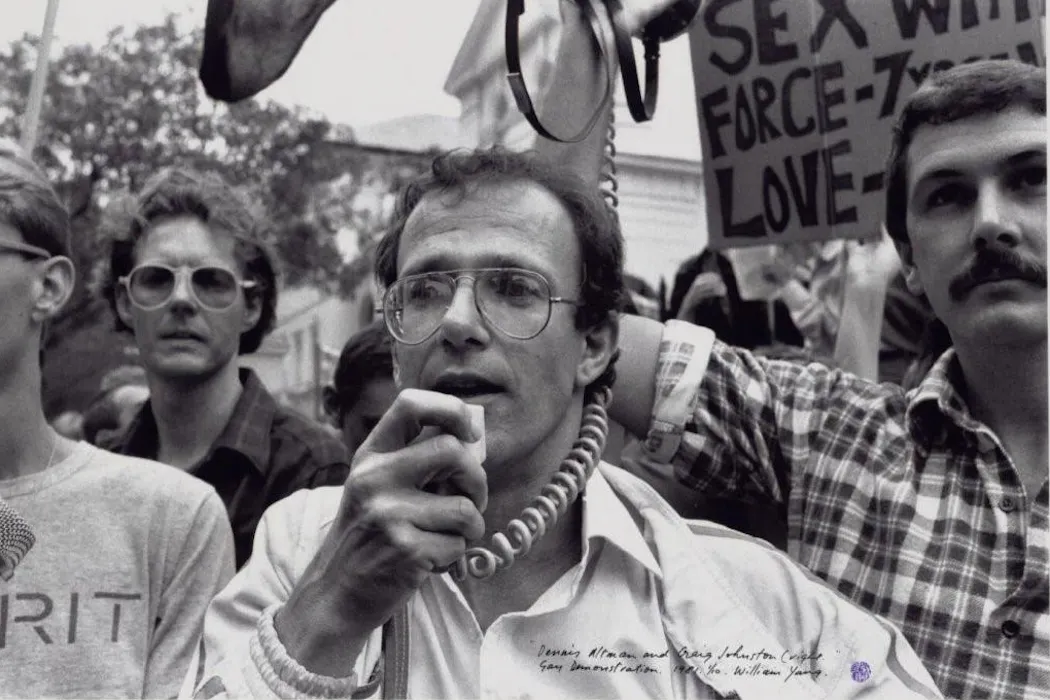
Dennis Altman (centre) National Library of Australia

At the first Sydney Gay and Lesbian Mardi Gras, nearly 50 years ago, 53 people were arrested. Many lost their jobs when the Sydney Morning Herald published their names. That was in 1978.

Now, it’s the largest Pride event in Oceania – and a major income-generating tourist drawcard. Its hundreds of thousands of participants include emergency services, police and defence personnel.



Review: Righting My World by Dennis Altman (Monash University Press)


In 2023, the Australian prime minister marched for the first time. Rainbow signage in government buses, trains, ferries and light rail announced “Ride with Pride”. This was echoed by exhibitions, fashion items, shop displays, banners and murals. An activist element remained, with stickers calling for “Queer liberation not rainbow capitalism”. That year also saw the resolution of murder cold cases, and new inquiries into them.

This year, the rainbow flag flew from Sydney Town Hall and on Australia Post boxes, and the route of the 1978 march was heritage listed. The celebration received rapturous media coverage.

This incredible shift is because of people like academic and writer Dennis Altman. Righting My World, an anthology of essays spanning half a century, tells the story of his long history in activism. It began in 1960s New York amid the emerging gay liberation movement, which “grew out of the counterculture and other radical movements, particularly feminism”.

For younger members of LGBTQIA+ communities lamenting their “missing fathers” after the AIDS epidemic, Altman’s book counters the “absence of communal history in any mainstream historical records”.

When radical change seemed possible

Altman’s engaging early writing “at the boundaries of academia” shows humour and a nice turn of phrase: it’s up there with the Beat novelists, Charles Reich’s hip sociology, or Hunter S. Thompson’s gonzo journalism (minus the drugs).

It brings alive those exciting times when “radical change seemed possible” and the counterculture movement’s “glorious and beautiful pandemonium” opposed the young conservatives – “middle-aged men and women in their twenties”.

His later writing style is more polished and erudite. But it still seamlessly moves from the political to the personal, the global to the local – in a way used so well by #MeToo.

His eclectic range of topics includes living in Paris and Los Angeles, the revolutionary aspects of Brecht and Beethoven, and the protocols of having a massage at a lunch party.

Shifting with ease from the whimsical to the profound, he discusses Harry and Meghan (“pampered pets” engaged in the “sheer pettiness of royal family life”), mateship, grief, COVID, ageing and writer Gore Vidal (not, in fact, a world famous hair stylist, as comedian Ali G once suggested).

There’s even the comfort-read attraction of Agatha Christie novels, despite her “racism, snobbery and wooden dialogue”.

For Altman, writing, culture and activism are inextricably linked – and 1969’s anti-war musical Hair was “much more revolutionary than any number of protest marches”. Popular musicals often have a radical (for example, anti-racist) agenda, despite their conservative form. But they usually maintain “very conservative images of sexuality and gender, with the almost obligatory happy heterosexual coupling at the finale”.

Altman welcomes the marriage equality shift “from outlaws to in-laws”. But ingrained fears and uncertainties remain and “the experience of confronting deeply embedded social expectations leaves its mark on almost all of us”.

Liberation as marketing slogan?

Years after Billy Bragg sang “I prefer it all to be out in the open”, there remains the “persistent difficulty of coming out”, especially in religious families – and more so for trans people. (Writer and comedian Alan Carr, who claims never to have been in the closet, is one exception.)

From invisibility or derisive depictions in popular culture to the “almost compulsory inclusion of gays” on film, the movement’s successes can also be viewed as co-option by capitalism – “liberation as a marketing slogan”.

For Altman, liberation is more than equality. It’s about “altering the most fundamental tenets of our method of social organisation” and “abolishing privilege and exploitation and concentrated power”. He doesn’t see this much in contemporary movements, though I see it in the Transition, Rising Tide and Pacific Peace Network movements. Maybe he’s unaware of them.

Altman lauds the “extraordinary bravery” of people doing AIDS work in war-ravaged countries. His own efforts in international movement-building and advocating the resettlement of LGBTQIA+ refugees from homophobic regimes are praiseworthy.

He hates “the byzantine cruelty of this country’s visa laws”. And he can’t understand religious leaders “who are so prone to be upset by consensual pleasure, [but] see no moral dimension to widespread human suffering”. Aboriginal issues could feature more, but Altman does mourn the No vote, for a Voice that would have been a “small and respectful step”.

Freud-influenced (citing the “inherent bisexuality of all humans”), he quips that therapy is “good […] for other people”, and that it “concentrates too much on the inner space at the expense of the larger social landscape”. However, he acknowledges both public and private change is necessary. For him, movement organising “helped create a sense of community and the development of political perspectives”.

Some topics may be confronting, such as “jack-off clubs” as a safe sex response to AIDS. Others don’t sit comfortably amid the ongoing Epstein revelations, such as an early reference to sexual liberation “no matter their sex or age”, a discussion of pederasty, and a mention of self-confessed paedophile Donald Friend in Bali. Altman does acknowledge, however, “some very ugly aspects to gay sex tourism”.

Iran, China and multiculturalism

He celebrates multiculturalism (“I love what Australia has become”) and the greater options for contemporary women.

book cover: Righting my World, with author smiling in a black jumper on the cover, wearing glasses

The Murdoch press, however, hounds the humanities and largely functions as “a house organ of the Israeli government”, Altman writes. Many of his mother’s family were murdered in World War II Poland; he has an empathy with other secular Jews, and feels vulnerable. But he believes Israel is a “brutal occupying power” whose “relentless search for military solutions has poisoned the country’s very soul”.

In 2009, he wrote presciently that “the threat of war with Iran and its Arab allies now looms large”.

The United States, led by a “convicted sex offender”, has slid into authoritarianism, showing “contempt for the basic rules of liberal democracy”, he writes.

China is “repressive and authoritarian”. But increasing our military spending and decreasing foreign aid won’t help, warns Altman. It’s better to commit to greater global equality and “build closer ties with neighbouring countries rather than play war games”.

In some areas, he believes things have improved. A detailed essay on La Trobe University describes more ethnically diverse and confident students than when he started there in 1985, and more women staff and collegiality. However, neoliberal pressures are corporatising universities, leading to increasingly complex managerialism and more online teaching. It’s essential to have staff and students on university councils, he argues.

For Altman, gay liberation is “the liberation of us all”, and “the radicalism of the sixties, long dismissed as irrelevant” is “worth re-examining”. He thinks “it is possible to radically re-imagine the future”. In this, he has allies in movements like solarpunk, an emerging, optimistic movement of speculative fiction, art, architecture and activism dedicated to social justice, mutual care and sustainability.

But it will take more brave and thoughtful activists like Altman. He is “waiting, breathless” for radical new ways of seeing and being. Ideas that will capture the imagination of the world, reshape our political and social lives – and help us change history.

The Conversation

Marty Branagan has worked in activist movements for more than 40 years. He is currently a volunteer trainer in nonviolent direct action with Rising Tide.

This article was originally published on The Conversation. Read the original article.

Sign up to read this article
Read news from 100's of titles, curated specifically for you.
Already a member? Sign in here
Related Stories
Top stories on inkl right now
One subscription that gives you access to news from hundreds of sites
Already a member? Sign in here
Our Picks
Fourteen days free
Download the app
One app. One membership.
100+ trusted global sources.