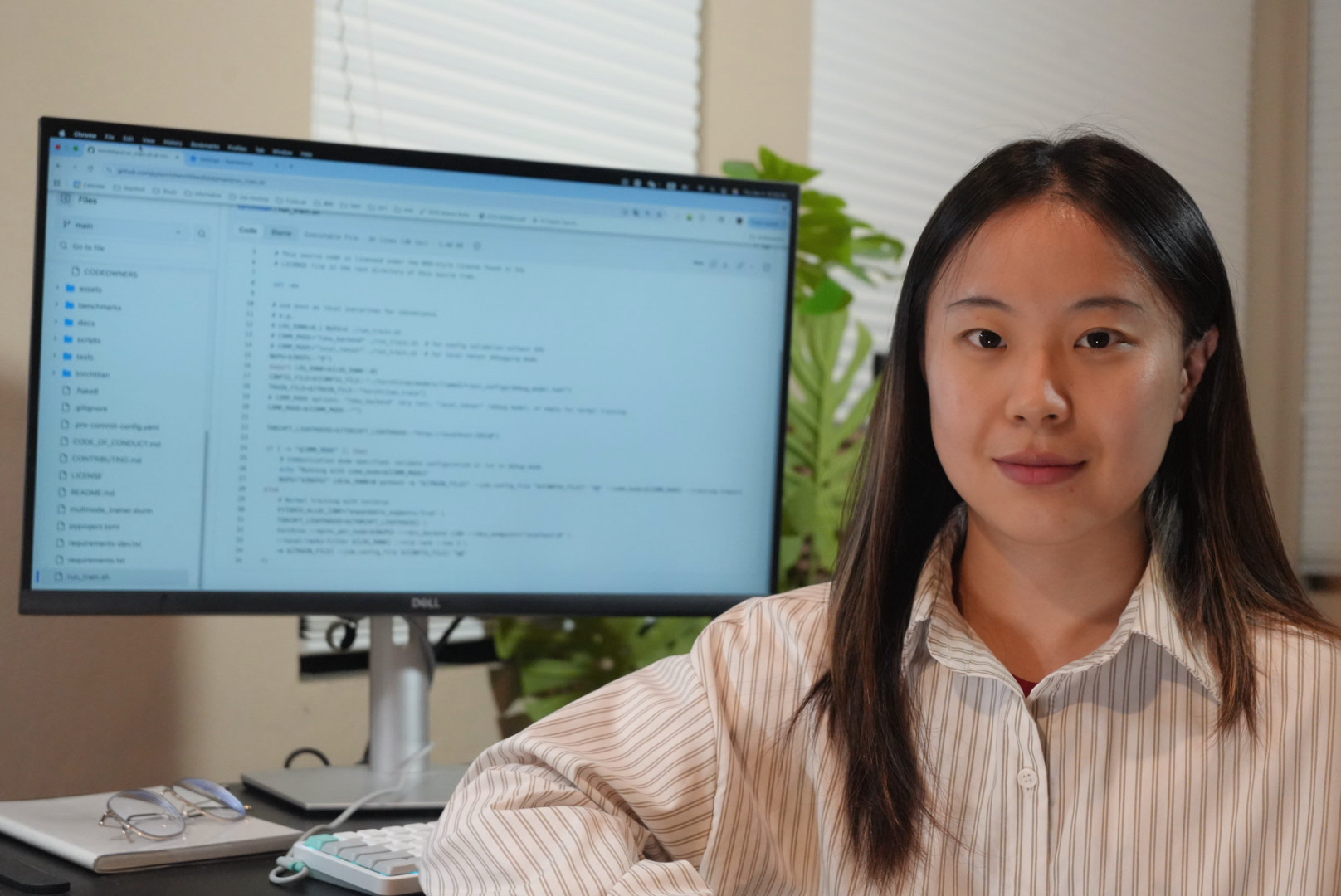
While the world of AI is currently expanding globally, its existence is still fragile and dependent on what one can imagine as a tech giant’s war chest of GPUs. However, one woman has managed to reconstruct the world of AI into something that a scrappy start-up's laptop cluster can power.
Meet Jiani Wang — a software engineer promising to reimagine AI through TorchTitan, an open-source powerhouse challenging AI’s exclusive club. Wang admits she’s practically built with the passion and grit needed for the industry, saying: “My personality mirrors the open, dynamic world of AI open source: extroverted, curious, and relentlessly passionate about exploration. I'm the type who thrives on dialogue—whether debating model compression over coffee or hiking with fellow contributors.”
Although TorchTitan was not created by Wang, she became one of its most influential contributors—driving key architectural improvements and helping the project evolve into a robust framework for scalable LLM training, which garnered over 3,500 stars worldwide. It’s a PyTorch-native platform, elegant in design but ferocious in executing LLM training.
Traditional AI setups struggle to handle a deluge of data, making further processing a headache for developers and users alike. Wang’s innovation enables various hybrid parallelism strategies that manage the necessary data without the usual meltdowns. Her framework has made iteration ten times faster. However, TorchTitan’s breakthrough didn’t just come out of nowhere. Instead, it was the product of years of Wang’s interest and training in technical systems.
A Technical Foundation
At 28, Wang has achieved remarkable success, far surpassing her peers. She attributes her discipline and perseverance to her youth in China, which fostered her growth in a culture that both challenged and encouraged her intellectual curiosity. As she pursued her studies, she also surrounded herself with the outdoors, constantly hiking, mountaineering, and exploring trails. Interestingly, this led to an even greater fascination with greater, complex systems. While not directly related to her technical career, it equipped her with a problem-solving mindset that broke down complex terrains into manageable paths. To some extent, it has contributed significantly to Wang's ability to debug algorithms effectively.
Soon enough, Wang moved to the United States to pursue further studies. Her rigorous education in mathematics and physics enabled her to thrive under pressure. Despite the new environment she found at Stanford University, she quickly learned to excel in her own niche. As a student, computer science became Wang’s passion, and she graduated with a near-perfect 3.97 GPA. She reflected upon it with pride, commenting: “Computer science, to me, is the perfect fusion of rigorous mathematical proofs and real-world applications. It's not just theory; it's a toolkit for transforming ideas into tangible impact.”
This passion led her to join various AI infrastructure projects, where she refined her technical skills. After serving as a research assistant in the CodaLab team, Wang quickly transitioned into multiple roles in companies, ultimately joining Meta.
As a software engineer, she primarily maintains and contributes to the open-source PyTorch-native language learning model, develops large-scale parallelization strategies, and collaborates with top-tier startups to enable elastic-scale LLM training.
Despite the difficulties that come with the job, Wang manages to achieve everything with grace, saying: “My work focuses on scalability: knowing how to transition a proof-of-concept from a single GPU to a cluster of hundreds or thousands. This isn't trivial—issues like communication overhead in distributed training or memory fragmentation can derail the entire process. But when it clicks, it's magical.” No matter the barriers, Wang is there for the rewarding payoff that the struggles bring.
An Innovative Impact
This same grit and passion follow Wang into her own individual pursuits. Her transition to Meta’s PyTorch Distribution Team led her to become a luminary in the field of open source AI. While Wang initially joined in March 2025, she quickly ascended the ranks and solidified herself as TorchTitan’s primary contributor and maintainer within seven months.
TorchTitan is a native platform to PyTorch. Developed by Facebook AI Research, PyTorch itself is widely used as an open-source deep learning framework. It can have an impact in academia and elsewhere where one needs to build and train neural networks, such as in natural language processing (NLP) and reinforcement learning. Its Pythonic design renders it intuitive and easy to pick up for many users. At the same time, it also has a comprehensive ecosystem that offers flexibility and modularity for new users.
It’s no surprise that Wang showed a deep expertise in PyTorch and TorchTitan. While talking about her interests, she touches on open source AI with deep admiration and commitment, reflecting: “Open source isn't just code; it's a vibrant community that transcends borders, companies, and individual egos. In AI, where models can cost millions to train, open source connects brilliant minds from diverse backgrounds—researchers from academia, engineers from startups, ethicists from NGOs—all collaborating to push boundaries.”
TorchTitan, as an innovation, is designed for rapid experimentation and large-scale training of generative AI models. PyTorch was intended to be open and minimal, providing a flexible foundation for TorchTitan and its interested developers. Custom extensions are easily created with the TorchTitan extension points, allowing everything to be quickly tailored to a user’s needs. TorchTitan is easily one of the most essential cornerstones of open-source AI, and Wang’s fingerprints are everywhere on it. In every PyTorch core implementation, she successfully embedded efficiency into the framework.
As widespread as it is, generative AI is now poised to become ubiquitous. It’s used in practically everything, from personalized medicine to various immersive worlds. Wang works hard to make sure it remains – and serves its purpose – as an open frontier. In fact, this is precisely what defines her work, as she muses: “What sets it apart? Passion for openness, yes—I'm driven by democratizing AI, not gatekeeping.
She reveals location helps: “Bay Area proximity to labs like Stanford and companies like NVIDIA means real-time feedback loops. But the core is technology, and we prioritize flexible parallelism, like 3D hybrids that adapt to unknown future models, using compilation for runtime dynamism.” Wang isn’t one to believe in solo geniuses. Instead, she believes in communal progress.
Her democratic approach to AI is a unique one. Unlike other machine learning platforms, such as OpenAI’s closed systems, Wang is dedicated to open infrastructure. She’s passionate about leveling the field, with everyone allowed to build rivals without gatekeeping.
As a result, the industry enjoys diverse models and apps from the most unlikely developers. She takes pride in this approach, stating: “Closed models hoard progress; open source unleashes it. I rise to build bridges: Sharing infra lets researchers stack innovations, from edge tweaks to novel losses.”
Wang’s effort has not gone unnoticed by her peers. Carlos Gomes, a deep learning engineer at a leading AI hardware company, comments: “What distinguishes Ms. Wang’s contributions further is the spirit of collaboration she brings to highly technical efforts. The Flux.1 benchmark implementation was not developed in isolation: it required close interaction between engineers from industry, researchers from academia, and contributors to the PyTorch open-source ecosystem. Ms. Wang’s leadership in co-developing TorchTitan ensured that the codebase was modular, transparent, and accessible to outside collaborators. This made it possible for engineers across different organizations—including those at NVIDIA and Google—to contribute improvements, validate results, and agree on a common benchmark.”
A Trailblazer in Tech
Before her current position at Meta and TorchTitan, Wang was already making her mark. She shone as a student in Beijing, where she studied in one of China’s most elite institutions, Tsinghua University. Her move from across the Pacific to Stanford University was just the beginning of a thriving professional career. Her coursework wasn’t just done. She made sure to excel at every turn, diving into courses on algorithms, data structures, and distributed systems. As each subject fueled her passion for scalable computing, she soon discovered the burgeoning field of machine learning.
In Silicon Valley’s vibrant ecosystem, Wang delved into advanced topics, pursuing skills and research in parallel computing and neural network optimization. She sought real-world experience, contributing to hackathons and early PyTorch experiments. She has a certain restlessness about her work, sharing: “The relentless pace of AI evolution keeps me vigilant. New models emerge weekly—multimodal behemoths and efficient MoEs—each demanding infrastructure tweaks. What stresses me? Ensuring our open source stack remains agile: Will our parallelism hold for tomorrow's sparse-attention hybrids? I lie awake strategizing extensions, like dynamic expert routing, to future-proof without bloat.” Whatever problem Wang faces, she ensures she has all the solutions.
After her graduation, she became a research assistant in Stanford’s CodaLab. She developed a machine learning training and evaluation platform, redesigned data structures, and implemented support for fault-tolerant data storage systems, thereby enhancing system reliability. It became her own personal laboratory for honing her skills, leaving her with a toolkit that included Python (with PyTorch), Flask, Django, and Git.
She made an impactful pivot to ByteDance, the company behind the viral mobile app, TikTok. There, Wang made sure to leave a mark. She immediately joined the System and Networking Team as a software engineer. Despite the chaos and challenges ByteDance consistently threw her way, she tackled everything head-on. She designed and implemented the Datacenter Intent-based Networking Management System (IBN), which automated the manipulation and monitoring of data switches. Her efficient approach resulted in quicker deployment times. This experience laid the groundwork for her later work at Bloomberg and Meta.
At Bloomberg, she held a pivotal role as a software engineer on the Data Storage Platform Team. She designed and implemented low-latency APIs for publishing and consuming data, revolutionizing search, discovery, batch analytics, and real-time streaming capabilities. She made sure everything could work without interruption. Terabytes of training data flowed seamlessly. As she joined Meta, she also became part of the epicenter of AI innovation.
She was initially part of the Instagram Reels Relevance Team, where she used AI to enhance user experiences, resulting in a measurable increase in user growth. She personalized recommendations with uncanny precision, utilizing demographic signals and innovative algorithms. Soon enough, she transitioned into Meta’s PyTorch Distribution Team, where she solidified herself as an AI luminary. She devised large-scale parallelism strategies that enabled LLMs to be pre-trained and fine-tuned.
To Wang, her work is more than just building a tool. She ensures clients can integrate support and scale seamlessly. She also prides herself on optimization. For example, she worked on Flux.1, a state-of-the-art text-to-image diffusion model. They managed to make it run with advanced parallelism techniques, enabling high-fidelity images for start-ups without incurring massive cloud bills. Wang states: “It's proof that open source AI infrastructure isn't just code—it's a catalyst for broader innovation, enabling smaller players to compete and accelerating the field's progress.”
As a young trailblazer, Wang definitely stands out. Shengyi Huang, a member of technical staff at a leading Silicon Valley AI company, Periodic Labs, points out how unique Wang is: “Ms. Wang has emerged as one of the most impactful young engineers I have encountered in recent years, and her contributions address a critical challenge facing our field: the reproducibility and accessibility of large-scale AI research. The dominant trend in AI has been toward ever larger models, sometimes requiring hundreds or even thousands of GPUs for training.”
Continued Innovation and Beyond
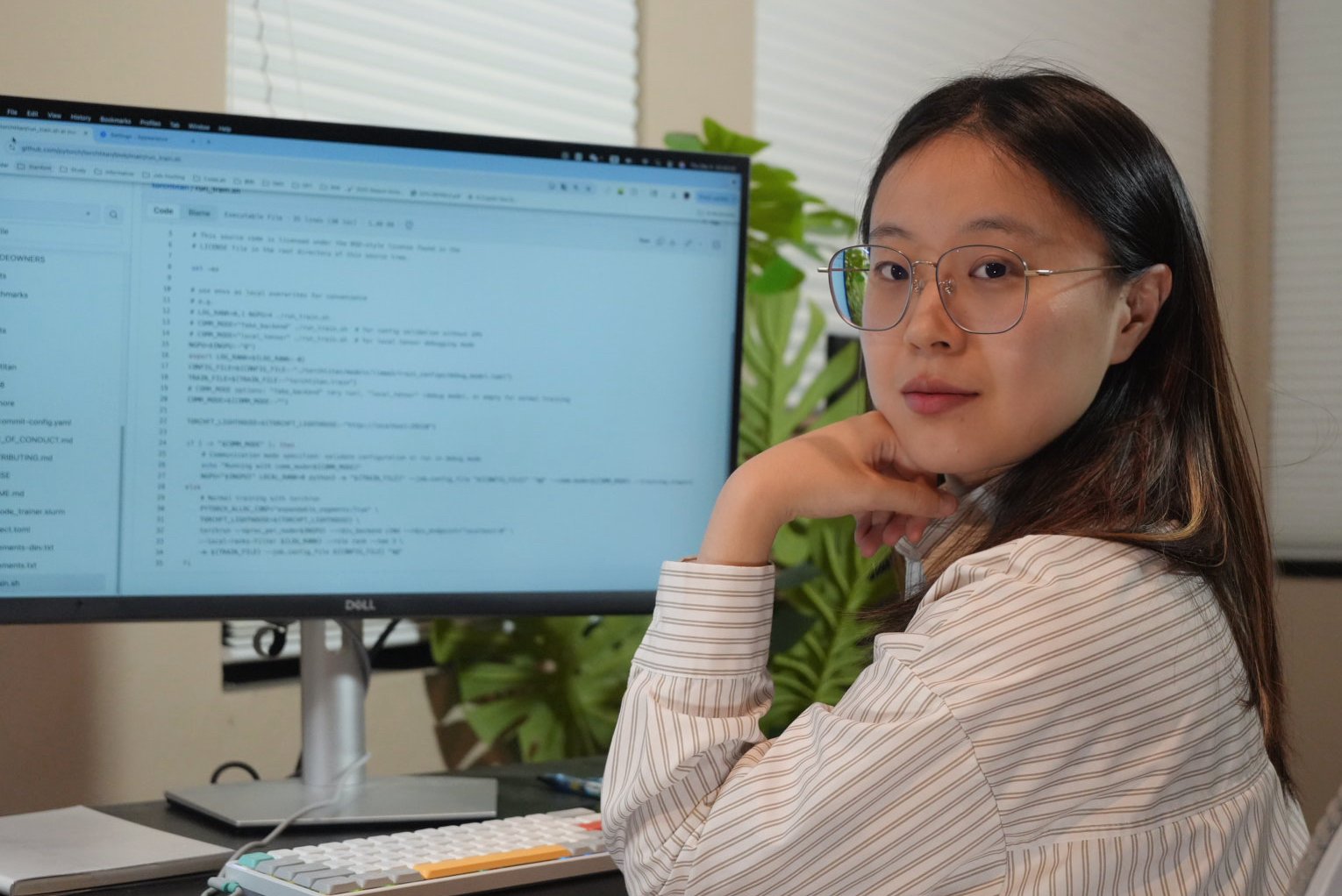
With the future of AI at hand, Wang shows no sign of stopping. AI isn’t flawless, but she is here to improve every step of the way. It was her pivot to AI that made her so dedicated to her craft. While she was a traditional software engineer at first, Wang quickly realized the importance of AI at the backend. Apps tended to falter at scale without it, and she carried this realization into her work to make it effective. Wang recalls: “It was a struggle of self-doubt and late nights poring over distributed systems papers, but it clarified my passion: enabling AI's potential through open infrastructure.”
As a software engineer and developer, Wang is a catalyst for development, progress, and change. Say what you will about Wang, but she’s here to make the impossible possible at every turn.