
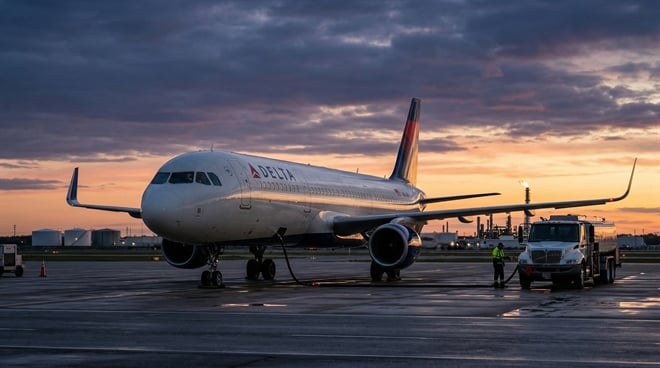
Delta Airlines (NYSE: DAL) reported Q1 2026 earnings on Wednesday, April 8, announcing a double miss.
In his earnings call comments, CEO Ed Bastian noted the role that “the significant step-up in fuel” played, while acknowledging that the airline faces “several external headwinds.”

Those headwinds include the fallout from the Iran war, and more specifically, the closure of the Strait of Hormuz, which has disrupted global supply chains for the spectrum of the fossil fuel industry, leading to a dramatic uptick in crude oil prices. Specific to the aviation industry, jet fuel prices have seen a 132% year-over-year (YOY) increase.
Delta’s earnings and revenue misses should come as a warning to the transportation industry, which falls into the broader industrials sector, as elevated input costs are likely to erode the profit margins of companies heavily reliant on oil. They also put the spotlight on a familiar airline risk: when jet fuel surges, even solid demand can get overshadowed.
Delta Posts Earnings and Revenue Miss for Q1
The Q1 results weren’t all bad news for shareholders, though. Bastian pointed to earnings that were 40% higher YOY—consistent with Delta’s guidance at the beginning of the year—as well as record revenue, which increased more than 9% YOY.
But some of the disappointing facets were more difficult to overlook than others. Despite record quarterly revenue, Delta has seen diminished YOY annual revenue growth every year since 2021, falling from nearly 75% to just 2.79% in 2025.
While earnings per share (EPS) of 64 cents missed analyst expectations by 6 cents, revenue of $14.20 billion missed the consensus by more than $497 million, fueling concerns about the company’s ability to rebound revenue growth in 2026.
The company attributes the quarterly misses to short-term headwinds. According to Delta, the conflict in the Middle East sent jet fuel assumptions for Q2 to about $4.30 per gallon, which is roughly double the price it was in Q2 2025. As a result, the airline expects to add more than $2 billion in incremental fuel expenses during the current quarter.
Despite Headwinds, Delta Issues Cautiously Optimistic Q2 Guidance
Delta says it plans to capture between 40% to 50% of that fuel headwind, which is notable given how Bastian referred to the spike in jet fuel prices as “unprecedented” during his comments.
That could offset up to $300 million in jet fuel overhead through its vertically integrated refinery. The company is the only U.S.-based airline to own its own refining operations. Delta acquired the Trainer Refinery from Phillips 66 (NYSE: PSX) in 2012 to secure its fuel supply, better manage fuel price volatility, and directly produce jet fuel for its fleet.
In his comments, Bastain added that the company’s focus “is on what we can control. Running a reliable operation, taking care of our people and customers, and protecting our margins and cash flow.”
In that vein, the company issued cautiously optimistic Q2 guidance, including:
-
YOY revenue %: Low-teens
-
Operating margin: 6% to 8%
-
EPS: $1.00 per share to $1.50 per share
With a forward price-to-earnings ratio of 8.93, Delta’s EPS is expected to grow nearly 9% over the next year, from $7.63 to $8.28. Those expectations are bolstered by an initiative to advance the airline’s fleet modernization, which entails 95 new aircraft orders, following eight new aircraft deliveries in Q1.
Wall Street Remains Bullish on Delta
Despite the double miss in its Q1 earnings report, Delta is still in Wall Street’s favor, with 24 of 26 analysts currently covering the stock assigning it a Buy rating. Overall, shares of DAL receive a Moderate Buy rating.
The stock carries a consensus 12-month price target of $79.14, which implies more than 16% potential upside from current prices. That prospective performance would place it above its 52-week high of $76.39.
Meanwhile, current short interest of 3.7% suggests that Wall Street’s bears do not expect sizable downside price action in the near term. Last month, $971 million worth of DAL shares were shorted, notably down from the five-year high of $2.27 billion worth of shares shorted in December 2024.
Additionally, institutional ownership has proven robust over the past 12 months, with 915 buyers outnumbering 554 sellers, and inflows of $6.41 billion marginally surpassing outflows of $4 billion.
Where Should You Invest $1,000 Right Now?
Before you make your next trade, you'll want to hear this.
MarketBeat keeps track of Wall Street's top-rated and best performing research analysts and the stocks they recommend to their clients on a daily basis.
Our team has identified the five stocks that top analysts are quietly whispering to their clients to buy now before the broader market catches on... and none of the big name stocks were on the list.
They believe these five stocks are the five best companies for investors to buy now...
The article "Delta's Double Miss Is a Warning for Airline Stocks" first appeared on MarketBeat.