
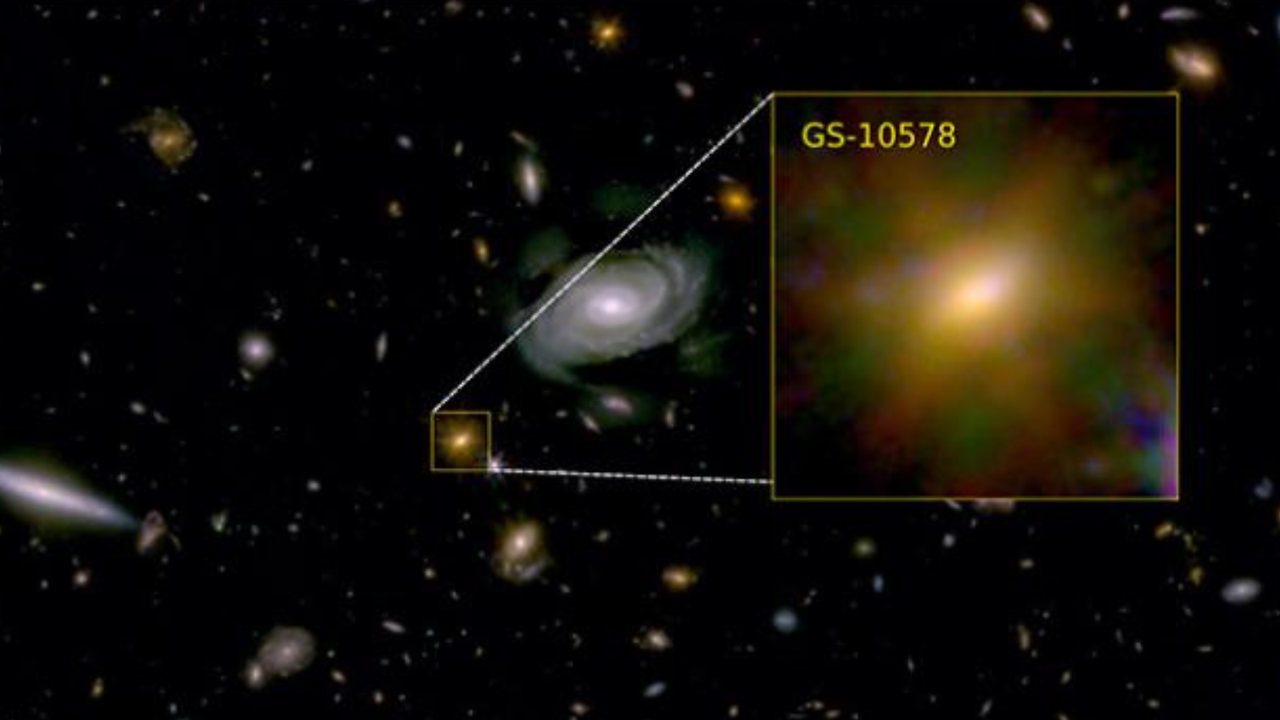
Astronomers have discovered that a young galaxy was gradually starved by its central supermassive black hole, in what was effectively a cosmic "death by a thousand cuts."
The James Webb Space Telescope (JWST) and the Atacama Large Millimeter/submillimeter Array (ALMA) studied this unfortunate galaxy, known as GS-10578 or by the slightly snappier nickname "Pablo's Galaxy" in honor of the first astronomer to study it in detail. The light from Pablo's Galaxy has taken around 11 billion years to reach us, meaning the JWST and ALMA allow astronomers to see it as it was just 3 billion years after the Big Bang. For such an early galaxy, it is exceptionally massive, containing as much mass as around 200 billion suns.