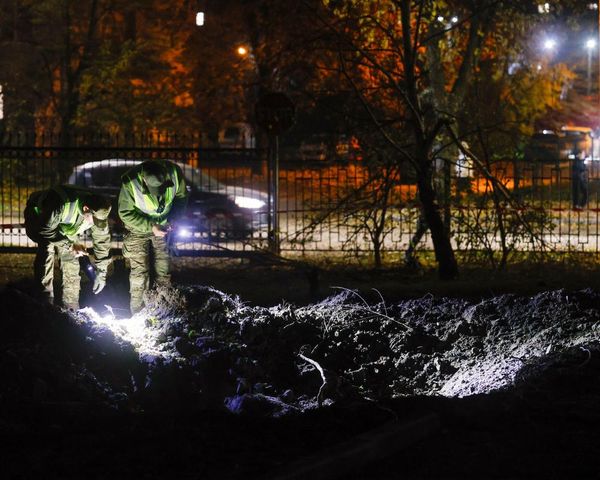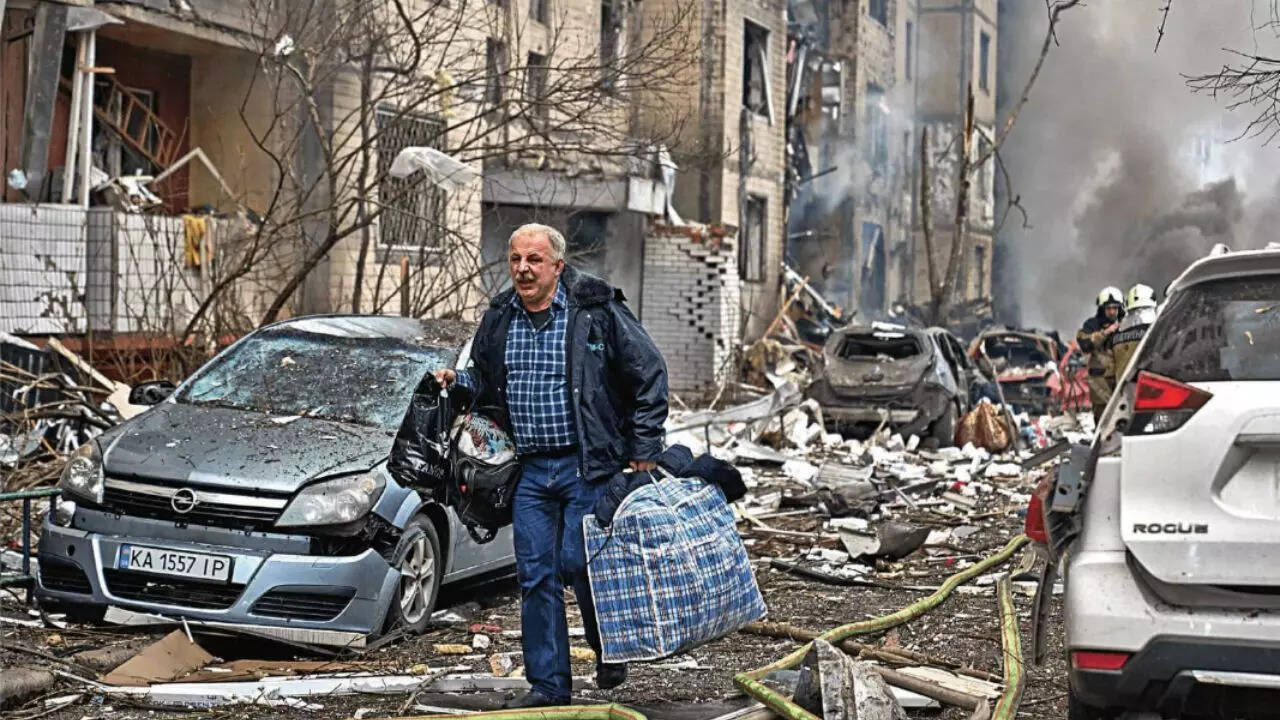
The war that, per Trump, is supposed to finish in four weeks, has shunted out of headlines the war that just saw its grim fourth anniversary. But as nasty a business war is, it’s never without its ironies. So, as the world’s gaze pivots towards West Asia — toward skies over the Gulf once thought insulated from chaos — Ukrainians are watching with an emotion that is difficult to admit publicly, but impossible to suppress privately: recognition edged with bitter vindication.
In cities across Saudi Arabia, UAE, and beyond, residents now scan the night sky as Iranian drones and missiles slice through the darkness. The illusion of permanent security has been punctured. For Ukrainians, these images feel hauntingly familiar.
“Now you know what Ukraine goes through every day.”
It is not insensitivity. It is Ukrainians’ memory speaking.
For four years, Iranian-designed Shahed drones — supplied to Russia and rebranded for Moscow’s war machine — have terrorised Ukrainian cities. Their sound is unmistakable. A low, mechanical buzz, like a lawnmower suspended in the sky. It begins faintly. It grows louder. It circles. It hunts. It descends.
And then it explodes. Shaheds are not just weapons. They are psychological torture instruments. Cheap to produce, easy to deploy in swarms, difficult to intercept in large numbers, they are designed to exhaust air defence systems, and unnerve civilian populations. They have targeted energy plants, substations, residential buildings, grain depots — sinews of modern life. Their objective is not only destruction, but erosion: of morale, of patience, of hope.
As Gulf residents now hear that same ominous hum for the first time, Ukrainians hear an echo of their own nights.
The Drone Generation
The war has rewritten military doctrine. Ukraine now leads Europe in drone innovation. From small reconnaissance UAVs to maritime drones, which have challenged Russia’s Black Sea Fleet, Ukrainian engineers and soldiers have adapted faster than many traditional militaries.
No one in Europe understands the Shahed threat as intimately as Ukrainians. That expertise is now sought by Western and Gulf partners confronting similar drones.
Daria Borysenko, commander of a strike UAV crew in Ukraine’s National Guard, put it plainly: “Ukraine is fighting alone, but we are not alone. Resources we use come from our partners. Without them, we cannot overpower the enemy.”
She spoke of sacrifice, without self-pity. “Help us stop Russians, from coming to other European towns and cities. We are doing our best, our maximum.”
Yuriy Filatov of the 3rd Army Corps echoed her determination. “Four years ago, Putin thought Ukraine would fall in three days. Many in the world thought the same. We held on.” Through that resistance, he said, Ukraine is buying time, for Europe to prepare.
Winter As A Weapon
I first visited Ukraine in Aug 2024 during Modi’s trip to Kyiv. The war was already more than two years old. The capital functioned with defiant normalcy. Cafés were open. Young couples walked along the Dnipro River. Construction cranes dotted the skyline. Yet sirens regularly interrupted conversation. People checked air raid apps, as casually as weather forecasts.
Drones were present then. But not in the suffocating volumes seen today.
Since that visit, Moscow has dramatically expanded drone production. Shaheds have become central to Russia’s strategy — not merely as offensive munitions, but as tools of attrition against civilian will. Their deployment is methodical. Night after night, wave after wave.
When I returned to Ukraine on the fourth anniversary of the invasion, the country felt heavier.
Ukraine had just endured the harshest winter of the war — the coldest in 16 years. Temperatures plunged to -20°C. And Russia had chosen that moment to systematically dismantle the country’s energy infrastructure.
In Kyiv, officials told me that every major power plant and substation had been struck. Some were hit multiple times. Transformers burned. Transmission lines snapped. Repair crews worked in shifts, which blurred into one another.
Winter in Ukraine is unforgiving even in peace. In war, it becomes a battlefield of its own.
“We live by outage schedules,” Yevhen, a Kyivbased entrepreneur, told me, sitting inside a McDonald’s cafe. “When electricity comes — maybe four hours — we charge everything.”
Phones. Laptops. Portable heaters. Power banks. He told me about an EcoFlow energy storage device — a battery pack now as essential as bread. “We charge it when power returns. Then we use it to run devices through the blackout. On very difficult days, we go to neighbours who have electricity.”
Improvisation has become survival. Across the city, cafés advertise “generator power”. Restaurants install diesel backups. Apartment blocks string extension cords across stairwells. Families cluster around single heated rooms.
Such stories are not dramatic; they are ordinary. And it is precisely that ordinariness that explains why Ukraine still stands.
“We cannot give up,” said Olha, a mother of three in Lviv. “Giving up means we will be finished.”
Her words carried no theatrics. Only clarity.
Resistance In Language
War in Ukraine is fought with missiles and mortars. But it is also fought with books.
At the Kyiv Gymnasium of Oriental Languages No.1, middle school students recently gathered to commemorate the 155th birth anniversary of Lesya Ukrainka — poet, playwright, feminist icon. She was also the first to translate the Rig Veda into Ukrainian, a detail that delighted the students when they learnt I was Indian.
They recited her poetry with a seriousness beyond their years.
The war, teachers explained, has triggered a revival of Ukrainian language and culture. Bookstores report surging demand for Ukrainian authors. Parents insist their children speak Ukrainian at home. Theatre productions sell out.
This cultural resurgence is not accidental. It is a historical correction. For centuries, Russian rulers sought to suppress Ukrainian identity.
In 1720, Tsar Peter I restricted Ukrainian-language religious publications. A year later, further proclamations attempted to erase linguistic distinctions. In 1729, Peter II ordered official documents be rewritten, from Ukrainian to Russian. Catherine II banned Ukrainian instruction in schools, and mandated Russian for church services. A 1876 decree by Alexander II, prohibited Ukrainian-language publications and performances.
Under Stalin, Ukrainian intellectuals were executed in the Great Purge. Even during the Khrushchev Thaw, writers like Vasyl Stus were imprisoned or exiled.
What Russia failed to extinguish by decree, it now attempts to erase by force.
When I asked the students how the war affects them, their answers were strikingly pragmatic.
“The war is always in the background,” one girl said. “There are days we don’t sleep much because of alarms,” a boy added. “We go to shelters. We are used to it.”
Used to it. And yet, they are still teenagers. They ask about India. About Bollywood. About beaches in Goa. Their curiosity survives, even as their nights are fractured by sirens.
A European War
At a Yalta European Strategy special meeting, marking four years since the full-scale invasion, Ukrainian businessman Victor Pinchuk described the conflict not as regional, but continental. “This is a great European, hybrid war,” he said. “It is happening on Ukrainian territory, but it is a European war.”
He described Russia as a totalitarian empire — vast in territory, nuclear capacity, and mineral wealth — animated by a profound sense of grievance. “For the last 25 years, it has lived with a sense of injustice, of being offended. No matter what you do, Russia will always be offended.”
This, Pinchuk suggested, is Russia’s real explosive device — a grievance that regenerates itself.
Across Ukraine, there is a widespread belief that Moscow will not stop at Ukraine. Baltic states share this anxiety. “We saw Russian aggression coming,” said former Lithuanian PM Ingrida Šimonyte. “We were called paranoid. Now we are living this nightmare.”She noted that Putin’s red lines have repeatedly shifted.
Most of Europe — barring Hungary and Slovakia — continues to pledge support “for as long as it takes.” But in Ukraine, that phrase inspires mixed emotions.
Gratitude, yes. But also, impatience. Ukrainians do not want indefinite solidarity. They want the war to end.
Territory And Dignity
Crimean Tatar MP Tamila Tasheva spoke with measured intensity. “All of us hope for a ceasefire,” she said. “But the biggest issue is territory.” Russia’s demand that Ukraine relinquish the Donbas is unacceptable, she insisted. “They don’t just want Donbas. They want to destroy Ukraine.”
Opinion polls show that even after four years of war, a large majority of Ukrainians refuse to surrender Crimea, or the Donbas. “For us, the most important thing is dignity,” Tasheva said. “Too many of our soldiers have died defending this land. We cannot just give it up.”
Ukraine has lost a generation of young men and women. The war has hollowed families, reshaped communities, scattered millions abroad. And yet surrender remains politically, and morally, impossible.
Nuclear Blackmail
If drones represent the future of warfare, the Zaporizhzhia Nuclear Power Plant represents its most terrifying present. Europe’s largest nuclear facility was seized by Russian forces early in the invasion, and converted into a military base.
“The technical condition is dangerous,” said Dmytro Orlov, mayor of Enerhodar. More than half the plant’s qualified staff have fled. Cooling systems have been compromised by the destruction of the Kakhovka dam.
“There is almost 10 times more nuclear material there than at Chornobyl,” Orlov warned. With up to 1,000 Russian troops stationed on site, the plant has become a shield — and a threat. If fighting intensifies, consequences could extend far beyond Ukraine’s borders.
Between Hope And Weariness
On the train from Kyiv to Poland — Ukrzaliznytsia, the railway that has become a wartime lifeline — I met a young Ukrainian woman. She’s studying computer science in Warsaw. She asked what Indians think about Ukraine.
“Do Indians know we have a separate history from Russia?” she asked. When we discussed proposals for European troops to secure western Ukrainian facilities, she listened carefully. After a pause, she said only: “We will see.”
Those three words captured the prevailing Ukrainian mood. Grateful. Tired. Determined. Sceptical.
Promises of “as long as it takes” sound different after four years of funerals.
As the train pulled into Warsaw Central, her boyfriend stood, waiting with flowers. She ran into his arms, laughing.
Life insists on itself, even in exile. So, as drones now buzz over other regions of the world, Ukrainians listen with recognition. They do not celebrate fear. But they know its sound. They have lived beneath it.
And despite everything — the winter cold, the blackouts, the funerals, the nuclear blackmail — they remain standing. Not because they are unbreakable. But because they believe surrender would break something far bigger than their buildings.
It would break their dignity. And that, they have decided, is not negotiable.
Redefining Resistance
A NEW UKRAINIAN HERO
Skeleton racer Vladyslav Heraskevych became the poster boy of Ukrainian resilience, after he refused to race without his ‘helmet of remembrance’, at the recent MilanoCortina Winter Olympic Games. The helmet was a tribute to Ukrainian athletes killed in the Russian invasion. The Olympic Committee deemed the helmet political. Heraskevych insists that ‘remembrance isn’t violation’. “Russian athletes are willing to give up their flag for participating in the Olympics. Ukrainian athletes are willing to give up the Olympics for our flag and principles,” he said.
RED CARD FOR USING RUSSIAN
Four years of war have brought language politics back to the forefront. True, Ukraine remains a multilingual country, but the use of Russian in public has reduced drastically, as people assert their Ukrainian identity. For instance, football in Ukraine has seen incidents where players have been carded by referees, for speaking in Russian. This happened last year, in a Ukrainian Women’s Premier League football match, and again, recently, during a Ukrainian Media League game.
POINTS OF INVINCIBILITY
Ukraine just saw its harshest winter in 16 years, with temperatures plummeting to -20°C. With no electricity or heating, and rolling blackouts, thanks to Russia’s targeting of Ukrainian energy infrastructure, ‘points of invincibility’ became key centres of sustenance. These are heated premises — tents, schools, and even trains — stocked with food, power banks, and water. ‘Points of invincibility’ have become a symbol of Ukraine’s resistance.
WEAVES OF DEFIANCE
In frontline cities such as Kherson, Russians have resorted to ‘human safari’ tactics — drone attacks on individual civilians to spread terror, and force them to leave. This has been recognised as a war crime by a UN report. Kherson artist Iryna, whose husband was killed by a Russian drone, and her children injured, weaves beautiful Ukrainian embroidery. She wants to raise awareness about what’s happening in her hometown. Ukrainians respond with beauty to the ugliness of war.
SAMURAI OF KHARKIV
Fuminori Tsuchiko came to Ukraine after the war began. In his 70s, the Japanese national set up a free café in the city of Kharkiv, serving food to 300-400 people daily. He also opened a free library for children, seeking to provide Ukrainian kids with a sense of normality, amidst the war. All through crowd funding. Fumi, as he is known affectionately, is a true legend in Kharkiv.