Get all your news in one place.
100's of premium titles.
One app.
Start reading
The Times of India
The Times of India
World
TOI World Desk

Deadliest slaughter of Native Americans in US history: The 1863 Bear River massacre that left hundreds of Shoshone dead and a sacred land forever changed

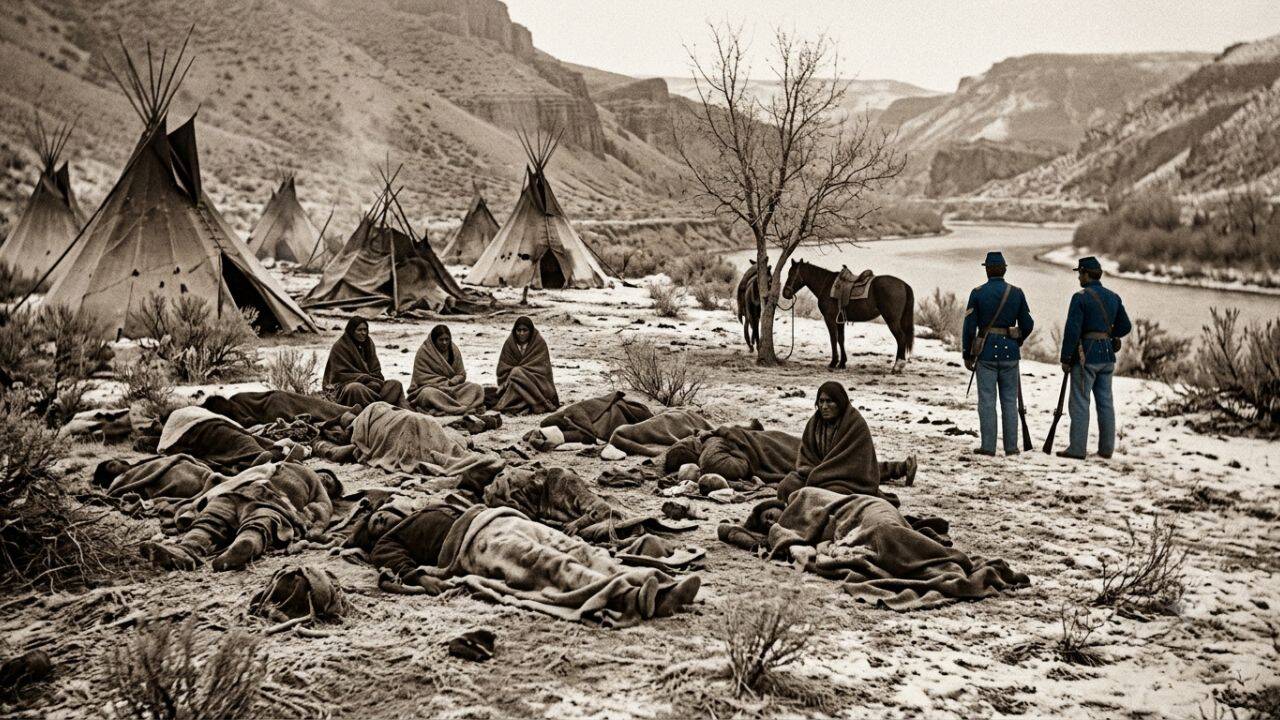
On a cold January morning in 1863, a Shoshone winter camp near the Bear River in present-day Idaho became the centre of a violent confrontation that continues to shape Indigenous memory more than a century later. The settlement, known to the Northwestern Band of the Shoshone as Boa Ogoi, was attacked by US military forces during a period of rising tensions between Native communities, settlers, and government authorities. Historians regard the attack as one of the deadliest massacres of Indigenous people in the American West during the nineteenth century.

Get breaking news anytime, anywhere. Download the TOI app now!
Life at the Shoshone Bear River settlement before the deadly 1863 attack

The Shoshone tribe that inhabited the territory of Bear River selected the site due to the availability of resources as well as for the sake of their safety during winter season. Families used to come to the territory in case of bad weather because the landscape provided them with the necessary provisions and building materials.

In the beginning of the 1860s, there was an increasing amount of tension between the Native American lands and miners, settlers, as well as emigrants who passed by the area and started to complain about the resource disputes and thefts from local Shoshone tribes.

Connor, commander of the California Volunteers, had already developed a hostile view of Native communities. During the American Civil War, he also sought military action that would strengthen his reputation as a battlefield commander. He eventually ordered an expedition toward the Shoshone settlement near the Bear River.

As reported by the National Postal Museum, before sunrise on January 29, 1863, soldiers arrived at the camp. The attack unfolded quickly, with gunfire breaking the quiet of the winter morning.

Bear River massacre: The deadly attack on the Shoshone village

The Shoshone people attempted to defend themselves as the soldiers advanced. Men in the village took up weapons, while families tried to escape the violence. After hours of fighting, many Shoshone defenders had exhausted their ammunition.

Historical accounts differ in exact numbers, but hundreds of Shoshone people were killed during the attack. As reported by National Park Service History, many accounts estimate the death toll at around 250, while Northwestern Band of the Shoshone leaders and descendants have described the loss as exceeding 400 people. Those killed included women, children, and elderly members of the community.

The California Volunteers reported eighteen military deaths. However, for Shoshone descendants, the event has never been remembered as a conventional military engagement. They argue that the attack on a winter village containing families and civilians should be recognized as the Bear River Massacre rather than the Battle of Bear River.

For generations, the wording used to describe the event reflected a wider struggle over whose experiences were included in American history.

Boa Ogoi restoration: The Shoshone Nation’s effort to reclaim sacred land

As reported by Utah State University, more than 150 years after the massacre, the Northwestern Band of the Shoshone Nation began working to transform Boa Ogoi from a place associated with tragedy into a centre for cultural renewal and remembrance.

The site is considered sacred ground by the Shoshone people. For descendants, the land is not only a memorial to those who died but also a connection to their ancestors, traditions, and identity.

The tribe has planned the Boa Ogoi Cultural and Interpretive Center as a place where visitors can learn about Shoshone history, traditions, and the events surrounding the massacre. The centre is intended to provide educational experiences that go beyond the military account of the event by highlighting the lives, culture, and resilience of the people who lived there.

Bringing back the landscape of 1863

The restoration of Boa Ogoi extends beyond preserving historical memory. The Northwestern Band of the Shoshone Nation has also worked to restore the natural environment of the site to more closely resemble the landscape that existed before the massacre.

To support this effort, the tribe collaborated with graduate students from Utah State University’s Climate Adaptation Science Program to develop plans for habitat restoration.

The work began with historical records created by Mae Timbimboo Parry, a respected Shoshone historian and storyteller who documented traditional knowledge, oral histories, and culturally significant plants and animals.

Her records provided important information about the relationship between the Shoshone people and the land. Her grandson, Darren Parry, a tribal council member, has credited her work as a foundation for the restoration project.

How ecological restoration is bringing Boa Ogoi’s historic landscape back to life

Plants that once played important roles in Shoshone life are central to the restoration plans. Willow trees, for example, held both practical and historical significance. Shoshone communities used willow branches to create baskets and winnowing tools, and during the 1863 attack, willow vegetation also provided places where some people attempted to hide.

Restoration teams have studied ways to improve stream conditions and encourage the return of native vegetation. Some efforts have focused on recreating natural processes associated with beavers, whose activity can help improve waterways and create healthier habitats for plants and wildlife.

Climate change has also become part of the planning process. Researchers have examined how future conditions may affect culturally important species growing at Boa Ogoi. Some plants may face declining habitat, while others may remain stable or expand depending on changing conditions.

The goal is not simply to restore a landscape from the past, but to ensure that culturally important species can continue to survive in the future.

How Boa Ogoi restoration is preserving Shoshone culture and ancestral traditions

For the Shoshone people, ecological restoration is closely connected to cultural survival. The return of native plants and animals also represents the return of traditions linked to those species.

Wildlife that once supported Shoshone communities carries deep cultural meaning. The bald eagle remains one of the tribe’s most sacred animals, with its feathers traditionally used in ceremonies and regalia. The trumpeter swan represents peace, while deer and fish were important sources of food and sustenance.

Restoring Boa Ogoi allows these relationships with the land to continue.

The site’s future is therefore shaped not only by remembrance of the massacre but also by efforts to preserve living traditions. The cultural centre, habitat restoration projects, and protection of ancestral lands all form part of a broader attempt by the Northwestern Band of the Shoshone Nation to honour those who were lost while strengthening connections for future generations.

A place of memory and renewal

The Bear River Massacre is among the most traumatic moments for the Shoshone tribe. However, Boa Ogoi means much more than simply the site of the massacre. For the descendants of the victims, the care for the territory becomes the care for the memory of the ancestors. This means that the work done on the territory of Boa Ogoi aims to provide for the story of the Shoshone tribe being told in their own voice rather than that of the attackers.

More than 150 years later, the land keeps the memory of the tragic history as well as its potential for revival.

Sign up to read this article
Read news from 100's of titles, curated specifically for you.
Already a member? Sign in here
Related Stories
Top stories on inkl right now
One subscription that gives you access to news from hundreds of sites
Already a member? Sign in here
Our Picks
Fourteen days free
Download the app
One app. One membership.
100+ trusted global sources.